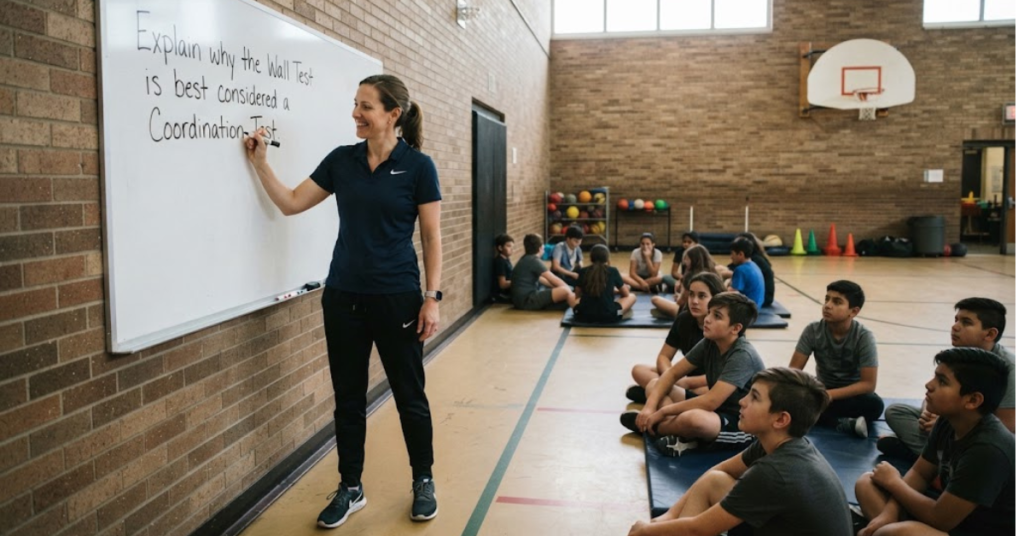

Have you ever tried standing on one leg or maintaining a position while keeping your body steady? What looks like a simple movement can actually require several parts of the body to work together. This is why, when asked to explain why the wall test is best considered a coordination test, the key is to look at how the body controls movement rather than focusing on strength alone.
The wall test requires a person to coordinate their muscles, balance, posture, vision, and movement at the same time. The ability to perform the task successfully depends on how effectively these systems work together.
What Is the Wall Test?
The wall test is a simple physical assessment used to observe aspects of motor control, balance, stability, and coordination. Depending on the specific version being used, a person may be asked to perform a controlled movement or maintain a particular position while using a wall as a reference or support.
The important point is that the test is not simply about how strong someone is. Instead, it provides an opportunity to observe how well different parts of the body work together to produce a controlled response.
That ability to combine different physical actions is what makes coordination central to the test.
Why Is the Wall Test Considered a Coordination Test?
To explain why the wall test is best considered a coordination test, consider everything the body has to manage during the activity.
A person must generally:
- Control the movement of different muscles
- Maintain an appropriate body position
- Adjust balance when necessary
- Coordinate movements between different limbs
- Use visual information to guide movement
- Control the timing and direction of movement
- Make small corrections when the body begins to move out of position
These actions don’t happen independently. The nervous system has to organize them so that the body responds smoothly and accurately.
In other words, the wall test examines how effectively the body coordinates movement, rather than measuring one isolated physical ability.
Coordination Requires Several Body Systems to Work Together
Coordination is more complicated than simply moving a muscle. The brain and nervous system constantly receive information from the body and environment, process it, and send instructions to muscles.
During a physical coordination test, several systems contribute.
1. The Brain and Nervous System
The brain plans and controls voluntary movement. It receives information about body position and movement, then sends signals to the appropriate muscles.
This communication allows movements to be adjusted as the activity continues.
2. Muscles and Joints
Muscles must contract at the right time and with an appropriate amount of force. Joints also need to move through controlled ranges of motion.
If one muscle group works too early, too late, or with too much force, the movement may become awkward or unstable.
3. Vision
Vision can help a person understand their position in relation to the wall and surrounding environment. Visual information can therefore contribute to maintaining accurate posture and movement.
4. Balance and Body Position
The body constantly makes tiny adjustments to remain stable. These adjustments involve coordination between muscles, joints, the nervous system, and sensory information.
That’s why coordination and balance are closely connected, even though they aren’t exactly the same thing.
Coordination vs. Strength: What’s the Difference?
This distinction is important when explaining the wall test.
Strength refers primarily to the ability of muscles to produce force.
Coordination, on the other hand, involves controlling movement efficiently and accurately.
For example, someone may have strong leg muscles but still struggle with a movement that requires precise timing and balance. Conversely, someone with moderate strength may perform the movement smoothly because they have good motor control.
The wall test is therefore more useful as an assessment of movement control and coordination than as a simple measurement of muscular strength.
What Skills Can the Wall Test Involve?
Depending on the exact wall test being performed, it can involve several components of physical performance.
| Skill | Role in the test |
| Balance | Helps maintain a stable body position |
| Timing | Allows movements to occur in the correct sequence |
| Motor control | Helps regulate muscle activity |
| Spatial awareness | Helps the person understand body position |
| Postural control | Keeps the body properly aligned |
| Reaction and adjustment | Allows corrections during movement |
| Visual coordination | Helps guide movement accurately |
These components overlap, which is another reason coordination is an appropriate way to describe the test.
How Does the Wall Test Demonstrate Motor Coordination?
Motor coordination is the ability to organize muscles and movements so that an action can be performed efficiently.
Imagine reaching toward a specific point on a wall. Your brain has to determine where the target is, your eyes provide visual information, your muscles move the arm, and your body adjusts its position to keep you stable.
That single action involves multiple processes occurring almost simultaneously.
If those processes are well coordinated, the movement tends to be smooth and controlled. If coordination is poor, movements may become slower, less accurate, or less stable.
Why Is Balance Related to Coordination?
Balance is often discussed separately from coordination, but the two are strongly connected.
When you try to maintain a stable position, your body makes continuous small adjustments. Your brain receives information about your position from sensory systems and then coordinates muscle activity to keep you stable.
So, while a wall test may involve balance, the underlying ability to make appropriate adjustments is part of motor coordination.
This is why describing the wall test solely as a balance test may not capture everything it assesses.
Is the Wall Test a Test of Agility?
Not necessarily.
Agility usually involves the ability to change body position or direction quickly and effectively. A wall-based test may involve some aspects of movement control, but that does not automatically make it an agility test.
The exact classification depends on the specific wall test protocol.
If the task emphasizes controlled positioning, timing, balance, and coordinated movement, coordination is a more appropriate description than agility.
What Makes a Good Coordination Test?
A useful coordination test generally requires a person to control several aspects of movement at once.
Common characteristics include:
- Accuracy – The movement needs to reach the intended position or target.
- Timing – Different body parts need to move at appropriate moments.
- Control – Movements should be deliberate rather than random.
- Consistency – The person should be able to repeat the movement reliably.
- Adaptability – The body may need to make small corrections during the task.
The wall test can involve many of these characteristics, depending on how it is administered.
Why the Wall Test Is Not Simply a Strength Test
It’s easy to assume that any physical test measures strength because muscles are involved. But muscle involvement doesn’t automatically make something a strength test.
Almost every physical activity requires muscles.
The real question is what the test is asking the person to demonstrate.
If the task requires the person to coordinate several muscles, maintain posture, control movement, and respond accurately, then the primary skill being observed is coordination.
Frequently Asked Questions
Is the wall test a coordination test?
Yes, the wall test can be considered a coordination test when the activity requires controlled movement, balance, timing, posture, and cooperation between different muscle groups and sensory systems.
Why is the wall test considered a coordination test?
The wall test involves several physical processes working together. The brain, nervous system, muscles, joints, vision, and balance mechanisms must coordinate their actions to produce controlled movement.
Does the wall test measure balance?
It can. Balance may be an important component of the test, but balance and coordination are not identical. Maintaining balance often requires coordinated adjustments from multiple body systems.
Does the wall test measure strength?
Strength may contribute to performance, but the test is not necessarily a direct measure of muscular strength. Its emphasis is generally on controlling and coordinating movement.
What is coordination in physical fitness?
Coordination is the ability to control different parts of the body so they work together efficiently and accurately during movement.
Why is coordination important in physical activity?
Good coordination helps people perform movements smoothly, maintain control, respond to changes, and use their muscles efficiently. It is important in everyday activities as well as sports and exercise.
Conclusion
To explain why the wall test is best considered a coordination test, the simplest answer is that it requires several parts of the body to work together in a controlled and organized way. Balance, posture, muscle control, vision, timing, and the nervous system can all contribute to successful performance.
The test isn’t simply asking, “How strong are your muscles?” Instead, it is asking whether your body can coordinate different physical processes to produce an accurate and controlled movement.
That distinction is what makes coordination the most useful way to understand the wall test.