

If you’ve ever used a lever to lift something heavy, pushed a loaded cart with a ramp, or used a pulley to raise an object, you’ve benefited from mechanical advantage. The idea sounds technical, but the basic concept is surprisingly simple: a machine can help you move a load by allowing you to use force more effectively.
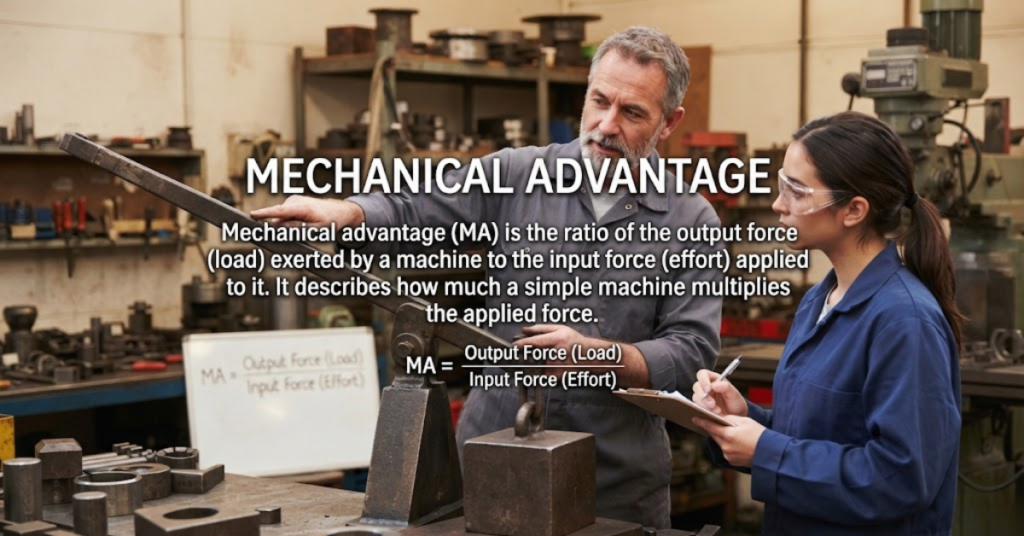
So, what is meant by the term mechanical advantage? In simple terms, mechanical advantage is the ratio of the force produced by a machine to the force applied to it. It tells us how much a machine multiplies or improves the force we put into it.
Understanding mechanical advantage makes it easier to understand how levers, pulleys, gears, wheels, and other simple machines work.
What Is Mechanical Advantage?
Mechanical advantage (MA) describes how effectively a machine uses an applied force to produce an output force.
The basic formula is:
Mechanical Advantage = Output Force ÷ Input Force
For example, suppose you apply 20 newtons of force to a machine and it produces 100 newtons of output force.
MA = 100 ÷ 20 = 5
That means the machine has a mechanical advantage of 5. In an ideal situation, it multiplies your input force fivefold.
However, mechanical advantage doesn’t mean that a machine creates energy. Instead, it allows you to trade force for distance, speed, or convenience.
Why Is Mechanical Advantage Important?
Mechanical advantage is important because machines allow people to perform tasks that would otherwise require much more effort.
A simple machine can help you:
- Lift a heavier object.
- Move a load with less input force.
- Change the direction of a force.
- Apply force over a more convenient distance.
- Make certain physical tasks easier and more manageable.
Think about pushing a heavy box onto a truck. Lifting it straight up might require considerable force. Using a ramp allows you to push the box over a longer distance while using less force.
The ramp doesn’t eliminate the work involved. It simply changes how the force is applied.
How Does Mechanical Advantage Work?
Mechanical advantage works by changing the relationship between force and distance.
In an ideal machine, the amount of work going into the machine equals the amount of work coming out:
Input work = Output work
Work can be expressed as:
Work = Force × Distance
Therefore, if a machine allows you to use less force, you generally have to apply that force over a greater distance.
This is why mechanical advantage involves a trade-off. You may gain force, but you don’t get something for nothing.
A Simple Example
Imagine you need to lift a 300-newton load.
Without a machine, you might need to apply close to 300 newtons of force.
Now imagine a machine with a mechanical advantage of 3.
You would ideally need:
300 ÷ 3 = 100 newtons
So, instead of applying 300 newtons directly, you apply approximately 100 newtons through the machine.
The trade-off is that your input force may need to move through a greater distance.
Mechanical Advantage Formula
The most common formula for mechanical advantage is:
MA = Output Force / Input Force
Where:
- MA = mechanical advantage
- Output force = force exerted by the machine on the load
- Input force = force applied to the machine
Example Calculation
Suppose you use a lever and apply 50 newtons of force. The lever produces 200 newtons of output force.
MA = 200 ÷ 50
MA = 4
The mechanical advantage is 4.
In an ideal situation, the lever multiplies the input force by four.
What Does a Mechanical Advantage Greater Than 1 Mean?
A mechanical advantage greater than 1 means the machine produces more output force than the input force.
For example:
- MA = 2 → output force is twice the input force.
- MA = 5 → output force is five times the input force.
- MA = 10 → output force is ten times the input force.
This type of mechanical advantage is particularly useful when lifting or moving heavy loads.
What Does a Mechanical Advantage Less Than 1 Mean?
A mechanical advantage below 1 means the machine produces less output force than the force applied.
At first, that might sound useless. But machines with a mechanical advantage below 1 can provide other benefits, such as increasing speed, distance, or range of movement.
For example, some levers are designed to make the output end move farther and faster than the input end.
So, a mechanical advantage of less than 1 isn’t necessarily a disadvantage. It depends on what the machine is designed to accomplish.
Types of Simple Machines That Use Mechanical Advantage
Mechanical advantage can be found in several common simple machines.
1. Lever
A lever consists of a rigid bar that rotates around a fixed point called a fulcrum.
Examples include:
- Crowbars
- Seesaws
- Bottle openers
- Wheelbarrows
A lever can provide mechanical advantage by changing the distances between the applied force, fulcrum, and load.
2. Pulley
A pulley uses a wheel and rope to help lift or move a load.
A single fixed pulley primarily changes the direction of the applied force. Multiple pulleys can provide mechanical advantage by distributing the load across several sections of rope.
3. Inclined Plane
An inclined plane is essentially a ramp.
Instead of lifting an object vertically, you move it along a longer, sloped surface. This reduces the force needed at any particular moment, although the load travels farther.
4. Wheel and Axle
A wheel and axle consists of two connected circular components with different radii.
Examples include:
- Steering wheels
- Door handles
- Screwdrivers
- Some winches
The difference in size between the wheel and axle can provide mechanical advantage.
5. Screw
A screw can be thought of as an inclined plane wrapped around a cylinder.
The threads allow a relatively small turning force to produce a much larger force along the screw’s axis.
6. Wedge
A wedge is another type of simple machine. It converts an applied force into forces that push sideways.
Examples include:
- Knives
- Axes
- Doorstops
- Chisels
Mechanical Advantage in Real Machines
Real machines are not perfectly efficient. Friction, bending, heat, and other factors cause some energy to be lost.
Because of this, the actual mechanical advantage (AMA) can differ from the theoretical or ideal mechanical advantage.
Actual Mechanical Advantage
Actual mechanical advantage is calculated using the forces that are actually measured:
AMA = Actual Output Force ÷ Actual Input Force
Ideal Mechanical Advantage
Ideal mechanical advantage assumes that there is no energy loss:
IMA = Input Distance ÷ Output Distance
The ideal value represents how the machine would perform under perfect conditions.
In real-world machines, the actual mechanical advantage is generally lower than the ideal mechanical advantage because of friction and other losses.
Mechanical Advantage vs. Efficiency
The Mechanical advantage and efficiency are related, but they aren’t the same thing.
Mechanical advantage tells you how the machine changes force.
Efficiency tells you how much of the input energy is converted into useful output energy.
For example, a machine might have a substantial mechanical advantage but still lose some energy because of friction.
A useful way to remember the difference is:
- Mechanical advantage: How much does the machine multiply or change force?
- Efficiency: How effectively does the machine use the energy supplied to it?
Why Mechanical Advantage Doesn’t Create Energy
One common misunderstanding is that mechanical advantage somehow gives you free energy.
It doesn’t.
A machine can reduce the amount of force you need, but you generally have to compensate by applying that force over a greater distance or for a longer period.
For instance, a ramp makes it easier to push a heavy object upward, but the object travels farther than it would if lifted vertically.
The machine changes the way the work is done, rather than eliminating the work itself.
Mechanical Advantage in Everyday Life
You don’t need to work in engineering to encounter mechanical advantage.
You use it in everyday activities such as:
- Opening a bottle with a bottle opener.
- Cutting food with a knife.
- Using a wrench to loosen a tight bolt.
- Pushing a heavy object up a ramp.
- Raising an object with a pulley.
- Turning a steering wheel.
- Using a screwdriver.
These machines make tasks more practical by manipulating force, distance, direction, or speed.
A Quick Way to Remember Mechanical Advantage
If you’re studying mechanical advantage for a class or exam, remember this simple idea:
Mechanical advantage tells you how a machine changes the force you apply.
Then remember the basic formula:
MA = Output Force ÷ Input Force
If the answer is greater than 1, the machine provides force multiplication.
The answer is 1, the input and output forces are equal in an idealized calculation.
If the answer is less than 1, the machine may sacrifice force to provide another benefit, such as greater speed or movement.
Frequently Asked Questions
What is the simple definition of mechanical advantage?
Mechanical advantage is the ratio of the output force produced by a machine to the input force applied to it. It describes how a machine can make a task easier by changing the amount or direction of force required.
What is the formula for mechanical advantage?
The basic formula is:
Mechanical Advantage = Output Force ÷ Input Force
What does a mechanical advantage of 4 mean?
A mechanical advantage of 4 means that, ideally, the output force is four times the input force.
Does mechanical advantage reduce the amount of work required?
No. In an ideal machine, mechanical advantage doesn’t reduce the total amount of work. Instead, it allows you to trade force for distance or another mechanical benefit.
Can mechanical advantage be less than 1?
Yes. A mechanical advantage below 1 means the output force is smaller than the input force. Such machines can still be useful because they may increase movement speed, distance, or range.
What are examples of mechanical advantage?
Common examples include levers, pulleys, ramps, wheel-and-axle systems, screws, and wedges.
What is the difference between mechanical advantage and efficiency?
Mechanical advantage describes the relationship between output and input force. Efficiency describes how much of the input energy becomes useful output energy after losses such as friction.
Conclusion
So, what is meant by the term mechanical advantage? Simply put, it is a measure of how a machine changes the force you apply. The basic concept is captured by the formula output force divided by input force.
From levers and pulleys to ramps and screws, mechanical advantage is behind many of the tools we use every day. Once you understand that machines trade force for distance, speed, or direction rather than creating energy, the concept becomes much easier to grasp.