
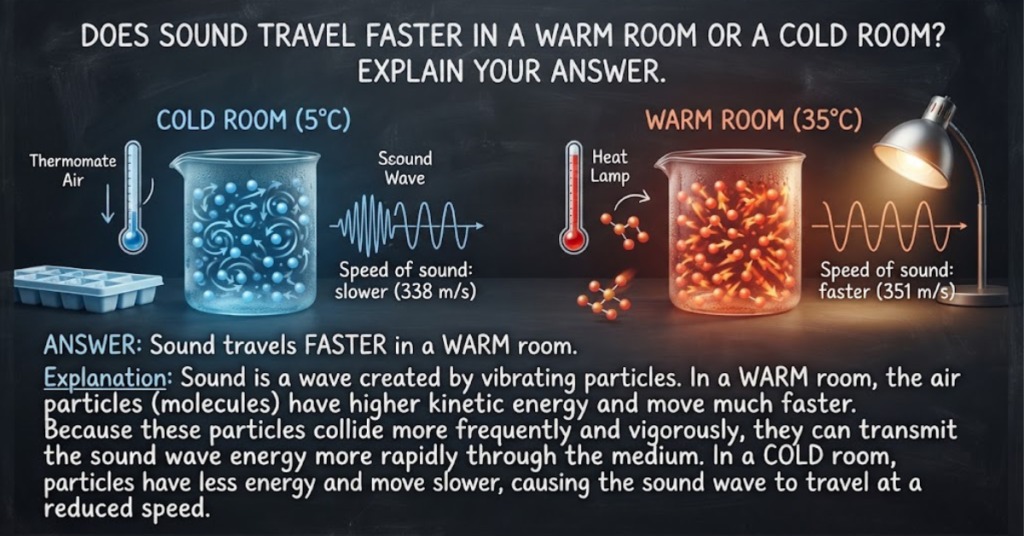

Have you ever wondered whether sound reaches your ears faster in a warm room or a cold one? The answer is a warm room. Sound generally travels faster through warm air because the speed of sound increases as air temperature rises. Does Sound Travel Faster in a Warm Room or a Cold Room?
This may seem surprising at first. After all, warm and cold air are both made of the same gases. The difference comes down to how temperature affects the motion of air molecules and, consequently, how quickly a sound wave can move through the air.
Does Sound Travel Faster in a Warm Room or a Cold Room?
Sound travels faster in a warm room than in a cold room.
The reason is simple: temperature affects the average speed at which molecules in the air move. When the air gets warmer, its molecules move more rapidly. This allows pressure disturbances—the vibrations that make up sound—to travel through the air more quickly.
In colder air, molecules have less thermal energy and move more slowly, so sound travels at a lower speed.
For air near ordinary atmospheric conditions, the speed of sound can be approximated by:
Speed of sound ≈ 331 + 0.6T meters per second
Here, T is the air temperature in degrees Celsius.
For example:
- At 0°C, sound travels at about 331 m/s.
- At 20°C, it travels at about 343 m/s.
- At 30°C, it travels at about 349 m/s.
So, as the temperature rises, the speed of sound increases.
Why Does Temperature Affect the Speed of Sound?
To understand this, it helps to think of sound as a chain reaction.
When something makes a sound, it causes nearby air molecules to vibrate. Those molecules push against neighboring molecules, which push against others. This creates a moving pressure disturbance that travels through the air.
Temperature changes how quickly the molecules are already moving.
In warm air
Air molecules have greater average kinetic energy and move more rapidly. As a result, disturbances can be transmitted through the gas more quickly.
In cold air
The molecules have less average kinetic energy and move more slowly. The pressure disturbance therefore travels more slowly.
It’s important to note that sound isn’t simply being carried along by individual molecules flying from the source to your ear. The molecules mainly oscillate around their positions while the sound wave propagates through the medium.
How Much Faster Does Sound Travel in Warm Air?
The difference may be small over ordinary room temperatures, but it is measurable.
Consider two rooms:
| Air temperature | Approximate speed of sound |
| 0°C | 331 m/s |
| 10°C | 337 m/s |
| 20°C | 343 m/s |
| 30°C | 349 m/s |
| 40°C | 355 m/s |
This means that increasing the temperature from 0°C to 20°C increases the speed of sound by roughly 12 meters per second.
That doesn’t mean you’ll notice a dramatic difference when someone speaks in a warm versus cold room. For everyday distances, the change in arrival time is extremely small.
Does Humidity Also Affect Sound Speed?
Yes. Temperature isn’t the only factor involved.
Humidity can also influence the speed of sound in air. At the same temperature and pressure, more humid air generally allows sound to travel slightly faster than dry air.
This happens because water vapor has a lower molecular mass than the main components of dry air, particularly nitrogen and oxygen. Replacing some of those heavier molecules with water vapor changes the physical properties of the air.
However, for the basic question of whether sound travels faster in a warm or cold room, temperature is the key factor.
Does Air Pressure Affect the Speed of Sound?
This is a little more complicated.
For an ideal gas, the speed of sound depends primarily on temperature, rather than directly on atmospheric pressure. If temperature remains constant, changing the pressure and density together doesn’t produce a large direct change in the speed of sound.
That’s why temperature is usually the variable emphasized when explaining the speed of sound in air.
What Happens to Sound in a Very Cold Environment?
In extremely cold conditions, sound travels more slowly through air.
For example, at temperatures well below freezing, the speed of sound can be considerably lower than it is in a typical indoor environment.
This is one reason temperature gradients can matter in outdoor acoustics. Sound doesn’t always travel through air with a uniform temperature, and changes in temperature can affect how sound waves propagate.
What Happens to Sound in a Very Warm Environment?
The opposite happens when air becomes warmer.
As temperature increases, the speed of sound increases. At sufficiently high temperatures, sound can travel significantly faster than it does under ordinary room conditions.
The relationship isn’t perfectly linear under every possible physical condition, but for typical atmospheric temperatures, the approximation:
v ≈ 331 + 0.6T
works well.
Here, v represents the speed of sound in meters per second and T represents temperature in degrees Celsius.
Does Sound Itself Get Faster Because It Is Louder?
No.
A common misconception is that louder sounds travel faster. Under ordinary conditions, sound intensity or loudness doesn’t determine the speed of sound.
The speed depends primarily on the properties of the medium through which the sound travels.
For sound moving through air, temperature is particularly important. The frequency and loudness of a sound don’t normally change its propagation speed in the way temperature does.
Warm Room vs. Cold Room: A Simple Comparison
Imagine two identical rooms separated by the same distance.
- Room A: 10°C
- Room B: 30°C
The sound wave will travel faster through Room B because the air is warmer.
At 10°C, the speed of sound is approximately 337 m/s.
At 30°C, it is approximately 349 m/s.
So the warmer room provides the faster medium for sound propagation.
The difference might not be obvious to someone standing in the room because sound travels hundreds of meters per second. Nevertheless, sensitive measurements can detect it.
Why Does Sound Need a Medium?
Sound is a mechanical wave, which means it needs a material medium through which to propagate.
That medium can be:
- Air
- Water
- Wood
- Metal
- Other solids or liquids
Sound cannot travel through a vacuum because there are no particles available to transmit the mechanical disturbance.
This also explains why the speed of sound isn’t the same everywhere. Different materials have different physical properties, so sound can move at dramatically different speeds through them.
Sound Speed in Air vs. Other Materials
Temperature matters when sound travels through air, but the material itself is also extremely important.
For example:
- Air: roughly 343 m/s at 20°C
- Water: roughly 1,480 m/s
- Steel: roughly 5,000 m/s
The exact values vary with temperature, composition, pressure, and other conditions.
This is why underwater sounds can behave very differently from sounds traveling through the atmosphere.
Frequently Asked Questions
Does sound travel faster in a warm room?
Yes. Sound generally travels faster in a warm room than in a cold room because the speed of sound in air increases as temperature rises.
Why does sound travel faster in warm air?
Warm air molecules have greater average kinetic energy and move more rapidly. This changes the physical properties of the gas and allows pressure disturbances to propagate at a higher speed.
What is the speed of sound at room temperature?
At around 20°C, the speed of sound in dry air is approximately 343 meters per second.
Does cold air slow down sound?
Yes. As air temperature decreases, the speed of sound decreases. At 0°C, for example, sound travels at approximately 331 m/s.
Does humidity affect the speed of sound?
Yes. Humidity has a smaller but measurable effect. At the same temperature, sound generally travels slightly faster through humid air than through dry air.
Does sound travel faster when it is louder?
No. Loudness doesn’t normally determine the speed of sound. The properties of the medium, especially temperature in the case of air, are much more important.
Does sound travel faster in hot or cold water?
Temperature also affects sound speed in water, but the relationship is more complicated than it is in air. Other factors, including pressure and salinity, can also influence the speed of sound in water.
Conclusion: Warm Air Makes Sound Travel Faster
So, does sound travel faster in a warm room or a cold room? The answer is a warm room.
As air temperature increases, the speed of sound increases. At approximately 0°C, sound travels through air at around 331 m/s, while at 20°C it travels at roughly 343 m/s.
The key idea to remember is that sound is a mechanical wave whose speed depends on the properties of its medium. In air, temperature is one of the most important factors affecting that speed.
If you’re studying physics, the simple rule is worth remembering: warmer air → faster sound; colder air → slower sound.