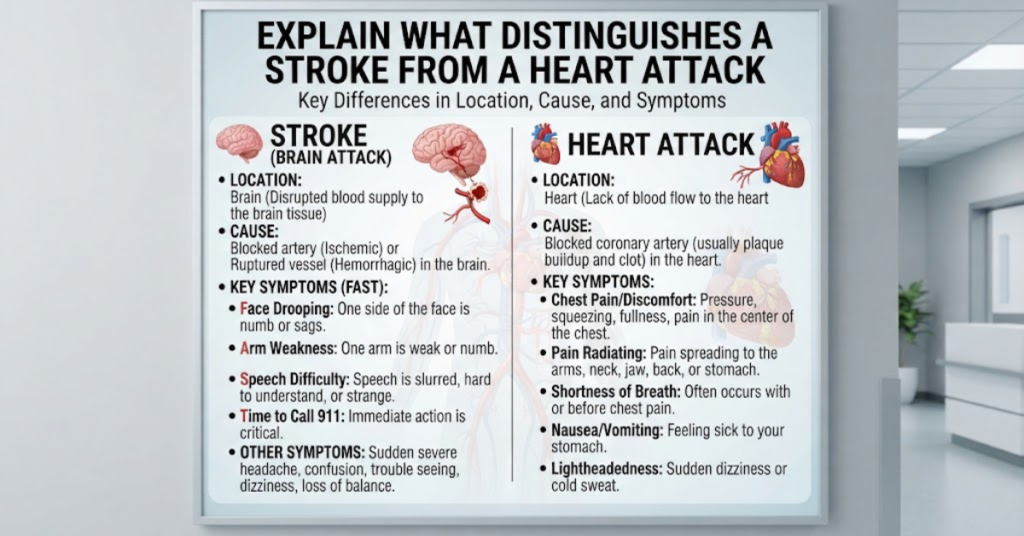

A stroke and a heart attack can both happen suddenly, and both are medical emergencies. But they are not the same condition. If you’re trying to explain what distinguishes a stroke from a heart attack, the simplest answer is this: a heart attack affects the heart, while a stroke affects the brain.
The two conditions often involve problems with blood flow, which is why they can sometimes be confused. Understanding the difference matters because recognizing the right warning signs and getting emergency medical care quickly can make a major difference.
What Distinguishes a Stroke From a Heart Attack?
The main difference is the organ affected and what happens to its blood supply.
A heart attack, medically called a myocardial infarction, occurs when blood flow to part of the heart muscle becomes blocked. Without enough oxygen-rich blood, heart muscle can become damaged or die.
A stroke occurs when blood flow to part of the brain is interrupted or when a blood vessel in the brain bursts. Brain cells can become damaged within minutes when they don’t receive enough oxygen.
Here’s a quick comparison:
| Feature | Heart Attack | Stroke |
|---|---|---|
| Main organ affected | Heart | Brain |
| Primary problem | Reduced or blocked blood flow to heart muscle | Blocked or ruptured blood vessel in the brain |
| Common symptoms | Chest discomfort, shortness of breath, sweating | Facial drooping, arm weakness, speech problems |
| Major types | Usually caused by a blocked coronary artery | Ischemic or hemorrhagic |
| Emergency treatment | Restores blood flow to the heart | Restores blood flow or controls bleeding, depending on type |
Although the underlying mechanisms can overlap, the symptoms and treatments are different.
What Is a Heart Attack?
A heart attack happens when part of the heart muscle doesn’t receive enough blood and oxygen.
The most common cause is coronary artery disease. Fatty deposits can build up inside the arteries, forming plaques. If a plaque ruptures, a blood clot can form and obstruct blood flow to the heart.
Common heart attack symptoms include:
- Pressure, squeezing, fullness, or pain in the chest
- Pain or discomfort spreading to the arm, shoulder, back, neck, jaw, or upper abdomen
- Shortness of breath
- Cold sweating
- Nausea or vomiting
- Unusual tiredness
- Lightheadedness or dizziness
Not everyone experiences dramatic chest pain. Symptoms can vary between individuals, and some people may have relatively subtle warning signs.
Why a Heart Attack Is an Emergency
Heart muscle requires a constant supply of oxygen. The longer an artery remains blocked, the greater the potential damage to the heart.
Emergency treatment focuses on restoring blood flow as quickly as possible. Depending on the situation, treatment may include medications, procedures such as angioplasty and stent placement, or coronary artery bypass surgery.
What Is a Stroke?
A stroke happens when blood supply to part of the brain is interrupted or when a blood vessel in the brain ruptures.
There are two major types:
Ischemic Stroke
An ischemic stroke occurs when a blood clot blocks an artery supplying the brain. This is the most common type of stroke.
The blockage prevents oxygen and nutrients from reaching brain tissue, potentially causing permanent damage.
Hemorrhagic Stroke
A hemorrhagic stroke occurs when a blood vessel in the brain breaks and causes bleeding.
The blood can damage surrounding brain tissue and increase pressure inside the skull. Treatment is therefore different from that used for an ischemic stroke.
How Are Stroke Symptoms Different From Heart Attack Symptoms?
One of the easiest ways to distinguish the two is to look at where the symptoms appear.
Heart attacks commonly produce symptoms involving the chest and upper body, while strokes often produce sudden changes involving movement, speech, vision, or balance.
Common Stroke Warning Signs
A useful way to remember major stroke warning signs is FAST:
- F — Face: One side of the face may droop when the person smiles.
- A — Arms: One arm may become weak or numb.
- S — Speech: Speech may become slurred, confused, or difficult to understand.
- T — Time: Treat it as an emergency and seek medical help immediately.
Other possible stroke symptoms include:
- Sudden trouble seeing
- Sudden difficulty walking
- Loss of balance or coordination
- Sudden severe headache without an obvious cause
- Sudden numbness or weakness, particularly on one side of the body
The sudden onset is especially important. Stroke symptoms shouldn’t be ignored simply because they improve after a few minutes.
Stroke vs. Heart Attack: Why the Treatment Is Different
Although both conditions can involve blocked blood vessels, doctors need to determine where the blockage is and what caused it before choosing treatment.
For a suspected heart attack, medical professionals may use:
- An electrocardiogram (ECG/EKG)
- Blood tests for markers of heart muscle injury
- Imaging or coronary angiography when appropriate
For a suspected stroke, doctors may use brain imaging, such as a CT scan or MRI, to determine whether the problem is a blocked blood vessel or bleeding.
That distinction is crucial. A medication that helps dissolve a clot in certain ischemic strokes would not be appropriate for someone experiencing a hemorrhagic stroke.
Risk Factors Shared by Stroke and Heart Attack
Stroke and heart attack have several overlapping risk factors because both are strongly associated with cardiovascular and blood-vessel disease.
Common risk factors include:
- High blood pressure
- High cholesterol
- Diabetes
- Smoking
- Obesity
- Physical inactivity
- Older age
- Family history of cardiovascular disease
- Certain heart conditions
- Excessive alcohol consumption
Some risk factors can be changed, while others cannot. Managing blood pressure, cholesterol, blood sugar, tobacco use, diet, physical activity, and other cardiovascular risks can help reduce the likelihood of both conditions.
Can a Heart Attack Cause a Stroke?
Yes, a heart attack can sometimes increase the risk of having a stroke.
One reason is that some heart conditions can encourage blood clots to form. For example, certain abnormal heart rhythms can allow clots to develop in the heart and travel through the bloodstream to the brain.
This is one reason doctors pay close attention to cardiovascular health after a heart attack.
Can a Stroke Cause a Heart Attack?
The relationship can also work in the other direction.
Some people experiencing a stroke can develop heart-related complications. The brain and cardiovascular system are closely connected, and severe neurological injury can affect heart rhythm and other aspects of cardiovascular function.
However, a stroke and a heart attack remain distinct medical conditions.
What Should You Do if You Suspect Either One?
Don’t try to determine the diagnosis yourself or wait to see whether symptoms disappear.
If someone suddenly develops symptoms suggesting a heart attack or stroke:
- Treat the situation as an emergency.
- Call your local emergency medical service immediately.
- Note when the symptoms started, or when the person was last known to be well.
- Follow the emergency operator’s instructions.
- Avoid driving the person yourself if emergency medical transport is available.
For stroke in particular, knowing the time symptoms began—or the last time the person was known to be normal—can help medical professionals determine which treatments may be appropriate.
Frequently Asked Questions
Is a stroke worse than a heart attack?
Neither is inherently “worse.” Both can be life-threatening and cause permanent disability or death. The outcome depends on factors such as the type of event, the area affected, the severity, and how quickly treatment begins.
What is the biggest difference between a stroke and a heart attack?
The biggest difference is the organ affected. A heart attack damages heart muscle because its blood supply is blocked or severely reduced, while a stroke damages the brain because its blood supply is blocked or a brain blood vessel ruptures.
Do strokes cause chest pain?
Chest pain is not a typical primary symptom of stroke. Sudden facial weakness, arm weakness, speech difficulty, vision problems, or loss of balance are more characteristic warning signs.
Does a heart attack always cause severe chest pain?
No. Heart attack symptoms vary. Some people experience pressure or discomfort rather than severe pain, while others may have symptoms such as shortness of breath, nausea, sweating, or unusual fatigue.
Can the same person have both a stroke and a heart attack?
Yes. A person can experience both conditions, either at the same time or at different points in life. Several risk factors, including high blood pressure, diabetes, smoking, and vascular disease, can increase the risk of both.
Why is quick treatment important for both conditions?
Both the heart and brain depend on continuous blood and oxygen supply. The longer blood flow is disrupted, the greater the potential for tissue damage. Rapid medical evaluation allows doctors to determine the cause and begin appropriate treatment as quickly as possible.
Conclusion
To explain what distinguishes a stroke from a heart attack, remember one basic idea: a heart attack primarily affects the heart, while a stroke affects the brain. Heart attacks commonly produce chest and upper-body symptoms, whereas strokes often cause sudden problems with speech, facial movement, strength, vision, balance, or coordination.
Both are serious medical emergencies. If symptoms appear suddenly, don’t wait for them to resolve or attempt to diagnose the problem at home. Recognizing the warning signs and seeking emergency medical care quickly is far more important than trying to decide which condition it is yourself.