
If you follow a food chain from a green plant to a predator, each organism has a particular role. Understanding these roles makes it much easier to see how energy moves through an ecosystem.
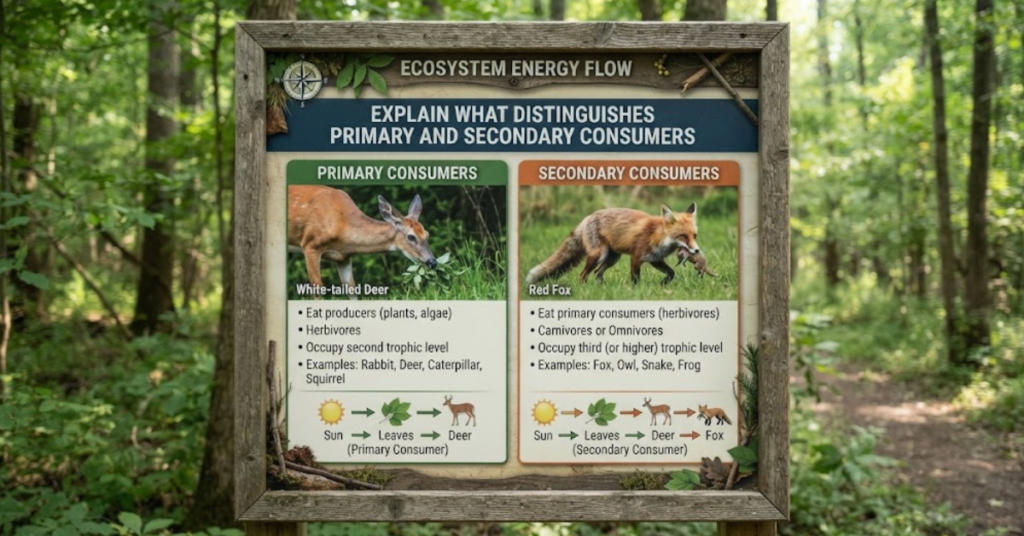
So, what distinguishes primary and secondary consumers? The simplest answer is their position in the food chain and what they eat. Primary consumers feed directly on producers such as plants and algae, while secondary consumers usually eat primary consumers.
That difference may sound straightforward, but there is more to it. Let’s look at how each group works, where they fit into food webs, and why they matter.
What Are Consumers in an Ecosystem?
Before comparing primary and secondary consumers, it helps to understand the word consumer.
In ecology, consumers are organisms that cannot make their own food from inorganic materials in the way producers do. Instead, they obtain energy and nutrients by eating other organisms.
Consumers are also called heterotrophs and include animals, many microorganisms, and other organisms that depend on organic matter for energy.
A basic food chain might look like this:
Grass → Grasshopper → Frog → Snake → Hawk
In this example:
- Grass is the producer.
- Grasshopper is a primary consumer.
- Frog is a secondary consumer.
- Snake may be a tertiary consumer.
- Hawk can occupy an even higher trophic level.
This arrangement is based on trophic levels, which describe an organism’s position in the transfer of energy through an ecosystem.
What Is a Primary Consumer?
A primary consumer is an organism that feeds directly on producers.
Producers are generally plants, algae, and certain microorganisms that make organic food using processes such as photosynthesis. Primary consumers obtain that stored energy by eating them.
Because many primary consumers eat plants, they are often called herbivores.
Examples of Primary Consumers
Common examples include:
- Rabbits eating grass
- Deer eating leaves
- Caterpillars eating plants
- Grasshoppers eating vegetation
- Zooplankton feeding on algae
- Cattle eating grass
For example, consider a simple meadow food chain:
Grass → Grasshopper → Frog
The grass is the producer, and the grasshopper is the primary consumer because it gets its energy directly from the grass.
Are All Primary Consumers Herbivores?
Not necessarily in every ecological situation.
Primary consumers are defined by their position in the food chain: they consume producers. In many familiar ecosystems, this means they are herbivores, but food webs can be more complicated than a simple textbook chain.
The key question is what the organism eats and where it obtains its energy, not simply what species it belongs to.
What Is a Secondary Consumer?
A secondary consumer generally feeds on primary consumers.
This places secondary consumers one trophic level above primary consumers. Many secondary consumers are carnivores, although some can be omnivores that eat both plants and animals.
Take the earlier example:
Grass → Grasshopper → Frog
Here, the frog is a secondary consumer because it eats the grasshopper, which is a primary consumer.
Examples of Secondary Consumers
Depending on the ecosystem, secondary consumers can include:
- Frogs eating insects
- Spiders eating herbivorous insects
- Small fish eating zooplankton
- Snakes eating herbivorous rodents
- Birds eating insects
The exact classification can change depending on what an organism eats. An animal isn’t permanently a primary or secondary consumer in every situation.
What Distinguishes Primary and Secondary Consumers?
The biggest difference is what they eat.
| Feature | Primary Consumers | Secondary Consumers |
| Main food source | Producers | Primary consumers |
| Typical trophic level | Second | Third |
| Common examples | Deer, rabbits, grasshoppers | Frogs, spiders, insect-eating birds |
| Typical feeding behavior | Herbivory | Carnivory or omnivory |
| Energy source | Directly from producers | Indirectly from producers |
In simple terms:
Producers → Primary consumers → Secondary consumers
Primary consumers get energy directly from producers, while secondary consumers obtain energy by eating organisms that have already consumed producers.
Primary vs. Secondary Consumers in a Food Chain
A food chain shows how energy and nutrients move from one organism to another.
Consider this example:
Algae → Zooplankton → Small Fish → Larger Fish
Here:
- Algae are producers.
- Zooplankton are primary consumers.
- Small fish are secondary consumers.
- Larger fish may be tertiary consumers.
Notice that the labels depend on feeding relationships. If a fish eats both zooplankton and plants, its trophic position can be more complicated than the simplified chain suggests.
This is why scientists often use food webs rather than relying solely on individual food chains.
What Is the Difference Between a Food Chain and a Food Web?
A food chain represents a relatively simple feeding pathway.
A food web combines many interconnected food chains to show the relationships that actually occur within an ecosystem.
For example, a grassland animal may eat several types of plants, while a predator may eat several different herbivores. That creates a network rather than a straight line.
This matters because an organism can sometimes occupy different trophic positions depending on what it eats.
How Energy Moves Between Consumers
Primary and secondary consumers are both important because they transfer energy through an ecosystem.
Plants capture energy and store it in organic molecules. When herbivores eat those plants, some of that energy becomes available to the herbivores. When predators eat those herbivores, some of the remaining energy moves to the next trophic level.
However, energy is lost at every trophic transfer, largely through metabolic processes and heat.
This helps explain why ecosystems generally support fewer organisms and less available energy at higher trophic levels.
A Simple Energy Example
Imagine a simplified ecosystem:
Plants → Grasshoppers → Frogs → Snakes
Energy begins with the plants and moves upward. At each step, only a portion of the energy becomes available to the next trophic level.
That’s one reason food chains typically don’t continue indefinitely.
Can an Animal Be Both a Primary and Secondary Consumer?
Yes.
This is especially common with omnivores.
Suppose a bird eats seeds from a plant. In that interaction, the bird is functioning as a primary consumer because it is eating a producer.
If the same bird eats an insect that feeds on plants, it is functioning as a secondary consumer in that particular interaction.
So, trophic levels aren’t always fixed labels attached permanently to an animal.
Why Are Primary Consumers Important?
Primary consumers play a crucial role in transferring energy from producers to higher trophic levels.
Without them, many predators would have less access to the energy stored in plants and other producers.
They also influence plant populations. By feeding on vegetation, herbivores can affect plant growth, competition, seed dispersal, and nutrient cycling.
In some ecosystems, their feeding behavior can even shape the structure of entire plant communities.
Why Are Secondary Consumers Important?
Secondary consumers help regulate populations of primary consumers.
For example, if a predator population declines sharply, the population of its prey may increase. That increase can place greater pressure on plants or other food resources.
Secondary consumers therefore contribute to population regulation and ecosystem balance.
Their role is not simply to “eat other animals.” They are part of a larger network of interactions that helps ecosystems function.
Primary and Secondary Consumers: A Simple Way to Remember
If you’re trying to remember the difference for a class or exam, use this shortcut:
Primary = eats producers.
Secondary = eats primary consumers.
For example:
Plant → Rabbit → Fox
- Plant = producer
- Rabbit = primary consumer
- Fox = secondary consumer
The trick is to focus on the feeding relationship, rather than memorizing long lists of animals.
Frequently Asked Questions
What distinguishes primary and secondary consumers?
Primary consumers eat producers such as plants and algae. Secondary consumers generally eat primary consumers, placing them one trophic level higher in a food chain.
Is a herbivore always a primary consumer?
Usually, when a herbivore eats a producer, it is acting as a primary consumer. The important factor is its feeding relationship with the producer.
Is a carnivore always a secondary consumer?
No. A carnivore can occupy different trophic levels depending on what it eats. A predator that eats a secondary consumer, for example, may function as a tertiary consumer.
Are humans primary or secondary consumers?
Humans can occupy different trophic levels because they have varied diets. Someone eating plants is consuming producers, while someone eating an herbivorous animal is obtaining energy through a higher trophic level.
What is an example of a primary and secondary consumer?
In the food chain grass → grasshopper → frog, the grasshopper is the primary consumer because it eats grass. The frog is the secondary consumer because it eats the grasshopper.
What are tertiary consumers?
Tertiary consumers generally feed on secondary consumers. In a simple food chain, they occupy a trophic level above secondary consumers.
Can secondary consumers eat plants?
Yes. Some organisms are omnivores and can eat both plants and animals. Their trophic level can therefore vary depending on the particular food they consume.
Conclusion
The key to understanding what distinguishes primary and secondary consumers is their place in the flow of energy through an ecosystem.
Primary consumers eat producers, such as plants and algae. Secondary consumers generally eat primary consumers, although real food webs can be more complicated because many organisms have varied diets.
Once you understand that relationship, trophic levels, food chains, food webs, and energy transfer become much easier to follow. When studying an ecosystem, start by asking one simple question: What does this organism eat? That answer often tells you where it fits in the food web.