

Flexibility is an important part of physical fitness, but measuring it doesn’t always require complicated equipment or fast-moving exercises. If you’ve ever wondered why fitness assessments so often use stretches where a person holds a position, the answer comes down to practicality and control.
To explain why static flexibility tests are more common than dynamic flexibility tests, it helps to understand what each type of test measures. Static tests assess how far a joint can move and how long a position can be maintained, while dynamic tests evaluate flexibility during movement.
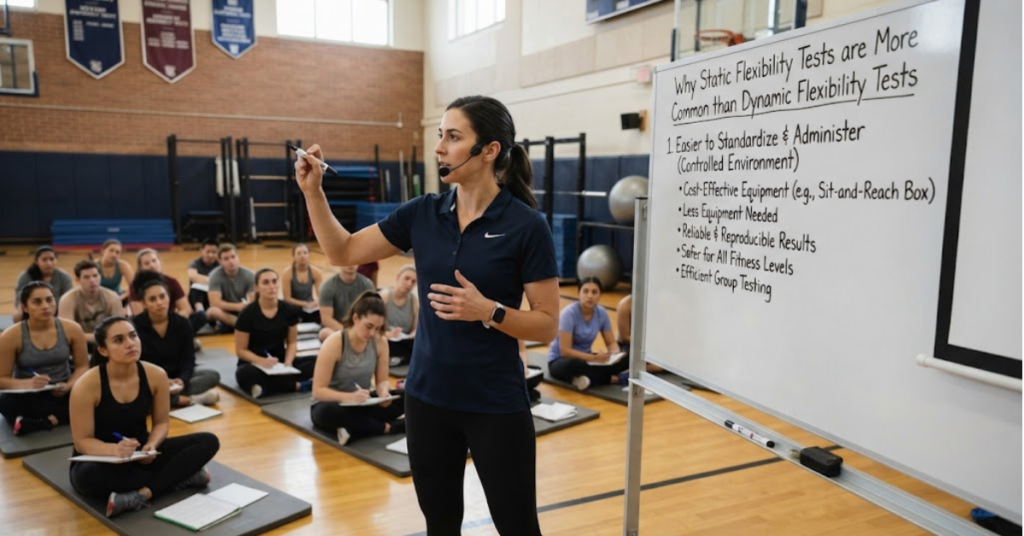
Static flexibility tests are generally more common because they are simple to perform, easier to standardize, relatively safe, inexpensive, and straightforward to measure. These advantages make them particularly useful in schools, gyms, sports programs, and general fitness assessments.
What Is a Static Flexibility Test?
A static flexibility test measures the range of motion around a joint while the body is held in a relatively still position.
For example, the sit-and-reach test is commonly used to assess the flexibility of the lower back and hamstring muscles. The person reaches forward and holds the position while the distance reached is measured.
Other static assessments may involve:
- Holding a shoulder stretch
- Measuring hip range of motion
- Performing a standing reach
- Holding a trunk-flexion position
- Measuring joint angles while maintaining a position
The key feature is that the movement is controlled and the final position can be observed or measured.
What Is a Dynamic Flexibility Test?
Dynamic flexibility refers to the ability to move a joint through its range of motion during active movement.
Unlike a static test, the body is not simply held in one position. Instead, the assessment may involve controlled leg swings, arm movements, walking movements, or other activities that require flexibility while the body is moving.
Dynamic flexibility can be especially relevant to athletes because many sports require flexibility during movement rather than while holding a stationary stretch.
However, testing dynamic flexibility can be more complicated because factors such as speed, momentum, balance, technique, and coordination can affect the result.
Why Are Static Flexibility Tests More Common?
There isn’t just one reason. Several practical advantages make static flexibility tests easier to use in fitness assessments.
1. Static Tests Are Easier to Perform
A static flexibility test usually requires a simple movement followed by a controlled hold.
That makes the instructions relatively easy to understand. A participant doesn’t necessarily need extensive training or athletic ability to perform the test correctly.
Dynamic tests, on the other hand, may require the person to coordinate several movements while maintaining appropriate technique.
2. They Are Easier to Standardize
A good fitness test should produce results that can be compared fairly between people or across different testing sessions.
Static tests make this easier because the tester can control factors such as:
- Starting position
- Movement direction
- Final position
- Duration of the hold
- Measurement method
With dynamic testing, movement speed and technique can vary considerably from one person to another.
This can make results harder to compare.
3. Static Tests Are Generally Safer
Safety is another important reason static assessments are widely used.
Because the movement is slow and controlled, there is generally less reliance on momentum or rapid changes in direction. This can make static testing more suitable for beginners and general fitness settings.
That doesn’t mean static stretching or testing is completely risk-free. A person should still avoid forcing a joint beyond a comfortable range and should follow appropriate testing instructions.
4. The Results Are Easy to Measure
One of the biggest advantages of static flexibility testing is measurement.
For example, a sit-and-reach score can be recorded in centimeters or inches. A joint angle can also be measured using appropriate equipment.
This gives the tester a clear numerical result.
A simple numerical score makes it easier to:
- Establish a baseline.
- Record the person’s performance.
- Compare future results.
- Monitor changes over time.
5. Static Tests Require Little Equipment
Many static flexibility assessments can be performed with inexpensive equipment—or sometimes with no specialized equipment at all.
A sit-and-reach assessment, for instance, can be performed using a standardized box or suitable measuring setup.
Dynamic assessments may require more space, video analysis, motion sensors, or other equipment if precise movement analysis is desired.
For schools and community fitness programs with limited resources, static tests are often the more practical option.
Static vs. Dynamic Flexibility Tests
The difference becomes clearer when the two approaches are compared directly.
| Feature | Static Flexibility Test | Dynamic Flexibility Test |
| Movement | Controlled and held | Performed through movement |
| Measurement | Usually straightforward | Can be more complex |
| Standardization | Relatively easy | Often more difficult |
| Equipment | Often minimal | May require more resources |
| Technique demands | Generally lower | Often higher |
| Speed | Usually slow or controlled | Movement speed may matter |
| Common use | General fitness testing | Sport and movement assessment |
Neither method is automatically “better.” They simply provide different types of information.
Why Static Tests Work Well in Schools and General Fitness
Static flexibility tests are especially convenient when many people need to be tested in a limited amount of time.
Imagine a physical education teacher assessing an entire class. A test that has simple instructions, requires minimal equipment, and produces an easy-to-record score is much easier to administer than a complex movement-based assessment.
The same principle applies in gyms, recreational programs, and basic fitness evaluations.
Static tests provide a practical way to answer a simple question:
How much range of motion can this person demonstrate under the conditions of the test?
Are Static Flexibility Tests Always Better?
Not necessarily.
Static tests have limitations. A person may demonstrate excellent flexibility while holding a position but struggle to use that range of motion during an actual movement.
This is where dynamic assessments can provide valuable information.
For example, an athlete may need to move a joint rapidly and repeatedly during a sport. Measuring flexibility only while the person is stationary may not fully represent that ability.
Therefore, the best assessment depends on the purpose of testing.
When Dynamic Testing May Be Useful
Dynamic flexibility testing can be particularly relevant when assessing:
- Athletes
- Sport-specific movement
- Functional mobility
- Movement quality
- Active range of motion
- Coordination between flexibility and movement
In these situations, simply measuring a stationary position may not tell the whole story.
Static Does Not Mean Unimportant
It’s easy to assume that because dynamic movements more closely resemble sports and everyday activity, dynamic flexibility tests must always be superior.
That’s not necessarily true.
A test is useful when it reliably measures what it is designed to measure. Static flexibility assessments remain popular because they offer a controlled and repeatable way to evaluate flexibility.
They are also useful for establishing a baseline before more advanced movement assessments are introduced.
Common Examples of Static Flexibility Tests
Several familiar fitness assessments use static positions or controlled end ranges of motion.
Sit-and-Reach Test
The sit-and-reach test is one of the best-known flexibility assessments. It primarily evaluates the flexibility associated with the lower back and hamstrings.
The participant sits with the legs extended and reaches forward as far as possible under standardized instructions.
Shoulder Flexibility Tests
Some assessments measure how far the arms or shoulders can move into specific positions. These tests can help evaluate upper-body range of motion.
Joint Range-of-Motion Measurements
A tester can also use tools such as a goniometer to measure the angle of a joint while it is positioned at a particular point in its range.
These measurements can be particularly useful when precise joint mobility information is needed.
Limitations of Static Flexibility Testing
Although static tests are practical, they aren’t perfect.
Some limitations include:
- They may not represent flexibility during movement.
- Results can be influenced by the participant’s technique.
- Different testing procedures can produce different results.
- Some tests focus on only one area of the body.
- Flexibility can vary depending on factors such as warm-up, fatigue, and previous activity.
For that reason, a single flexibility test should not necessarily be treated as a complete picture of someone’s mobility.
Why Dynamic Tests Are Less Common
Dynamic flexibility tests aren’t necessarily unpopular because they are ineffective. Instead, they can be more difficult to control and standardize.
Consider two people performing the same leg-swing assessment. One person might move quickly, while another moves slowly. One might have excellent balance, while another struggles to maintain posture.
Now the tester has to determine whether differences in the results are caused by flexibility or by differences in movement technique, speed, balance, or coordination.
That makes dynamic testing more demanding when the goal is a simple, standardized flexibility score.
What Makes a Good Flexibility Test?
A useful fitness assessment should ideally be:
- Reliable – It should produce reasonably consistent results under similar conditions.
- Valid – It should actually measure the physical quality it claims to measure.
- Practical – It should be realistic to administer.
- Safe – Participants should be able to perform it with appropriate precautions.
- Easy to interpret – Results should be understandable and useful.
Static flexibility tests perform well in many of these areas, which helps explain their widespread use.
FAQs About Static and Dynamic Flexibility Tests
Why are static flexibility tests more common?
Static flexibility tests are more common because they are generally simple, inexpensive, easy to standardize, straightforward to measure, and relatively easy to administer to large groups.
What is the main difference between static and dynamic flexibility?
Static flexibility involves holding a joint or body part in a particular position, while dynamic flexibility involves moving a joint through its range of motion during active movement.
Is a static flexibility test safer than a dynamic test?
Static tests can be easier to control because they generally involve slow, deliberate movements. However, any flexibility assessment should be performed correctly and without forcing a joint beyond a comfortable range.
Is dynamic flexibility more important for athletes?
Dynamic flexibility can be particularly relevant to athletes because sports involve movement. However, static flexibility measurements can still provide useful baseline information.
What is an example of a static flexibility test?
The sit-and-reach test is a common example. It measures how far a person can reach forward while maintaining a standardized seated position.
Can flexibility improve with training?
Yes. Regular, appropriately designed flexibility and mobility exercises can help improve range of motion. The type and amount of training should match the individual’s goals and physical needs.
Are static flexibility tests accurate?
They can provide useful and repeatable information when administered using a consistent procedure. However, no single test captures every aspect of flexibility or movement ability.
Conclusion
To explain why static flexibility tests are more common than dynamic flexibility tests, the biggest factors are practicality, simplicity, safety, standardization, and ease of measurement. Holding a controlled position makes it easier for testers to give consistent instructions and record results.
Dynamic flexibility testing still has an important role, particularly when the goal is to understand how flexibility functions during movement. Ultimately, the best test depends on what you are trying to measure.
For general fitness assessments, however, static tests remain popular because they provide a simple and practical way to evaluate flexibility and track changes over time.