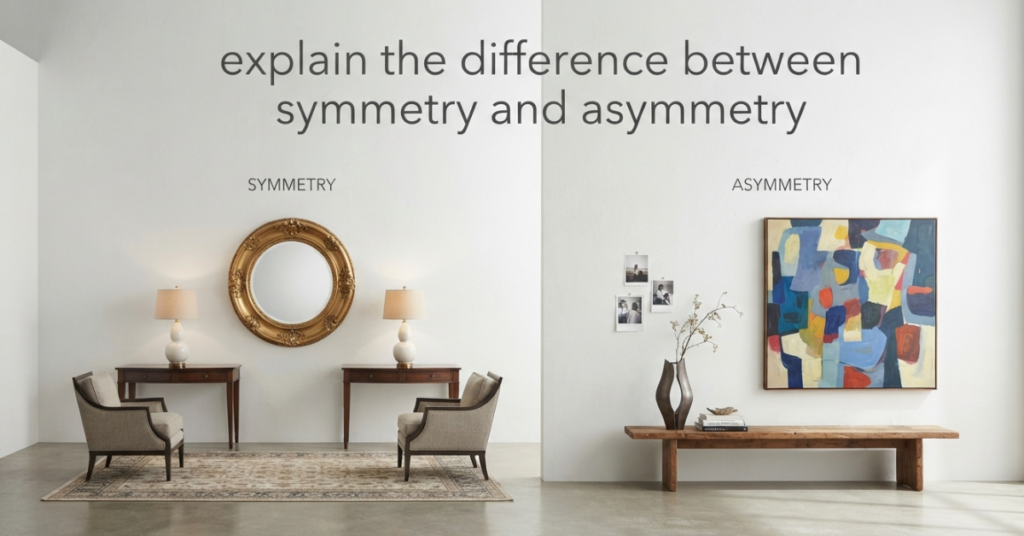

Look around you and you’ll notice symmetry almost everywhere—from a butterfly’s wings to the layout of a building. But many things in nature and design deliberately break that balance. To explain the difference between symmetry and asymmetry, the simplest idea is this: symmetry involves a sense of balance or matching parts, while asymmetry occurs when corresponding parts are not identical or evenly arranged.
Understanding the difference is useful in mathematics, science, art, architecture, photography, and everyday life. It also helps explain why some objects look orderly and predictable while others feel more dynamic or unexpected.
What Is Symmetry?
Symmetry refers to a balanced arrangement in which parts of an object or pattern correspond to one another in a consistent way.
A common example is a butterfly. If you imagine a line running down the center of its body, the left and right sides are broadly similar in shape. This is called bilateral symmetry.
Symmetry does not always mean that something has two identical halves. Different types of symmetry appear in different fields.
Common Types of Symmetry
Some important forms include:
- Reflection symmetry: One side mirrors the other across a line or plane.
- Rotational symmetry: An object looks the same after being rotated by a particular angle.
- Translational symmetry: A pattern repeats itself as it moves across a space.
- Radial symmetry: Similar parts are arranged around a central point, as seen in many flowers and some sea animals.
In mathematics, symmetry can be described precisely using transformations. In art and design, however, it can simply create a visual feeling of balance and order.
What Is Asymmetry?
Asymmetry describes a lack of exact correspondence between parts of an object, image, pattern, or arrangement.
For example, a person’s face is generally similar on both sides, but the two sides are not perfectly identical. Likewise, an asymmetrical photograph might place its main subject toward one side rather than directly in the center.
Asymmetry does not necessarily mean something is random or poorly organized. In fact, designers often use intentional asymmetry to make an image more interesting.
Examples of Asymmetry
You can find asymmetry in:
- Natural landscapes
- Modern architecture
- Abstract artwork
- Photography
- Graphic design
- Uneven patterns
- Many biological structures
Nature is especially full of examples. Trees, clouds, rocks, and coastlines rarely have perfectly matching sides.
Symmetry vs. Asymmetry: Key Differences
The easiest way to compare the two concepts is to look at how their parts relate to one another.
| Feature | Symmetry | Asymmetry |
|---|---|---|
| Balance | Usually regular or evenly distributed | Often uneven or irregular |
| Matching parts | Corresponding parts have a consistent relationship | Corresponding parts do not match exactly |
| Visual effect | Orderly, stable, predictable | Dynamic, varied, unexpected |
| Common examples | Snowflakes, geometric patterns, many buildings | Trees, natural landscapes, abstract designs |
| Design use | Creates harmony and structure | Creates movement and visual interest |
The important point is that asymmetry is not simply the opposite of beauty or organization. Both approaches can be carefully planned and visually effective.
Why Symmetry Matters in Nature
Symmetry plays an important role in biology. Many organisms have body structures that are organized around an axis or plane.
Humans and many other animals have bilateral symmetry, meaning their bodies generally have corresponding left and right sides. This arrangement is particularly useful for organisms that move in a particular direction.
Flowers and other organisms may display radial symmetry, where similar structures extend around a central point.
However, biological symmetry is rarely perfect. Growth, genetics, environmental conditions, and injuries can all create small differences between corresponding parts.
Why Asymmetry Is Common in Nature
If symmetry is so common, why is nature also full of irregular shapes?
The answer is that natural systems are influenced by countless factors. Wind, sunlight, gravity, genetics, weather, nutrition, and physical surroundings can all affect how something develops.
Consider a tree growing beside a building. It may receive more sunlight from one direction, causing its branches to grow unevenly. The result is asymmetrical, but it is still a natural and functional form.
This is one reason asymmetry can be just as important as symmetry when studying the natural world.
Symmetry and Asymmetry in Art and Design
Artists and designers use both concepts intentionally.
A symmetrical composition can make an image feel:
- Calm
- Formal
- Stable
- Balanced
- Organized
An asymmetrical composition can create:
- Movement
- Tension
- Energy
- Curiosity
- A more informal appearance
For example, placing a large object on one side of a photograph and several smaller objects on the other can create asymmetrical balance. The objects do not match, but their visual weight can still feel balanced.
Symmetry in Architecture
Traditional buildings often use symmetry to communicate stability and order. A central entrance with matching windows on either side is a familiar example.
Modern architecture, on the other hand, frequently experiments with asymmetrical forms. Uneven walls, irregular windows, and unusual shapes can make a structure feel more contemporary.
Symmetry vs. Asymmetry in Mathematics
In mathematics, symmetry has a more specific meaning than it does in everyday conversation.
An object, equation, or shape is considered symmetrical when a particular transformation leaves its essential structure unchanged.
For example, a circle has rotational symmetry because you can rotate it around its center and it still looks the same.
Asymmetry occurs when such a matching relationship does not exist under the transformation being considered.
This distinction is particularly important in geometry, algebra, physics, and other mathematical fields.
Is Asymmetry the Same as Irregularity?
Not exactly.
Irregularity generally means something does not follow a predictable pattern. Asymmetry, meanwhile, specifically concerns a lack of correspondence or balance between parts.
Something can therefore be asymmetrical without being chaotic.
For example, a graphic designer might deliberately place elements at different sizes and positions while carefully controlling their visual weight. The design is asymmetrical, but it is still highly organized.
Why Both Symmetry and Asymmetry Are Useful
It is tempting to think of symmetry as “good” and asymmetry as “bad,” but that is too simplistic.
Both have practical and aesthetic purposes.
Symmetry is useful when you want:
- Clear organization.
- A strong sense of balance.
- Repetition and consistency.
- A formal or traditional appearance.
Asymmetry is useful when you want:
- A sense of movement.
- More visual variety.
- Attention directed toward a particular area.
- A modern or unconventional appearance.
The best choice depends on the purpose and context.
Frequently Asked Questions
What is the simple difference between symmetry and asymmetry?
Symmetry means that parts of something have a matching or balanced relationship. Asymmetry means those corresponding parts do not match or are not arranged in an equivalent way.
Is symmetry always perfectly identical?
No. Symmetry refers to a specific relationship between parts, and the type of symmetry matters. In nature, approximate symmetry is common because living organisms rarely develop as perfectly as mathematical shapes.
What is an example of symmetry?
A simple geometric example is a square. Its opposite sides and corners are arranged in a regular, balanced pattern, and it has several lines of reflection symmetry.
What is an example of asymmetry?
A tree with branches growing unevenly in different directions is a straightforward example of asymmetry. An intentionally off-center photograph is another.
Is asymmetry important in design?
Yes. Designers often use asymmetry to create movement, visual interest, contrast, and a less predictable composition.
Is the human body symmetrical?
The human body has broad bilateral symmetry, meaning the left and right sides generally correspond. However, they are not perfectly identical.
Conclusion
To explain the difference between symmetry and asymmetry in simple terms, symmetry creates a consistent relationship or balance between corresponding parts, while asymmetry lacks that exact correspondence. Symmetry often communicates order and stability, whereas asymmetry can introduce movement, variety, and visual interest.
Neither is automatically better. From mathematics and biology to architecture and art, symmetry vs. asymmetry is really about how parts relate to one another and how those relationships affect what we see and understand.