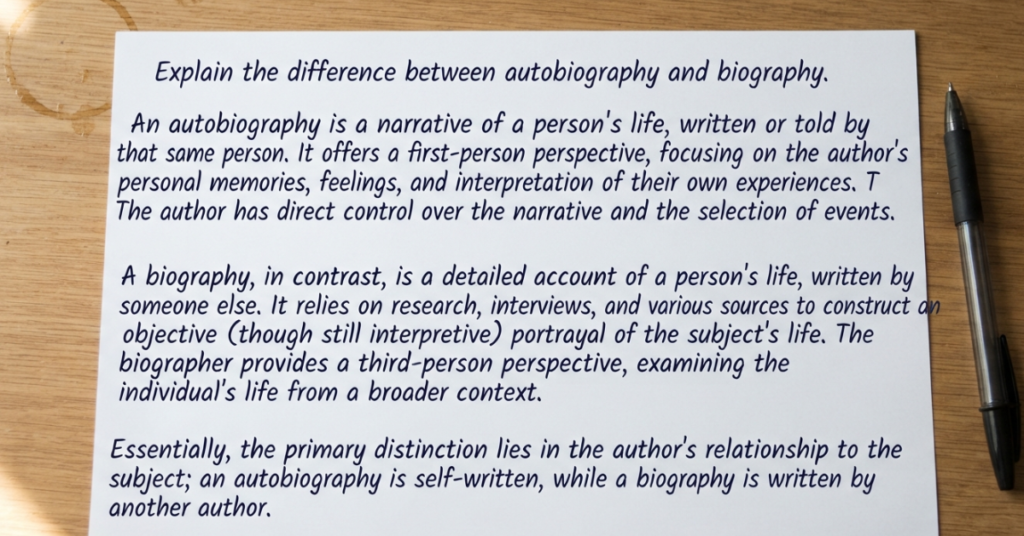

What makes a life story an autobiography instead of a biography? The answer is surprisingly simple: who tells the story. To explain the difference between autobiography and biography, it helps to look at the author, point of view, purpose, and the way each type of book presents a person’s life.
Both forms of writing can explore childhood, achievements, struggles, relationships, and major life events. However, they are created from very different perspectives, which can change how readers experience the story.
What Is an Autobiography?
An autobiography is a person’s account of their own life. In other words, the person who experienced the events is also the person writing about them.
Because the author is describing their own experiences, autobiographies are usually written in the first person, using words such as I, me, and my.
For example, if a famous athlete writes a book about growing up, becoming a professional player, and dealing with challenges throughout their career, that book would be an autobiography.
Key Features of an Autobiography
An autobiography commonly includes:
- The author’s personal experiences
- Childhood and family background
- Major achievements and challenges
- Personal thoughts and emotions
- Important relationships
- Lessons learned throughout life
- Events remembered from the author’s perspective
One of the biggest strengths of an autobiography is its personal nature. Readers get to hear directly from the person whose life is being described.
What Is a Biography?
A biography is a written account of another person’s life. Unlike an autobiography, it is written by someone who is not the main subject of the story.
Biographers often research a person’s life using interviews, letters, photographs, historical records, news reports, diaries, and other reliable sources.
A biography can therefore provide an outside perspective. Instead of simply describing what happened, the writer may also place events within their historical or social context.
Key Features of a Biography
A biography may include:
- Information about the subject’s childhood
- Education and career
- Family and relationships
- Major accomplishments
- Difficulties or controversies
- Historical background
- Interviews with people who knew the subject
- Research from documents and other sources
Because the writer is researching someone else’s life, biographies are generally written in the third person, using words such as he, she, or they.
Autobiography vs Biography: The Main Difference
The easiest way to remember the difference is to focus on who writes the story.
| Feature | Autobiography | Biography |
| Who writes it? | The person whose life is being described | Another person |
| Point of view | Usually first person | Usually third person |
| Main source | Personal memories and experiences | Research and multiple sources |
| Perspective | Inside, personal perspective | Outside perspective |
| Personal thoughts | Often emphasized | May be analyzed by the biographer |
| Research | May use supporting sources | Usually heavily research-based |
So, if you write about your own life, you are writing an autobiography. If someone else writes about your life, they are writing a biography.
Autobiography vs Biography: Point of View
Point of view is another important difference between the two.
Autobiography Uses a Personal Perspective
Since the author experienced the events firsthand, an autobiography can describe thoughts and emotions in a direct way.
For example:
“I was terrified before giving my first major speech.”
The reader is hearing directly from the person who experienced that moment.
Biography Uses an Outside Perspective
A biography might describe the same event differently:
“The young speaker reportedly felt nervous before delivering the speech.”
The biographer is observing and researching the person’s experience rather than claiming to have personally experienced it.
This difference can affect the tone and depth of the story.
How Autobiographies and Biographies Are Written
Although both tell stories about real people, the writing process can be quite different.
Writing an Autobiography
An autobiography often begins with the author’s own memories and experiences. The writer decides which events are important and how those events should be interpreted.
The author may also use:
- Diaries
- Personal photographs
- Letters
- Family records
- Old documents
- Personal journals
The challenge is that memory isn’t always perfect. A person may remember an event differently from how another person remembers it.
Writing a Biography
A biographer usually has to conduct extensive research before writing. They may interview relatives, friends, colleagues, historians, and other people connected to the subject.
They can also compare different sources to build a more complete picture of the person’s life.
This research-based approach is one reason biographies can provide valuable historical context.
Are Autobiographies Always Completely Accurate?
Not necessarily.
An autobiography represents the author’s understanding and memory of their own life. That doesn’t automatically make every detail inaccurate, but personal memory can be selective.
People may remember certain experiences more strongly than others. They may also interpret past events differently after gaining more experience.
This is why autobiographies are valuable not only as records of events but also as windows into how people understand their own lives.
Are Biographies More Objective?
Biographies can provide greater distance from the subject, but that doesn’t mean they are automatically completely objective.
A biographer makes decisions about:
- Which events to include
- Which sources to trust
- How to interpret evidence
- Which aspects of the subject’s life deserve attention
Two biographers could study the same person and produce noticeably different books.
A well-researched biography, however, should distinguish between documented facts, interpretations, and uncertain information.
Autobiography vs Biography: Which Is Better?
There isn’t a single winner. It depends on what you want to learn.
An autobiography may be better if you want:
- Personal thoughts and emotions
- Firsthand experiences
- The author’s own interpretation of events
- A more intimate storytelling style
A biography may be better if you want:
- Independent research
- Historical context
- Multiple perspectives
- Information gathered from different sources
Reading both can actually be more interesting. An autobiography tells you how someone understood their own life, while a biography can show how that life appeared from the outside.
Biography, Autobiography, and Memoir: What’s the Difference?
These terms are sometimes confused, especially autobiography and memoir.
An autobiography generally attempts to tell the story of a person’s life across a substantial portion of their lifetime. A memoir is usually more focused on particular experiences, periods, relationships, or themes.
For example:
- Autobiography: A broad account of someone’s life
- Memoir: A focused account of meaningful experiences
- Biography: Someone else’s researched account of a person’s life
The boundaries aren’t always rigid, and publishers sometimes use these labels differently.
Simple Examples to Remember
Here’s an easy way to keep the terms straight:
- You write about yourself → Autobiography
- Someone else writes about you → Biography
- You write about specific experiences from your life → Often a memoir
Think of it this way: “Auto” means self, so autobiography is a life story written by the person who lived it.
Frequently Asked Questions
What is the main difference between an autobiography and a biography?
The main difference is the author. An autobiography is written by the person whose life is being described, while a biography is written by someone else.
Is an autobiography written in first person?
Usually, yes. Because the author is writing about their own experiences, autobiographies commonly use first-person language such as “I,” “me,” and “my.”
Is a biography written in third person?
Generally, yes. A biographer is describing another person’s life, so third-person pronouns such as “he,” “she,” and “they” are commonly used.
Which is more personal, a biography or autobiography?
An autobiography is generally more personal because the subject is telling their own story and can directly describe their thoughts, feelings, and experiences.
Can an autobiography include research?
Yes. An autobiography can include documents, photographs, letters, diaries, interviews, and other sources to help the author remember or support details about their life.
Is a memoir the same as an autobiography?
No. They are closely related, but a memoir usually focuses on particular experiences, periods, or themes rather than attempting to cover the author’s entire life.
Conclusion
To explain the difference between autobiography and biography in the simplest way, remember one question: Who is telling the story? An autobiography is a person’s own account of their life, while a biography is someone else’s researched account of that person’s life.
Both forms can offer valuable insights, but they do so from different perspectives. If you’re studying a famous person’s life, comparing an autobiography with a well-researched biography can be especially useful because you’ll see both the personal perspective and the outside perspective.