
Imagine carrying a 60-kilogram object on Earth and then taking that same object to the Moon. Would it still have a mass of 60 kilograms? Yes. Would it feel just as heavy? Not at all. To explain the difference between mass and weight for objects on Earth and on the Moon, the key idea is simple: mass measures how much matter an object contains, while weight measures the force of gravity acting on that mass. Because the Moon’s gravity is much weaker than Earth’s, an object weighs much less on the Moon even though its mass does not change.
What Is Mass?
Mass is the amount of matter in an object. It is an intrinsic property, meaning it does not change simply because an object moves from one location to another.
Mass is commonly measured in:
- Kilograms (kg)
- Grams (g)
- Milligrams (mg)
For example, if a backpack has a mass of 10 kg on Earth, it still has a mass of 10 kg on the Moon.
The reason is that traveling to the Moon doesn’t remove or add matter to the backpack.
Mass Does Not Depend on Gravity
Mass remains essentially the same whether an object is:
- On Earth
- On the Moon
- In space
- On another planet
As long as the amount of matter in the object remains unchanged, its mass remains unchanged.
This is one of the most important differences between mass and weight.
What Is Weight?
Weight is the force exerted on an object because of gravity.
Unlike mass, weight can change depending on the strength of the gravitational field.
Weight can be calculated using:
Weight = Mass × Gravitational Acceleration
Or:
W = mg
where:
- W = weight in newtons (N)
- m = mass in kilograms (kg)
- g = gravitational acceleration in meters per second squared (m/s²)
On Earth, the gravitational acceleration is approximately:
9.8 m/s²
On the Moon, it is approximately:
1.62 m/s²
Because lunar gravity is much weaker, objects have much less weight on the Moon.
Mass vs. Weight on Earth
On Earth, gravity is relatively strong, so objects experience a significant downward force.
For example, suppose an object has a mass of 60 kg.
Its approximate weight on Earth would be:
W = 60 × 9.8
W = 588 N
So the object’s weight is approximately 588 newtons.
Notice that its mass is still 60 kg. The 60 kg describes the object’s mass, while 588 N describes the gravitational force acting on it.
Mass vs. Weight on the Moon
Now take that same 60 kg object to the Moon.
Its mass remains:
60 kg
But the Moon’s gravitational acceleration is only about 1.62 m/s².
So:
W = 60 × 1.62
W = 97.2 N
The object therefore weighs approximately 97 newtons on the Moon.
That’s dramatically less than its weight on Earth.
Why Does an Object Weigh Less on the Moon?
The Moon has less mass than Earth, which means its gravitational pull is weaker.
The surface gravity of the Moon is about one-sixth of Earth’s gravity.
That means an object on the Moon experiences only about one-sixth the gravitational force it would experience on Earth.
For example:
| Property | Earth | Moon |
| Mass of object | 60 kg | 60 kg |
| Gravity | 9.8 m/s² | 1.62 m/s² |
| Weight | 588 N | 97.2 N |
| Amount of matter | Same | Same |
This is why astronauts can appear to bounce or move more easily on the Moon. Their bodies haven’t become less massive; they’re simply experiencing much less gravitational force.
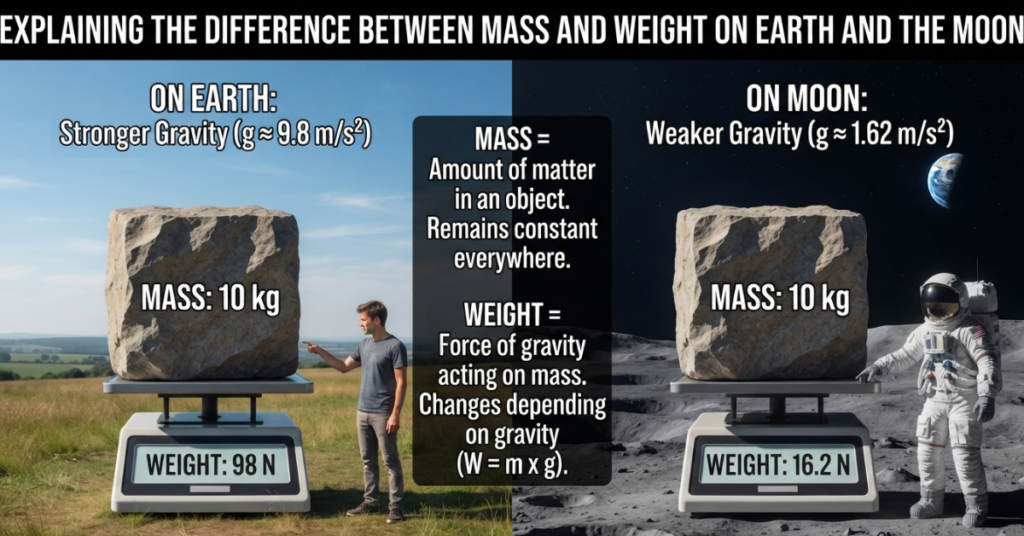
A Simple Example to Remember
Imagine you have a 10 kg box.
On Earth
Mass:
10 kg
Weight:
10 × 9.8 = 98 N
On the Moon
Mass:
10 kg
Weight:
10 × 1.62 = 16.2 N
The box still contains the same amount of matter.
Only its weight changes because the gravitational force changes. explain the difference between mass and weight for objects on earth and on the moon.
Mass and Weight Use Different Units
Another important difference is that mass and weight are measured using different units.
Mass
Mass is measured in:
kilograms (kg)
Weight
Weight is a force, so it is measured in:
newtons (N)
This distinction can be confusing because people often use the word “weight” when they really mean mass.
For example, someone might say:
“I weigh 70 kilograms.”
In everyday conversation, that’s perfectly normal. Scientifically, however, 70 kilograms describes the person’s mass.
Their actual weight on Earth would be approximately:
70 × 9.8 = 686 N
Does Your Mass Change on the Moon?
No.
If you have a mass of 70 kg on Earth, your mass is still approximately 70 kg on the Moon.
Your body still contains essentially the same amount of matter.
What changes is the gravitational force acting on your body.
So if your Earth weight is approximately:
70 × 9.8 = 686 N
your Moon weight would be approximately:
70 × 1.62 = 113.4 N
You might feel much lighter, but you haven’t lost mass.
Why Astronauts Can Jump Higher on the Moon
The difference between mass and weight helps explain one of the most recognizable effects of walking on the Moon.
Astronauts can jump higher and remain in the air longer because lunar gravity is much weaker than Earth’s.
Their bodies still have the same mass and therefore the same resistance to changes in motion. However, the gravitational force pulling them back toward the lunar surface is much smaller.
In simple terms:
Same mass + weaker gravity = less weight
Mass vs. Weight: Key Differences
Here is the easiest way to compare them:
| Mass | Weight |
| Amount of matter in an object | Gravitational force acting on an object |
| Usually measured in kilograms | Measured in newtons |
| Remains essentially constant | Changes with gravity |
| Does not depend on location | Depends on location |
| Same on Earth and Moon | Different on Earth and Moon |
Remembering this table can make many physics questions much easier.
Common Misconceptions About Mass and Weight
“My mass decreases on the Moon.”
Not true.
Your mass stays the same unless matter is added to or removed from your body.
“Kilograms are a unit of weight.”
Strictly speaking, kilograms are units of mass. Weight is a force and is measured in newtons.
“The Moon changes how much matter is in an object.”
It doesn’t.
The Moon’s weaker gravity changes the force acting on the object, not the amount of matter inside it.
“Objects have no weight in space.”
This requires some clarification. An object can experience very little apparent weight while in free fall, even though gravity may still be acting on it. Weight depends on the gravitational force and the context in which it is being measured.
Frequently Asked Questions
What is the difference between mass and weight?
Mass is the amount of matter in an object, while weight is the gravitational force acting on that object. Mass remains essentially constant, while weight changes when gravitational strength changes.
Does mass change from Earth to the Moon?
No. An object’s mass remains the same on Earth and the Moon as long as its amount of matter does not change.
Why does an object weigh less on the Moon?
The Moon’s gravitational acceleration is about one-sixth that of Earth. Therefore, the gravitational force acting on an object is much smaller.
What happens to a 60 kg object on the Moon?
Its mass remains 60 kg. Its weight is approximately 97.2 N, using lunar gravity of about 1.62 m/s².
Is weight measured in kilograms or newtons?
Weight is measured in newtons (N) because it is a force. Kilograms (kg) measure mass.
Is mass the same everywhere?
For ordinary situations, an object’s mass remains the same regardless of whether it is on Earth, the Moon, or elsewhere, provided no matter is added or removed.
How much is Earth’s gravity compared with the Moon’s?
Earth’s surface gravity is approximately 9.8 m/s², while the Moon’s is approximately 1.62 m/s². Lunar gravity is therefore about one-sixth as strong.
Conclusion
To explain the difference between mass and weight for objects on Earth and on the Moon, remember one simple distinction: mass is the amount of matter, while weight is the force of gravity acting on that matter.
An object’s mass stays essentially the same when it moves from Earth to the Moon. Its weight, however, becomes much smaller because the Moon’s gravitational pull is only about one-sixth as strong as Earth’s.
So, if you remember “mass stays the same, weight depends on gravity,” you’ve captured the central idea. This distinction is fundamental to understanding gravity, motion, and many other concepts in physics.