
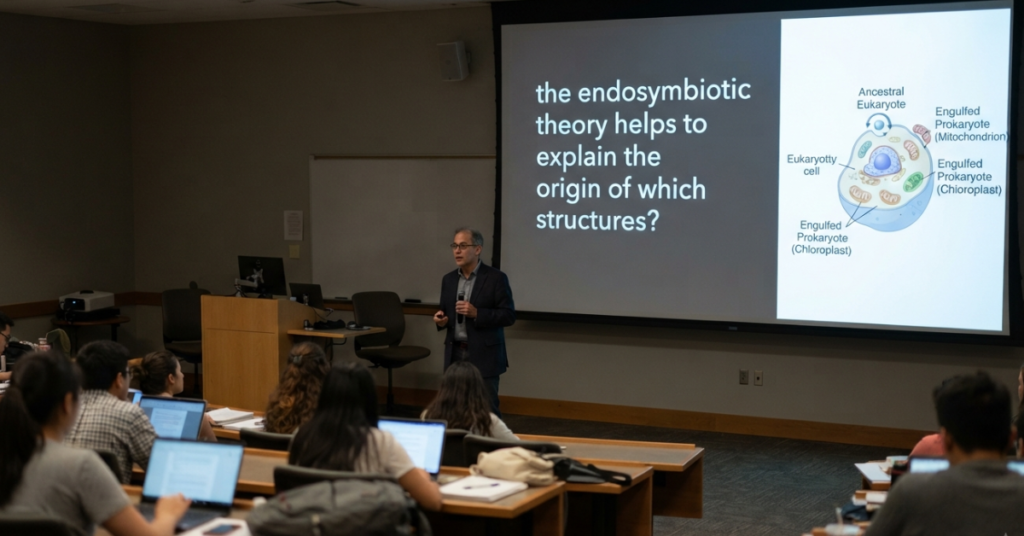

If you’ve ever wondered the endosymbiotic theory helps to explain the origin of which structures, the short answer is mitochondria and chloroplasts in eukaryotic cells.
These organelles are unusual because they have several features that make them resemble bacteria. They contain their own DNA, have membranes, and can reproduce in ways that are different from most other parts of a eukaryotic cell. The endosymbiotic theory proposes that their ancestors were once free-living bacteria that were engulfed by another cell and eventually formed a mutually beneficial relationship with their host.
This idea helps explain one of the biggest transitions in the history of life: the emergence of complex eukaryotic cells.
What Is the Endosymbiotic Theory?
The endosymbiotic theory is an explanation for how certain organelles inside eukaryotic cells originated.
The word endosymbiosis combines ideas about living together and living inside another organism. In this case, the theory suggests that an ancient host cell incorporated certain bacteria. Instead of being digested, those bacteria remained inside the host and eventually became permanent cellular structures.
Over a very long period, the relationship became increasingly integrated. The bacterial descendants evolved into organelles that now perform essential functions inside modern eukaryotic cells.
The two organelles most strongly associated with the theory are:
- Mitochondria, which are involved in cellular energy production.
- Chloroplasts, which carry out photosynthesis in plants and algae.
Which Structures Does the Endosymbiotic Theory Explain?
The most direct answer is:
The endosymbiotic theory helps explain the origin of mitochondria and chloroplasts.
Mitochondria are found in most eukaryotic organisms and play a central role in energy metabolism. Chloroplasts are found in plants and many algae and are responsible for photosynthesis.
The theory proposes different bacterial ancestors for these organelles:
| Organelle | Proposed ancestor | Main function today |
|---|---|---|
| Mitochondrion | An aerobic bacterium, generally associated with alphaproteobacteria | Energy metabolism |
| Chloroplast | A photosynthetic cyanobacterium | Photosynthesis |
The evidence does not suggest that modern mitochondria or chloroplasts simply entered cells recently. Rather, their ancestors became integrated into ancient cells over evolutionary time.
How Did Mitochondria Originate?
Mitochondria are often described as the cell’s major energy-processing organelles.
According to the endosymbiotic theory, an ancestral eukaryotic lineage acquired a bacterium capable of aerobic respiration. Instead of destroying the bacterium, the host and bacterium developed a relationship that benefited both.
The bacterium could efficiently use oxygen to obtain energy from nutrients, while the host provided a protected environment and access to resources.
Over generations, the relationship became permanent. Many genes from the original bacterial endosymbiont were eventually transferred to the host cell’s nuclear genome, while the mitochondrion retained a much smaller genome of its own.
How Did Chloroplasts Originate?
Chloroplasts have a similar evolutionary story, but their proposed ancestor was a cyanobacterium.
Cyanobacteria are photosynthetic bacteria. They use light energy to drive photosynthesis, producing chemical energy that can support cellular activities.
The theory proposes that an ancient eukaryotic cell incorporated a cyanobacterium. Over evolutionary time, the cyanobacterium became increasingly dependent on its host and eventually evolved into the chloroplast found in modern plants and algae.
This process is called primary endosymbiosis.
Evidence Supporting the Endosymbiotic Theory
The endosymbiotic theory isn’t based on appearance alone. Scientists have identified several lines of evidence supporting the bacterial ancestry of mitochondria and chloroplasts.
1. They Have Their Own DNA
Mitochondria and chloroplasts contain their own genomes.
Their DNA is separate from the majority of the cell’s DNA, which is stored in the nucleus. Their genomes are also generally circular, a characteristic commonly associated with bacterial chromosomes.
2. They Have Bacterial-Like Ribosomes
Ribosomes are structures that help cells make proteins.
The ribosomes inside mitochondria and chloroplasts have several features more closely resembling bacterial ribosomes than the ribosomes found in the eukaryotic cytoplasm.
This is an important clue about their evolutionary history.
3. They Reproduce by Division
Mitochondria and chloroplasts reproduce through forms of division that resemble bacterial cell division.
Rather than being produced from scratch by the nucleus each time a cell divides, existing mitochondria and chloroplasts divide to produce additional organelles.
4. They Have Double Membranes
Both mitochondria and chloroplasts have two surrounding membranes.
The double-membrane structure fits well with the idea that an ancestral host cell engulfed a bacterium. The inner membrane can be linked to the original bacterial membrane, while the outer membrane is consistent with the engulfing process.
The details of membrane evolution are complex, but the structure provides additional support for the theory.
5. Their Genes Have Bacterial Relatives
Genetic research provides particularly strong evidence.
Genes found in mitochondria and chloroplasts show evolutionary relationships with genes from bacterial groups. Mitochondrial genes are closely associated with alphaproteobacteria, while chloroplast genes trace to cyanobacteria.
Modern genomic research has substantially strengthened the bacterial-origin explanation.
What Is Primary Endosymbiosis?
Primary endosymbiosis refers to the acquisition of a free-living bacterium by a eukaryotic host.
The classic examples are:
- A host cell incorporated an aerobic bacterium, eventually giving rise to mitochondria.
- A eukaryotic cell later incorporated a cyanobacterium, giving rise to chloroplasts in the lineage leading to plants and algae.
The process involved far more than simple engulfment. Over evolutionary time, the host and endosymbiont became genetically and functionally integrated.
What Is Secondary Endosymbiosis?
The story becomes even more interesting with secondary endosymbiosis.
In this process, a eukaryotic cell containing a primary plastid is itself engulfed by another eukaryotic cell. This contributed to the evolution of plastids in several groups of algae.
As a result, some photosynthetic organisms have plastids with more complicated membrane structures than the typical chloroplast found in plants.
Secondary endosymbiosis helps explain why plastids occur across several distantly related eukaryotic lineages.
Why Is the Endosymbiotic Theory Important?
The theory is important because it helps explain how relatively simple cellular systems became more complex.
Eukaryotic cells contain specialized compartments called organelles. These compartments allow different biochemical processes to occur in organized ways.
Mitochondria and chloroplasts are especially significant because their evolutionary history appears to involve the incorporation of once-independent organisms.
The theory therefore connects two major concepts:
- Evolution
- Symbiosis
It shows that evolutionary innovation can involve cooperation and integration between different organisms, not simply competition.
Endosymbiotic Theory vs. Other Cell Structures
It’s important not to overextend the theory.
The endosymbiotic theory specifically provides a strong explanation for the bacterial origins of mitochondria and plastids, including chloroplasts.
It does not mean that every organelle originated from an engulfed bacterium.
For example, structures such as the:
- Nucleus
- Endoplasmic reticulum
- Golgi apparatus
- Lysosomes
are not generally explained by the same straightforward endosymbiotic model.
Their evolutionary origins are studied through other hypotheses and evidence.
A Simple Way to Remember the Answer
If you’re studying for a biology exam, remember:
Mitochondria + chloroplasts = endosymbiotic theory
A useful memory trick is:
“Energy and sunlight have bacterial roots.”
Mitochondria are central to energy metabolism, while chloroplasts capture light energy through photosynthesis. Both have characteristics that point toward ancient bacterial ancestors.
Common Misconceptions About Endosymbiosis
“Mitochondria are bacteria.”
Modern mitochondria aren’t simply bacteria living inside our cells. They are highly specialized organelles that have evolved through an extremely long period of integration with their host cells.
“Chloroplasts are just trapped cyanobacteria.”
Modern chloroplasts are much more integrated into plant and algal cells than their free-living bacterial ancestors were. Most of their original genetic independence has been lost.
“The theory is only based on the presence of DNA.”
No. The evidence comes from multiple sources, including genetics, membrane structure, reproduction, ribosomes, and evolutionary relationships.
Read also <<< Explain How Relaxing and/or Laughing Helps to Reduce Stress
Frequently Asked Questions
What does the endosymbiotic theory explain?
The endosymbiotic theory primarily explains the evolutionary origin of mitochondria and plastids, including chloroplasts, in eukaryotic cells.
The endosymbiotic theory helps to explain the origin of which structures?
It helps explain the origin of mitochondria and chloroplasts. Mitochondria are associated with an ancient bacterial lineage related to alphaproteobacteria, while chloroplasts originated from cyanobacteria through primary endosymbiosis.
Why do mitochondria have their own DNA?
Mitochondria retain a small genome that reflects their evolutionary history as descendants of bacteria. Most genes originally associated with the mitochondrial ancestor were either lost or transferred to the host cell’s nuclear genome during evolution.
Why do chloroplasts have their own DNA?
Like mitochondria, chloroplasts retain a small genome inherited from their bacterial ancestor. Their cyanobacterial ancestry helps explain why chloroplast DNA has bacterial-like characteristics.
What evidence supports the endosymbiotic theory?
Important evidence includes the presence of their own DNA, bacterial-like ribosomes, bacterial-style division, double membranes, and genetic relationships with bacterial groups.
Did mitochondria or chloroplasts evolve first?
Mitochondria are generally thought to have originated earlier in eukaryotic evolution than primary plastids. Plastids arose later in the lineage leading to photosynthetic eukaryotes through the incorporation of a cyanobacterium.
What bacteria are related to mitochondria?
Mitochondrial ancestors are generally linked to the alphaproteobacteria, although the precise evolutionary history continues to be studied.
What bacteria gave rise to chloroplasts?
Chloroplasts originated from an ancestral cyanobacterium that became incorporated into a eukaryotic cell through primary endosymbiosis.
Conclusion
So, the endosymbiotic theory helps to explain the origin of which structures? The key answer is mitochondria and chloroplasts.
Their bacterial-like DNA, ribosomes, reproduction, membranes, and genetic relationships provide several lines of evidence for an ancient symbiotic origin. Mitochondria are associated with an aerobic bacterial ancestor, while chloroplasts trace their ancestry to cyanobacteria.
The bigger lesson is just as fascinating: some of the most important structures inside complex cells may have begun as independent organisms that eventually became permanent partners. Understanding that connection makes both cell biology and evolution much easier to appreciate.