
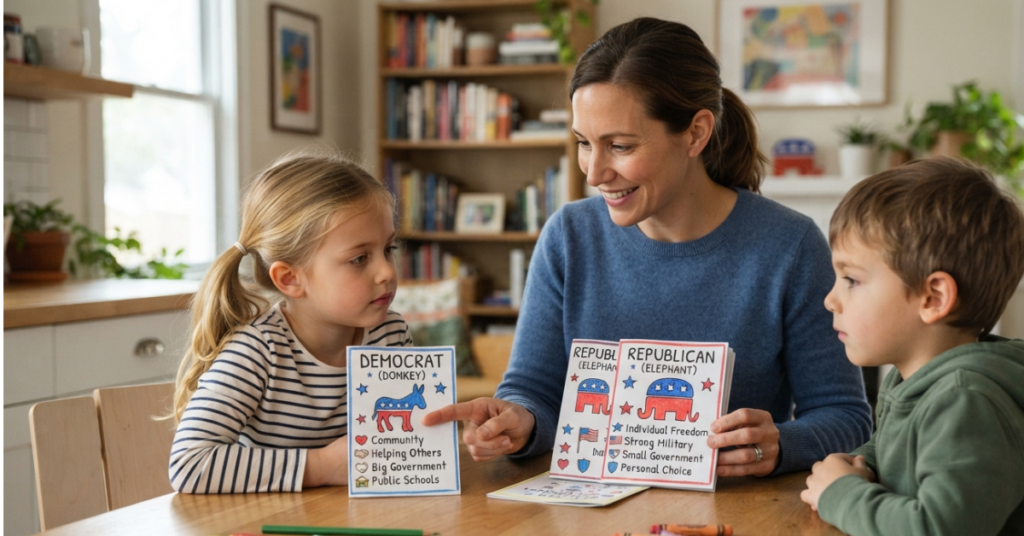

Talking about politics with a child can feel tricky. Political parties have complicated histories, changing platforms, and disagreements over issues that adults sometimes struggle to explain clearly. If you’re wondering how to explain Democrat vs. Republican to a child, the best approach is to keep the explanation simple, neutral, and age-appropriate. Rather than telling a child that one party is “good” and the other is “bad,” explain that they are two major political parties in the United States whose members often have different ideas about how government should work.
The goal isn’t to tell a child what to believe. It’s to give them enough context to understand what they hear at home, at school, online, or in the news.
What Are Democrats and Republicans?
Start with the simplest explanation:
Democrats and Republicans are two major political parties in the United States.
A political party is a group of people who generally share ideas about government and public policy and work together to support candidates and policies.
You can compare political parties to teams for a child, but make one important distinction: politics isn’t a sports game where one side always wins or where everyone on a team thinks exactly alike.
You might say:
“Democrats and Republicans are large groups of people who often have different ideas about how the country should be run. People in both groups can disagree with one another, too.”
That gives a child a basic framework without turning the conversation into a political argument.
How to Explain Democrats to a Child
When explaining the Democratic Party, avoid describing every Democrat as believing exactly the same things.
Instead, explain that Democrats often support certain approaches to government and public policy.
For example, Democrats have often emphasized:
- Government programs that provide assistance to people who need it.
- Expanding access to health care.
- Environmental protection and action on climate change.
- Civil rights and protections against discrimination.
- Higher taxes on some higher-income individuals and corporations to fund government programs.
A child-friendly explanation might be:
“Many Democrats think the government should play a bigger role in helping people through programs such as health care, education, and assistance for people who are struggling.”
Then add an important qualifier:
“But not every Democrat agrees about every issue.”
That distinction helps children understand that political parties aren’t single-minded groups.
How to Explain Republicans to a Child
The same principle applies when explaining the Republican Party.
Republicans have often emphasized:
- Lower taxes and less government spending.
- Limited government involvement in people’s lives and businesses.
- Individual responsibility.
- National defense and public safety.
- Conservative approaches to issues such as abortion, although views can differ among Republicans.
- Immigration policies that place greater emphasis on border security and enforcement.
A child-friendly explanation could be:
“Many Republicans think government should have a smaller role in people’s everyday lives and that people, families, businesses, and communities should have more responsibility for solving problems themselves.”
Again, emphasize that Republicans don’t all agree with one another.
Democrat vs. Republican: A Simple Comparison
For an older child, a basic comparison can make the differences easier to understand.
| Topic | Democrats often favor | Republicans often favor |
|---|---|---|
| Role of government | A more active government role in many areas | A more limited government role |
| Taxes | Greater willingness to raise taxes on higher incomes to fund programs | Greater emphasis on lower taxes |
| Health care | Greater government involvement and broader access | More emphasis on private markets and individual choice |
| Environment | Stronger government action on climate and environmental issues | Greater emphasis on economic impacts and market-based approaches |
| Social issues | Generally more socially liberal policies | Generally more socially conservative policies |
| Immigration | Often emphasizes legal pathways and humanitarian considerations | Often emphasizes border security and enforcement |
| Government spending | More willingness to use spending for public programs | Greater concern about government spending and deficits |
These are general tendencies, not rules. Political positions can vary considerably among individual politicians and voters.
Use a School Example to Explain Political Differences
Children often understand abstract ideas better when you connect them to something familiar.
Imagine a classroom where students have different opinions about how to spend money collected for a class activity.
One group might say:
“Let’s use more of the money to make sure everyone has what they need.”
Another group might say:
“Let’s spend less and let students decide how to use more of their own money.”
Neither explanation automatically makes one group right or wrong. The disagreement is about how to solve a problem and what priorities should come first.
You can explain that political debates often work in a similar way. People may agree that something is a problem but disagree about the best solution.
Explain That Political Parties Change Over Time
It’s also important not to present today’s political parties as if they have always had exactly the same beliefs.
The Democratic and Republican parties have changed significantly throughout U.S. history. Their coalitions, priorities, and positions on particular issues have shifted over time.
For a child, you can simply say:
“Political parties aren’t permanent teams with exactly the same ideas forever. Their ideas and the people who support them can change over many years.”
This prevents children from developing an overly simplistic view of American political history.
Explain That Not Every Democrat or Republican Agrees
This may be one of the most important lessons.
A child might hear:
“Democrats believe this.”
or:
“Republicans always do that.”
Explain that political labels don’t describe every belief a person has.
A person might:
- Vote for one party but disagree with some of its policies.
- Agree with Democrats on one issue and Republicans on another.
- Change their political preference over time.
- Consider themselves independent rather than identifying with either major party.
A useful phrase is:
“Often, but not always.”
That small distinction makes political explanations much more accurate.
What About Independent Voters?
Children may also hear the word independent.
An independent voter generally does not identify as a member of either major political party. However, being independent doesn’t mean a person has no political opinions.
An independent voter might support:
- A Democratic candidate in one election.
- A Republican candidate in another.
- A third-party candidate.
- Different candidates for different offices.
You can explain it simply:
“An independent is someone who doesn’t identify mainly with either of the two biggest political parties.”
Explain What Voting Means
Once a child understands political parties, explain why they matter.
In elections, voters choose among candidates for offices such as:
- President
- Governor
- Senator
- Representative
- Mayor
- Other state and local positions
Political parties often help candidates organize campaigns, raise money, communicate with voters, and promote their policy ideas.
You can tell a child:
“Voting is one way people choose who they want to represent them in government.”
It’s also useful to explain that not every election has only a Democrat and a Republican. Other candidates and parties can appear on ballots, depending on the election and jurisdiction.
Explain the Difference Between a Party and a Person
Children sometimes assume that a politician and a political party are basically the same thing.
They’re not.
A political party is a large organization and coalition of voters, candidates, activists, and officials.
A politician is an individual who holds or seeks public office.
For example, two politicians from the same party can disagree about a particular policy.
You can explain:
“Being a Democrat or Republican gives someone a general political identity, but it doesn’t mean they agree with every person in their party.”
How to Discuss Political Disagreements With Children
Political disagreement doesn’t have to be presented as something scary or hostile.
Teach children that reasonable people can look at the same problem and reach different conclusions.
For example:
Person A:
“I think the government should spend more money on this problem.”
Person B:
“I think the government is already spending too much, and there should be another solution.”
The two people may disagree about the solution while still agreeing that the problem exists.
This is an important part of understanding democracy.
Teach Children to Ask Questions
Rather than encouraging children to memorize political labels, encourage them to ask questions.
For example:
- What does this person believe?
- What problem are they trying to solve?
- What would their proposal change?
- How would it be paid for?
- Who might benefit?
- Who might be affected negatively?
- What evidence supports the claim?
- Do people who disagree have a reasonable argument?
These questions help children develop critical-thinking skills instead of simply choosing a political “side.”
Avoid Turning the Explanation Into “Good vs. Bad”
When explaining Democrat vs. Republican to a child, one of the easiest mistakes is saying that one party is good and the other is bad.
Political parties represent millions of people with different experiences and beliefs. Reducing the discussion to heroes versus villains makes it harder for children to understand why political disagreements exist.
Instead, use language such as:
- “They often disagree about…”
- “One side may argue…”
- “The other side may believe…”
- “Some members of the party think…”
- “People can have different opinions about this.”
This teaches children that political ideas can be examined rather than simply accepted or rejected.
Adjust the Explanation to the Child’s Age
The right explanation depends heavily on the child’s age.
For Younger Children
Keep it very simple:
“Democrats and Republicans are two large political groups. They often have different ideas about what the government should do and how it should solve problems.”
There’s no need to introduce dozens of policy issues at once.
For Older Children
You can discuss:
- Taxes
- Government spending
- Health care
- Education
- Immigration
- Climate policy
- Civil rights
- Elections
- The role of government
Encourage the child to ask questions and understand more than one perspective.
For Teenagers
You can introduce more advanced ideas, including:
- Political platforms
- Primary elections
- Party coalitions
- Federal versus state government
- Political ideology
- Public policy
- Campaigns
- Legislative processes
- Evaluating political claims and sources
At this age, it can be particularly useful to teach them how to distinguish between an opinion, a factual claim, and evidence.
A Simple Script Parents Can Use
If you’re looking for a straightforward way to begin the conversation, you could say:
“Democrats and Republicans are the two biggest political parties in the United States. They often have different ideas about how the government should work and how to solve problems. Democrats generally support a larger role for government in providing services and addressing certain social and economic issues, while Republicans generally favor a smaller government role, lower taxes, and more individual responsibility. But those are broad descriptions. People in each party have different opinions, and people can change their minds. You don’t have to choose a side just because someone else does.”
This gives a child a starting point without telling them what political opinion they should have.
Common Mistakes to Avoid
When teaching children about American politics, try to avoid these approaches:
Using Political Insults
Words used to mock or attack political groups can make children think politics is primarily about disliking other people.
Presenting Opinions as Facts
If you’re expressing your own view, make that clear.
For example:
“I believe…”
is different from:
“Everyone knows…”
Oversimplifying Every Issue
Saying that Democrats always believe one thing and Republicans always believe another creates an inaccurate picture.
Assuming Party Members Agree on Everything
Internal disagreement exists within both major parties.
Making Children Feel They Must Choose a Side
A child can learn about politics without immediately adopting a political identity.
Frequently Asked Questions
What is the easiest way to explain Democrats and Republicans to a child?
Explain that they are two major U.S. political parties that often have different ideas about government and public policy. Then use simple examples rather than complicated political terminology.
Are Democrats and Republicans opposites?
Not necessarily. They often disagree on important issues, but individual Democrats and Republicans can share many beliefs. Political positions also vary within each party.
Which party is better?
There isn’t an objective answer that applies to everyone. People evaluate political parties according to their own values, priorities, and views about government.
Are all Democrats liberal?
No. Democrats generally form a broad coalition, and individual Democrats can hold a range of political views.
Are all Republicans conservative?
No. Although the Republican Party is generally associated with conservative politics, individual Republicans can differ significantly on particular issues.
Can someone agree with both Democrats and Republicans?
Yes. A person can support policies associated with either party and may not identify strongly with either one.
What should a child know about political parties?
A useful starting point is understanding that political parties are groups of people who generally share political goals, but individual members don’t necessarily agree on every issue.
Conclusion
Knowing how to explain Democrat vs. Republican to a child is less about giving them a list of political labels and more about teaching them how political differences work.
Explain that Democrats and Republicans are two major U.S. political parties with different general approaches to government. Then make it clear that neither party represents a single set of opinions shared by every member.
Most importantly, teach children that disagreement is a normal part of democracy. They can listen to different viewpoints, ask questions, examine evidence, and eventually form their own opinions.
The best political education doesn’t tell a child what to think. It teaches them how to think carefully about what they hear.