
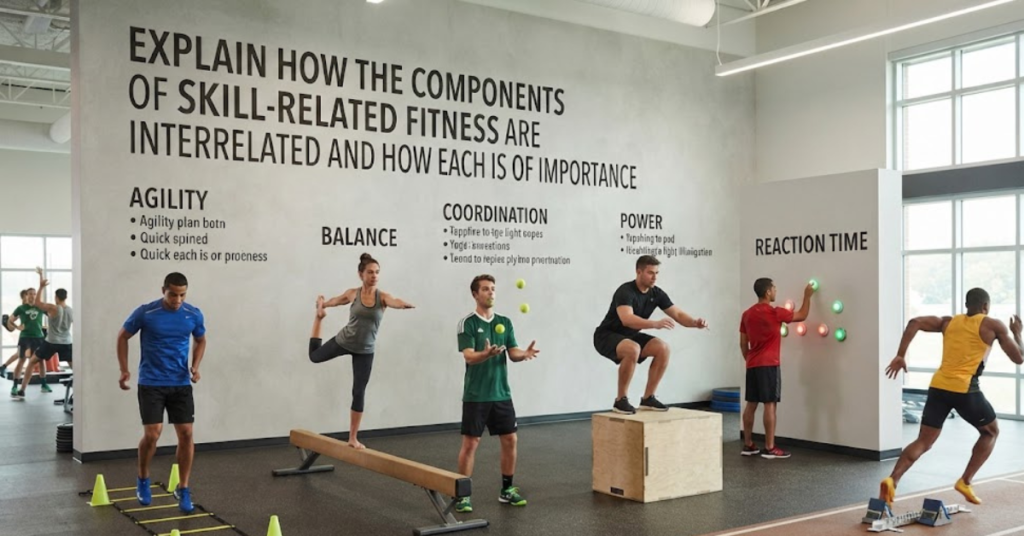

Being physically fit isn’t only about running faster or lifting heavier weights. In sports, exercise, and everyday movement, your ability to explain how the components of skill-related fitness are interrelated and how each is of importance comes down to understanding how several physical abilities work together.
Skill-related fitness refers to physical abilities that help a person perform movements efficiently and effectively. The six main components are agility, balance, coordination, power, reaction time, and speed.
Although each component has a different purpose, they are closely connected. A basketball player, for example, needs speed to move quickly, balance to stay controlled, coordination to handle the ball, and reaction time to respond to an opponent. Improving one ability can often support performance in others.
What Is Skill-Related Fitness?
Skill-related fitness is a group of physical abilities that contribute to successful movement and athletic performance.
Unlike health-related fitness, which focuses heavily on areas such as cardiovascular endurance and muscular strength, skill-related fitness emphasizes how effectively the body can perform movements.
The six components are:
- Agility
- Balance
- Coordination
- Power
- Reaction time
- Speed
These components are especially important in sports, but they also contribute to everyday activities that require quick, controlled, and coordinated movement.
The Six Components of Skill-Related Fitness
1. Agility
Agility is the ability to change the body’s direction or position quickly while maintaining control.
It is essential in sports such as soccer, basketball, tennis, and football, where players constantly respond to opponents and changing situations.
For example, a soccer player may need to suddenly change direction to avoid a defender. Good agility allows the player to make that movement quickly without losing balance.
2. Balance
Balance is the ability to maintain control of the body’s position, whether stationary or moving.
There are two general forms:
- Static balance: Maintaining control while staying still.
- Dynamic balance: Maintaining control while moving.
Balance is important in activities such as gymnastics, skating, martial arts, and even everyday tasks like walking across an uneven surface.
3. Coordination
Coordination is the ability to use different parts of the body together smoothly and efficiently.
Hand-eye coordination is particularly important in sports involving catching, throwing, hitting, or striking.
A baseball player, for example, needs to coordinate their eyes, arms, hands, legs, and torso when hitting a moving ball.
4. Power
Power is the ability to produce force quickly.
It combines strength and speed. A person may be strong, but producing that force rapidly requires power.
Examples include:
- Jumping
- Sprinting from a starting position
- Throwing
- Explosive lifting movements
- Striking a ball
Power is particularly valuable in sports where explosive movements can determine performance.
5. Reaction Time
Reaction time is the amount of time it takes to respond to a stimulus.
The stimulus could be a sound, visual signal, movement from another player, or an unexpected change in the environment.
A tennis player reacting to an opponent’s serve is a good example. Faster reaction time allows the player to respond sooner and potentially reach the ball before it passes.
6. Speed
Speed is the ability to perform a movement or cover a distance quickly.
It is particularly important in sprinting and sports where athletes need to accelerate or move rapidly.
However, speed alone isn’t enough. An athlete who can run quickly but cannot stop, change direction, or maintain control may not perform effectively.
That’s where the other components become important.
How the Components of Skill-Related Fitness Are Interrelated
The six components don’t operate independently. They constantly interact during physical activity.
Consider a basketball player driving toward the basket.
The player may need:
- Speed to move quickly toward the basket.
- Agility to change direction around a defender.
- Balance to remain controlled during movement.
- Coordination to control the ball while running.
- Reaction time to respond to the defender.
- Power to jump and shoot effectively.
This example demonstrates why skill-related fitness is best understood as a connected system rather than six separate abilities.
Agility, Balance, and Coordination Work Together
These three components are especially closely related.
A person needs balance to maintain control while changing direction. They also need coordination to make different body parts work together during that movement.
Without sufficient balance, agility becomes difficult. Without coordination, quick movements may become inefficient or uncontrolled.
For example, a soccer player changing direction at high speed needs all three abilities simultaneously.
Power and Speed Are Closely Connected
Power and speed also have a strong relationship.
Power involves producing force quickly, while speed involves moving rapidly. Developing muscular strength can contribute to power, but power requires the ability to apply force rapidly.
A sprinter leaving the starting blocks demonstrates this relationship. The athlete needs explosive power to accelerate and speed to maintain rapid movement.
Reaction Time Supports Agility and Coordination
Reaction time influences how quickly a person can respond to what is happening around them.
Once a person reacts, they need coordination and agility to perform the appropriate movement.
For instance, a goalkeeper sees a ball traveling toward the corner of the goal. Reaction time allows the goalkeeper to respond quickly, while balance, agility, coordination, and power help them move into position and attempt the save.
Why Each Component of Skill-Related Fitness Is Important
Each component contributes something different to physical performance.
| Component | Why It Matters |
| Agility | Helps you change direction quickly and stay controlled |
| Balance | Helps maintain body control during stationary and moving activities |
| Coordination | Allows body parts to work together efficiently |
| Power | Helps produce force quickly and explosively |
| Reaction time | Allows rapid responses to stimuli |
| Speed | Helps you move quickly from one point to another |
Ignoring one component can create limitations, especially in activities that require several skills simultaneously.
Importance of Skill-Related Fitness in Sports
Athletes often rely on several components at the same time.
Basketball
Basketball requires:
- Speed for fast breaks
- Agility for changing direction
- Coordination for dribbling and shooting
- Balance for controlled movement
- Reaction time for responding to opponents
- Power for jumping and explosive movements
Soccer
Soccer players use speed to cover the field, agility to avoid opponents, coordination to control the ball, and reaction time to respond to passes and changing plays.
Power also helps with shooting, jumping, and acceleration.
Tennis
Tennis requires rapid reactions, quick changes of direction, balance, and hand-eye coordination.
Players also rely on power and speed when serving and moving around the court.
Skill-Related Fitness Is Important Beyond Sports
You don’t have to be an athlete to benefit from these abilities.
Skill-related fitness contributes to everyday activities such as:
- Walking safely
- Climbing stairs
- Avoiding obstacles
- Catching objects
- Maintaining balance
- Responding quickly to unexpected situations
These abilities can also become increasingly important as people age because maintaining balance, coordination, and reaction ability can support safe movement and independence.
How to Improve Skill-Related Fitness
Because the components are interconnected, exercises that challenge several abilities at once can be especially useful.
Try activities such as:
- Agility drills – Improve directional changes and body control.
- Balance exercises – Practice standing on one leg or using controlled movement patterns.
- Ball drills – Develop coordination and reaction time.
- Plyometric exercises – Develop explosive power.
- Sprint training – Improve acceleration and speed.
- Reaction drills – Practice responding quickly to visual or auditory signals.
A balanced fitness program can combine several of these approaches rather than focusing exclusively on one component.
Why Improving One Component Can Help Another
Because these abilities overlap, improvement in one area may support performance in another.
For example, improving balance can make directional changes more controlled. Better coordination can make movement more efficient, while improved power can help an athlete accelerate faster.
However, improvement is not always automatic. Each component has its own characteristics and may require specific training.
The best approach is to develop them together while considering the demands of the activity or sport.
Read also <<< Besque Magic Body Oil Reviews
Frequently Asked Questions
What are the six components of skill-related fitness?
The six components are agility, balance, coordination, power, reaction time, and speed.
Why are the components of skill-related fitness interrelated?
They are interrelated because physical activities usually require several abilities at the same time. For example, changing direction quickly requires agility, balance, coordination, and often speed and reaction time.
Which skill-related fitness component is most important?
There isn’t one component that is universally the most important. Its importance depends on the activity. A sprinter may prioritize speed and power, while a gymnast may rely heavily on balance and coordination.
How does agility relate to balance?
Balance helps a person maintain control while changing direction. Good balance therefore supports effective agility, particularly during fast movements.
How does coordination improve sports performance?
Coordination allows different parts of the body to work together smoothly. This can improve skills such as throwing, catching, kicking, striking, and dribbling.
What is the difference between power and strength?
Strength is the ability to produce force, while power involves producing force quickly. Power therefore combines force production with speed.
Why is reaction time important?
Reaction time allows a person to respond quickly to a stimulus. It is especially important when situations change rapidly, such as during competitive sports.
Can skill-related fitness be improved?
Yes. Regular training can improve agility, balance, coordination, power, reaction time, and speed. Exercises should be selected according to the person’s goals, ability, and activity.
Conclusion
To explain how the components of skill-related fitness are interrelated and how each is of importance, it helps to think of them as parts of the same system. Agility, balance, coordination, power, reaction time, and speed each have a distinct role, but they frequently work together during real-world movement and sports.
A basketball player changing direction, a tennis player returning a serve, or a person avoiding an unexpected obstacle may use several of these abilities at once. Developing all six components can therefore lead to better movement control, faster responses, improved athletic performance, and greater physical confidence.
The key takeaway is simple: skill-related fitness isn’t about mastering just one ability. It’s about developing a combination of skills that allows your body to move quickly, efficiently, and under control.