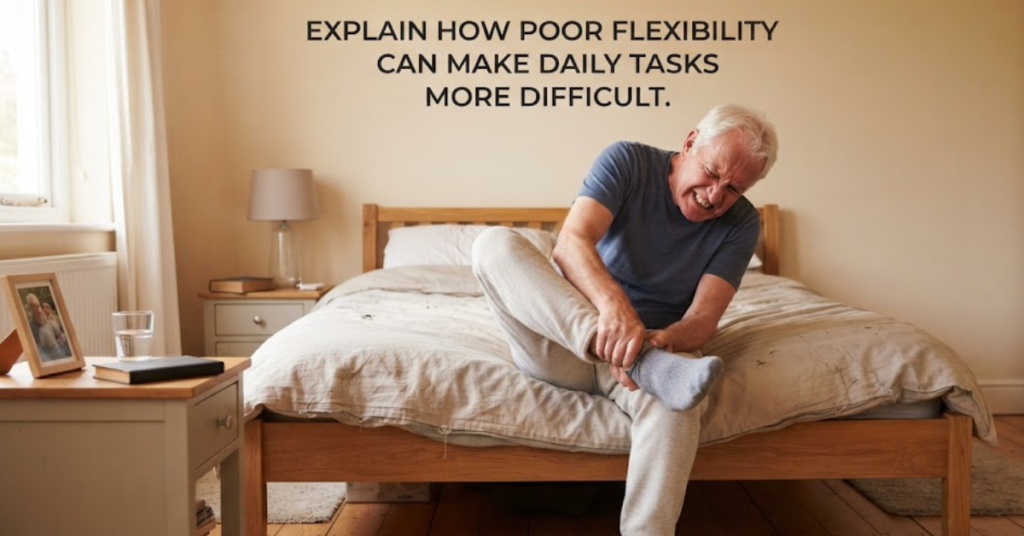

You might not think much about flexibility until a simple movement suddenly becomes difficult. Bending down to tie your shoes, reaching for something on a high shelf, getting out of a chair, or turning your body can all require a reasonable range of motion. To explain how poor flexibility can make daily tasks more difficult, it helps to understand that flexibility allows your joints and muscles to move through an appropriate range of motion. When that range is limited, ordinary movements may require more effort, feel uncomfortable, or become harder to perform safely.
Poor flexibility does not necessarily mean someone is unable to move. Rather, it can make certain movements less efficient and restrict how comfortably a person performs everyday activities.
What Is Flexibility?
Flexibility is the ability of a joint and the surrounding muscles and soft tissues to move through an available range of motion.
Different parts of the body have different flexibility requirements. For example, your shoulders need enough mobility to reach overhead, while your hips and ankles contribute to movements such as walking, squatting, and climbing stairs.
Flexibility can be influenced by several factors, including:
- Age
- Physical activity levels
- Muscle tightness
- Joint structure
- Previous injuries
- Posture and movement habits
- Time spent sitting or remaining in one position
Having adequate flexibility can make everyday movement feel smoother and more comfortable.
How Poor Flexibility Makes Daily Tasks More Difficult
When flexibility is limited, everyday activities may require compensatory movements. In other words, if one joint or muscle group cannot move enough, another part of the body may have to work differently to complete the movement.
Here are some common examples.
1. Bending Down Becomes Harder
Tasks such as picking something up from the floor, tying shoelaces, or loading a low cupboard require movement around the hips, knees, and ankles.
Limited flexibility can make it difficult to bend comfortably. A person may compensate by rounding their back, bending their knees more, or avoiding the movement altogether.
2. Reaching and Stretching Can Be Limited
Reaching for objects on high shelves or putting something into an overhead cupboard requires adequate shoulder and upper-body mobility.
If flexibility around the shoulders or upper back is limited, reaching overhead may feel restricted or uncomfortable. This can turn an otherwise simple household task into a frustrating one.
3. Getting Dressed May Take More Effort
Getting dressed involves many movements that people perform without thinking about them.
Putting on socks, fastening shoes, pulling on a shirt, or reaching behind the body can require flexibility in the hips, shoulders, back, and legs. Poor flexibility can make these movements more challenging, particularly when several joints must work together.
4. Sitting and Standing Can Become More Difficult
Getting up from a chair requires coordinated movement involving the hips, knees, ankles, and surrounding muscles.
Restricted flexibility may affect how comfortably a person gets into or out of a seated position. Someone may need to use their hands for additional support or change their movement pattern to compensate.
5. Walking and Climbing Stairs May Feel Less Comfortable
Walking requires repeated movement through several joints, including the hips, knees, and ankles.
Adequate flexibility helps the body move through these positions efficiently. If flexibility is restricted, movement can become less fluid, and activities such as climbing stairs may feel more demanding.
6. Maintaining Good Posture Can Be Harder
Flexibility and posture are closely connected, although posture is also influenced by strength, balance, habits, and body structure.
Tight muscles can restrict comfortable positioning and encourage compensatory postures. For someone who spends many hours sitting, limited mobility in areas such as the hips or upper back may make it harder to maintain a comfortable upright position.
Poor Flexibility and Everyday Movement
One important point is that flexibility is not about being able to perform impressive stretches. You do not need to be able to touch your toes or perform advanced yoga poses to handle normal daily activities.
The goal is functional flexibility—having enough range of motion to perform necessary movements comfortably and effectively.
For example:
| Daily activity | Flexibility involved |
| Tying shoes | Hips, back, legs |
| Reaching overhead | Shoulders and upper back |
| Picking objects up | Hips, knees, ankles |
| Getting out of a chair | Hips, knees, ankles |
| Turning around | Spine, hips, shoulders |
| Climbing stairs | Hips, knees, ankles |
| Putting on clothes | Shoulders, hips, back |
This shows why flexibility is more than a fitness-test measurement. It can influence how easily the body handles ordinary movements.
Why Flexibility Matters Alongside Strength and Balance
Flexibility is only one part of physical fitness. Strength, muscular endurance, balance, coordination, and cardiovascular fitness also contribute to how effectively a person performs daily activities.
Think of movement as a team effort.
- Flexibility provides an appropriate range of motion.
- Strength helps produce force.
- Balance helps maintain control.
- Coordination helps different body parts work together.
- Endurance helps sustain activity over time.
If one component is limited, certain movements may become more challenging.
How to Improve Flexibility Safely
Regular movement can help maintain or improve flexibility. Stretching is one option, but everyday activities that take joints through comfortable ranges of motion can also contribute to mobility.
Some practical approaches include:
- Stretch regularly: Gentle stretching can help maintain range of motion.
- Move throughout the day: Avoid remaining in one position for prolonged periods.
- Use controlled movements: Move gradually rather than forcing a joint into a position.
- Include mobility exercises: Exercises that move joints through their available range can complement stretching.
- Strengthen the body: Strength and flexibility often work together to support functional movement.
- Progress gradually: Flexibility usually improves over time rather than after one intense session.
Avoid forcing a stretch or bouncing aggressively into a position. If a movement causes significant pain, stopping and seeking appropriate professional advice is sensible.
Does Poor Flexibility Always Cause Pain?
Not necessarily. Limited flexibility can exist without pain, while pain can occur for many reasons unrelated to flexibility.
However, restricted movement may make some activities feel uncomfortable or cause a person to move differently to accomplish a task. Persistent pain, sudden loss of movement, or difficulty with normal activities should not simply be assumed to result from poor flexibility.
A qualified healthcare or fitness professional can help determine what may be contributing to a particular movement problem.
FAQs About Poor Flexibility and Daily Tasks
How does poor flexibility affect everyday life?
Poor flexibility can restrict joint movement and make activities such as bending, reaching, dressing, walking, sitting, standing, and climbing stairs more difficult or less comfortable.
Why is flexibility important for daily activities?
Flexibility helps joints and muscles move through the ranges of motion required for everyday activities. Adequate flexibility can make movements more comfortable and efficient.
Can poor flexibility affect posture?
It can. Restricted movement in certain muscles and joints may contribute to compensatory positioning, although posture is also influenced by strength, habits, balance, and individual anatomy.
Does stretching improve flexibility?
Regular stretching can help improve or maintain flexibility, particularly when performed consistently and appropriately. Improvements generally develop gradually.
What everyday activities require flexibility?
Many routine activities require flexibility, including putting on clothes, tying shoes, reaching overhead, bending down, getting into a car, standing from a chair, and climbing stairs.
Can flexibility decrease with age?
Flexibility can decrease with age, although the amount varies considerably between individuals. Regular physical activity and appropriate mobility or stretching exercises can help maintain functional range of motion.
Is flexibility more important than strength?
Neither is universally more important. Flexibility and strength serve different purposes and work together to support effective movement and physical function.
Conclusion
To explain how poor flexibility can make daily tasks more difficult, the simplest answer is that limited range of motion can make ordinary movements harder to perform comfortably and efficiently. Bending, reaching, dressing, walking, sitting, standing, and climbing stairs can all involve flexibility.
The good news is that flexibility is not an all-or-nothing quality. Regular movement, appropriate stretching, mobility exercises, and overall physical activity can help support functional range of motion.
Rather than focusing on extreme flexibility, aim for enough mobility to move comfortably, confidently, and safely through the activities you do every day.