
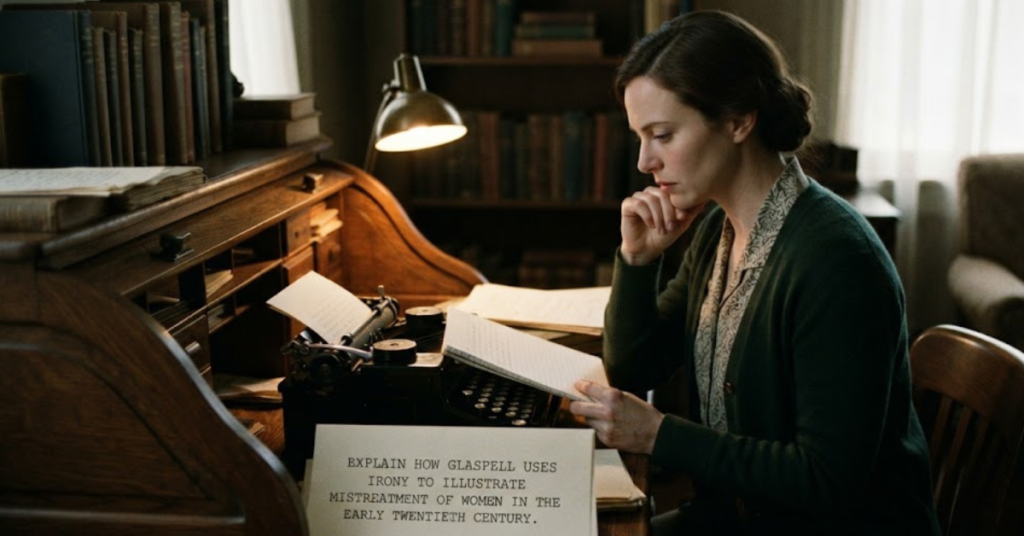

Sometimes the smallest details reveal the biggest truths. In Susan Glaspell’s one-act play Trifles, what appears insignificant to the male characters becomes the key to understanding a woman’s life and the crime at the center of the story. To explain how Glaspell uses irony to illustrate mistreatment of women in the early twentieth century, it is important to look at how the characters, setting, and dialogue expose the unequal treatment of women. Glaspell repeatedly shows that the men dismiss women’s experiences as unimportant, while the women quietly recognize details that the men completely overlook.
The irony is especially powerful because the people who believe they are conducting the investigation are unable to understand the evidence right in front of them.
What Is Trifles About?
Trifles was written by Susan Glaspell and first performed in 1916. The play centers on the investigation of John Wright’s murder and the suspicion surrounding his wife, Minnie Wright.
The county attorney, sheriff, and Mr. Hale examine the Wright farmhouse for evidence. Mrs. Hale and Mrs. Peters accompany them, but the men largely treat the women’s observations as irrelevant.
As the investigation continues, however, the women discover details that help explain Minnie’s unhappy marriage and what may have led to John’s death.
The central irony is simple but effective:
The men search for important evidence while dismissing the very things that reveal the truth.
How Glaspell Uses Irony in Trifles
Glaspell uses several forms of irony to expose the unequal position of women.
1. The Men Call Women’s Concerns “Trifles”
One of the clearest examples of irony appears in the title itself.
The men repeatedly dismiss women’s concerns about household matters as insignificant. The county attorney and sheriff are interested in the murder investigation, while Mrs. Hale and Mrs. Peters notice things such as the unfinished sewing, the broken birdcage, and the condition of Minnie’s kitchen.
The men assume these details have nothing to do with the crime.
Ironically, these supposedly meaningless “trifles” provide some of the most important clues in the entire play.
Glaspell uses this contrast to make a larger point: what society considers unimportant may actually be extremely important when viewed from a woman’s perspective.
2. The Men Look for Evidence in the Wrong Places
The male investigators search the farmhouse for obvious evidence of murder. They examine the kitchen but quickly become distracted by its disorder.
Their attitude reflects the gender expectations of the period. They associate women’s work with housekeeping and domestic responsibilities, but they do not consider that domestic spaces might contain meaningful evidence.
Mrs. Hale and Mrs. Peters see the situation differently because they understand the emotional significance of the household.
This creates situational irony: the people with official authority are less capable of understanding the evidence than the women they dismiss.
The Irony of the Kitchen
The kitchen is particularly important because it represents the domestic world in which Minnie Wright spent much of her life.
The men criticize the kitchen’s condition, suggesting that Minnie has failed in her responsibilities as a housekeeper. Yet they never seriously ask why the kitchen has been neglected.
Mrs. Hale understands that Minnie’s circumstances may explain the condition of the house.
This is ironic because the men judge Minnie according to the standards imposed on women while failing to consider the emotional circumstances that may have prevented her from maintaining those standards.
The kitchen therefore becomes more than a setting. It represents the restrictive domestic role expected of women.
The Bird as a Symbol of Minnie’s Life
One of the most important discoveries is the dead canary.
Mrs. Hale and Mrs. Peters find the bird hidden in a box. They realize that John Wright had likely killed it by wringing its neck.
The bird’s death mirrors the violence that Minnie experienced within her marriage.
Before marriage, Minnie Foster had been described as lively and cheerful. Mrs. Hale remembers her as a woman who enjoyed singing. After marrying John Wright, however, she became isolated and unhappy.
The canary can therefore be interpreted as a symbol of Minnie’s former identity.
Why the Bird Matters
The men never discover the bird because they do not understand the importance of the women’s observations.
That creates another layer of irony:
- The men search for physical evidence.
- The women discover emotional evidence.
- The men believe the women’s discoveries are insignificant.
- Those discoveries provide a possible explanation for the murder.
Glaspell uses this irony to show how women’s experiences can be overlooked when society refuses to take them seriously.
Gender Roles and Social Expectations
The play also uses irony to criticize traditional gender roles.
Women in the early twentieth century were often expected to focus on domestic responsibilities, including cooking, cleaning, sewing, and caring for the household.
The men in Trifles view these activities as ordinary and unimportant. Yet the entire investigation depends on understanding the domestic world that they dismiss.
This creates a striking contradiction.
The women are excluded from authority because their lives are considered less important, but their knowledge of that very domestic world allows them to understand the crime better than the men.
Glaspell turns society’s assumptions against itself.
Mrs. Hale and Mrs. Peters Understand Minnie
The Mrs. Hale and Mrs. Peters gradually develop sympathy for Minnie.
Mrs. Hale feels particularly guilty because she realizes she should have visited Minnie more often. She understands that Minnie was isolated and that her life had changed dramatically after marriage.
Mrs. Peters initially approaches the situation more cautiously because she is married to the sheriff and has a connection to the law.
However, as she learns more about Minnie’s life, she begins to understand her suffering.
Their response contrasts sharply with the men’s attitude.
The women do not simply see Minnie as a suspect. They see her as a person.
The Irony of Justice
Perhaps the most complicated irony in Trifles concerns justice itself.
The men believe that justice requires discovering evidence and proving Minnie’s guilt. The women, meanwhile, find evidence that could potentially help convict her—but they choose not to reveal it.
This creates an important moral question:
Is following the law always the same as achieving justice?
Glaspell does not give the audience an easy answer.
Instead, she forces readers to consider what happens when the legal system ignores the social conditions that contributed to a woman’s suffering.
How the Male Characters Represent Society
The male characters are not simply individual people who happen to misunderstand Minnie. They also represent broader social attitudes toward women.
The Sheriff
The sheriff represents official authority. His focus is on the practical investigation, but he does not recognize the significance of the women’s discoveries.
The County Attorney
The county attorney is particularly dismissive. His comments about the farmhouse and women’s concerns reveal how easily women’s domestic experiences can be treated as unimportant.
Mr. Hale
Mr. Hale provides information about the Wright household, but he also participates in the tendency to overlook Minnie’s perspective.
Together, these characters demonstrate how institutional authority can fail when it is based on assumptions rather than empathy.
Why the Title Trifles Is Ironic
The title is one of Glaspell’s most effective uses of irony.
A “trifle” is something considered small, insignificant, or unimportant.
The men believe they are dealing with serious matters while the women are concerned with insignificant household details.
But the audience gradually realizes that these “trifles” contain the emotional history of Minnie’s marriage.
The title therefore challenges the idea that domestic life is unimportant.
Glaspell suggests that when society dismisses women’s experiences as trivial, it may also be dismissing evidence of their suffering.
Irony and the Mistreatment of Women
Glaspell’s irony ultimately reveals several forms of mistreatment.
Women’s voices are dismissed
The men rarely take the women seriously as investigators or observers.
Domestic labor is undervalued
The work women perform inside the home is treated as ordinary and insignificant.
Emotional suffering is ignored
Minnie’s loneliness and unhappiness are not investigated with the same seriousness as the physical evidence surrounding the murder.
Women are judged by unequal standards
Minnie is criticized for the condition of her home without anyone seriously considering the circumstances that may have contributed to it.
Women lack institutional power
The men control the investigation, while the women have little official authority despite understanding Minnie better.
Why Glaspell’s Irony Is So Effective
Glaspell does not need long speeches explaining that women are oppressed. Instead, she lets the audience discover the contradiction for itself.
The men laugh at what they believe are insignificant details.
The women quietly examine those same details.
By the end, the audience understands that the “trifles” were never trivial at all.
That reversal makes the play’s message especially powerful. The audience sees the limitations of the male characters’ assumptions while watching the women become increasingly aware of Minnie’s experience.
Read also <<< Why Is the Information Lobbyists Provide to Lawmakers Significant?
Frequently Asked Questions
How does Glaspell use irony in Trifles?
Glaspell uses irony by having the male investigators dismiss women’s observations as insignificant while those same observations provide important clues about Minnie’s life and the murder.
What is ironic about the title Trifles?
The title is ironic because the men consider household details to be “trifles,” or insignificant matters. However, those details ultimately help reveal the circumstances surrounding the murder.
How does Trifles show the mistreatment of women?
The play shows women being dismissed, isolated, denied authority, and judged according to restrictive domestic expectations. Minnie’s suffering is also overlooked by the people investigating her husband’s death.
What does the dead bird symbolize in Trifles?
The dead bird can symbolize Minnie’s lost happiness, freedom, and identity. Its death also parallels the violence and emotional oppression she experienced in her marriage.
Why do Mrs. Hale and Mrs. Peters hide the evidence?
Their decision reflects their growing sympathy for Minnie and their understanding of the circumstances surrounding her life. It also raises questions about whether legal justice and moral justice are always the same.
What does the kitchen represent in Trifles?
The kitchen represents the domestic sphere traditionally assigned to women. It also becomes a place where the women’s knowledge allows them to understand aspects of Minnie’s life that the men overlook.
Conclusion
To explain how Glaspell uses irony to illustrate mistreatment of women in the early twentieth century, we have to look beyond the murder investigation itself. In Trifles, Glaspell repeatedly shows men dismissing women’s knowledge, domestic work, and emotional experiences as insignificant.
The irony is that these supposedly unimportant details become the most meaningful evidence in the play. The women understand Minnie because they recognize the realities of isolation, domestic expectations, and social judgment that the male investigators overlook.
Ultimately, Glaspell uses irony to challenge a society that treats women’s experiences as “trifles.” By turning those overlooked details into the heart of the story, she demonstrates how easily injustice can remain hidden when certain voices are not taken seriously.