

Have you ever wondered why certain diseases seem to run in a family? The answer often lies in our genes. To explain how hereditary diseases are passed from one generation to another, we need to understand how DNA, genes, and chromosomes carry biological information from parents to their children.
Hereditary diseases are conditions caused by changes, or variants, in genetic material that can be inherited from one or both parents. However, inheritance does not always work in the same way. Some genetic conditions require only one altered gene, while others require two copies. Some are linked to sex chromosomes, and others can appear because of new genetic changes rather than being inherited directly.
Understanding these patterns makes it easier to see why a condition may affect several members of a family while skipping others.
What Are Hereditary Diseases?
Hereditary diseases are genetic conditions that can be passed from parents to their children through inherited genetic variants.
Genes are sections of DNA that provide instructions for making proteins and regulating many processes in the body. Humans typically have 23 pairs of chromosomes, receiving one chromosome of each pair from their mother and the other from their father.
A harmful change in a particular gene can interfere with normal biological functions and contribute to disease.
Examples of inherited genetic conditions include:
- Cystic fibrosis
- Sickle cell disease
- Huntington’s disease
- Hemophilia
- Some forms of inherited muscular dystrophy
- Phenylketonuria (PKU)
Not every genetic disease is hereditary, though. Some genetic changes develop during a person’s lifetime and are not passed to their children.
How Are Hereditary Diseases Passed From Parents to Children?
The basic process begins with reproduction. A child receives genetic material from both biological parents.
In most cases, each parent contributes one copy of each gene. If one or both parents carry a disease-causing genetic variant, the child may inherit it.
The likelihood depends on the particular inheritance pattern.
For example, suppose a condition follows an autosomal recessive pattern. A child generally needs to inherit two disease-causing variants—one from each parent—to develop the condition.
This is why two parents who are healthy carriers can have a child with a genetic disorder.
Major Patterns of Genetic Inheritance
Different hereditary diseases follow different inheritance patterns. The most common ones include autosomal dominant, autosomal recessive, X-linked, and mitochondrial inheritance.
Autosomal Dominant Inheritance
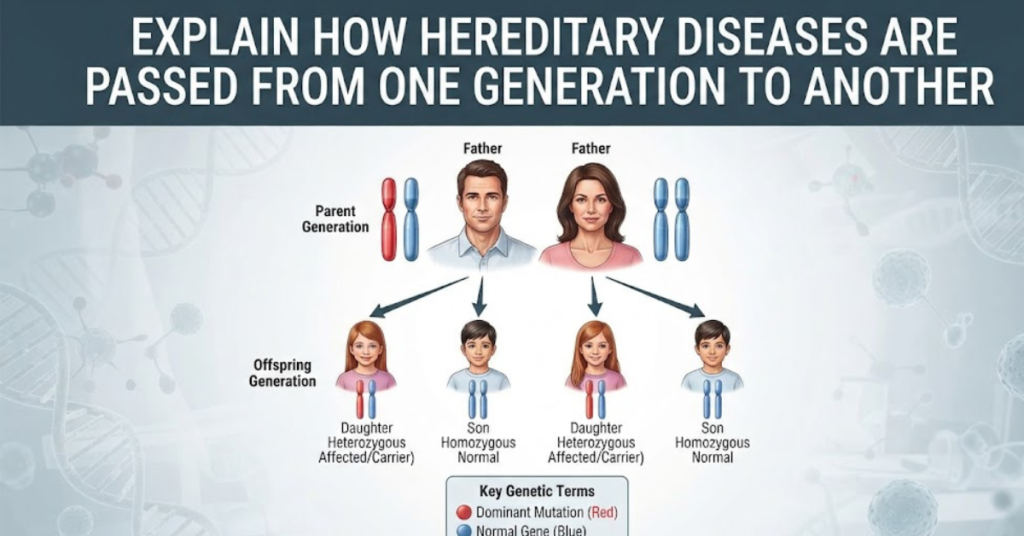
In autosomal dominant inheritance, a person usually needs only one altered copy of a gene to develop the associated condition.
If one parent has the condition and carries one altered copy while the other parent does not, each child may have a 50% chance of inheriting the altered gene.
Examples include:
- Huntington’s disease
- Marfan syndrome
- Familial hypercholesterolemia
The condition can often appear in successive generations, although the exact pattern can vary.
Autosomal Recessive Inheritance
Autosomal recessive conditions generally occur when a person inherits two disease-causing variants of the same gene.
A person with one altered copy is typically called a carrier. Carriers may have no symptoms but can pass the variant to their children.
When both parents are carriers, each pregnancy has:
- A 25% chance that the child will inherit two altered copies and be affected
- A 50% chance that the child will inherit one altered copy and be a carrier
- A 25% chance that the child will inherit neither altered copy
Cystic fibrosis and sickle cell disease are examples of conditions that can follow autosomal recessive inheritance.
X-Linked Inheritance
Some genetic conditions are caused by variants in genes located on the X chromosome.
Because males typically have one X chromosome and one Y chromosome, an X-linked variant can affect them differently from females, who typically have two X chromosomes.
Hemophilia A and some forms of Duchenne muscular dystrophy are examples of X-linked conditions.
The exact risk of inheritance depends on whether the mother or father carries the genetic variant and whether the variant is dominant or recessive.
Mitochondrial Inheritance
Mitochondria are structures inside cells that help produce energy. They contain their own small amount of DNA.
Mitochondrial DNA is generally inherited from the mother. Therefore, genetic conditions caused by mitochondrial DNA variants can follow a maternal inheritance pattern.
This means an affected mother may pass the mitochondrial variant to her children, while an affected father generally does not pass mitochondrial DNA to his children.
Why Do Some Hereditary Diseases Skip a Generation?
A hereditary disease may appear to “skip” a generation, but this does not necessarily mean the genetic variant disappeared.
This can happen with recessive conditions. For instance, a parent may carry a disease-causing variant without showing symptoms. If their child inherits the variant, the child may also be an unaffected carrier.
In some dominant conditions, reduced penetrance or other genetic factors can also make an inherited condition appear to skip generations.
So, family history alone does not always reveal the complete inheritance pattern.
Can Genetic Diseases Occur Without a Family History?
Yes. A person can develop a genetic condition even when nobody else in the family has been diagnosed with it.
One reason is a de novo variant, which is a genetic change that occurs for the first time in an individual rather than being inherited from a parent.
New genetic variants can arise in a reproductive cell or shortly after fertilization.
A condition can also go unnoticed in previous generations if relatives had mild symptoms, were never diagnosed, or carried a recessive variant without showing symptoms.
How Genes and Chromosomes Influence Inheritance
To understand hereditary disease transmission, it helps to picture genes as instructions stored within DNA.
DNA is organized into chromosomes, and chromosomes are passed from parents to children.
A simplified chain looks like this:
DNA → Genes → Chromosomes → Parents → Children
A disease-causing genetic variant can therefore be transmitted when a parent passes the relevant chromosome or genetic material to a child.
The child’s genetic makeup is a combination of material inherited from both biological parents.
What Happens When Both Parents Carry the Same Genetic Variant?
The outcome depends on the type of condition.
For a recessive disorder, two carrier parents can have an affected child because the child may inherit the altered gene from both parents.
This does not mean every child will be affected. Each pregnancy represents a new probability.
For example, if both parents are carriers of the same autosomal recessive condition, the commonly taught probability for each pregnancy is:
| Outcome | Probability |
| Child affected | 25% |
| Child is a carrier | 50% |
| Child inherits neither variant | 25% |
These percentages apply separately to each pregnancy; previous children’s outcomes do not change the basic probability for the next pregnancy.
Hereditary vs. Genetic Diseases
The terms genetic and hereditary are related but not identical.
A genetic disease results from a change in genetic material. A hereditary disease is a genetic condition that can be passed from parent to child.
That means:
- Genetic disease: May be inherited or may arise during a person’s lifetime.
- Hereditary disease: Passed through inherited genetic material.
- Acquired condition: Develops during life and is not necessarily caused by inherited genetic changes.
For example, many cancers involve genetic changes, but most cancers are not inherited directly from parents. Some inherited genetic variants can increase a person’s risk of particular cancers, but having such a variant does not always mean a person will develop cancer.
How Can Families Learn About Genetic Risk?
If a hereditary condition appears in a family, understanding the family medical history can be useful.
Important information may include:
- Which relatives have the condition
- The age at which symptoms appeared
- Whether the condition affected multiple generations
- Whether genetic testing has been performed
- Whether relatives experienced similar symptoms
A healthcare professional or genetic counselor can use this information to help determine whether genetic testing or additional evaluation may be appropriate.
Does Having a Genetic Variant Always Mean You Will Get the Disease?
Not necessarily.
Some genetic conditions have high penetrance, meaning most people with a particular disease-causing variant develop the associated condition. Other variants have reduced or incomplete penetrance, meaning not everyone who carries the variant develops symptoms.
Environmental factors, lifestyle, other genes, and chance can also influence how certain genetic conditions develop.
Therefore, inheriting a genetic variant and developing a disease are not always exactly the same thing.
Can Hereditary Diseases Be Prevented?
Not all hereditary diseases can be prevented because a person’s inherited genetic makeup is established before birth.
However, identifying genetic risks can sometimes help families make informed healthcare and reproductive decisions.
Depending on the condition, medical professionals may recommend:
- Genetic counseling
- Genetic testing
- Regular screening
- Preventive treatment
- Monitoring for early symptoms
- Reproductive planning
The appropriate approach depends heavily on the specific condition and the individual’s circumstances.
Frequently Asked Questions
How are hereditary diseases passed from one generation to another?
Hereditary diseases are passed through genetic material inherited from biological parents. A child may inherit a disease-causing genetic variant from one or both parents, depending on the condition’s inheritance pattern.
Can hereditary diseases skip generations?
Yes. Some hereditary conditions, particularly recessive disorders, can appear to skip generations because people can carry disease-causing variants without developing symptoms.
Can a child have a hereditary disease if neither parent has it?
Yes. This can happen because of a new genetic variant, an undiagnosed condition in a parent, or a recessive inheritance pattern in which both parents are healthy carriers.
What is the difference between genetic and hereditary diseases?
A genetic disease is caused by a change in DNA. A hereditary disease is a genetic condition that can be passed from parents to their children.
Are all hereditary diseases present at birth?
No. Some inherited genetic conditions cause symptoms during childhood, while others may not become apparent until adulthood.
Can hereditary diseases be passed through only the mother?
Not generally. Most genes are inherited from both parents. However, conditions involving mitochondrial DNA are typically passed through the mother because mitochondrial DNA is generally inherited maternally.
What are the main types of genetic inheritance?
The major inheritance patterns include autosomal dominant, autosomal recessive, X-linked, and mitochondrial inheritance. Other patterns and more complex forms of inheritance also exist.
Conclusion
To explain how hereditary diseases are passed from one generation to another, the key is to understand genes, DNA, chromosomes, and inheritance patterns. Parents pass genetic material to their children, and certain disease-causing variants can be inherited through dominant, recessive, X-linked, mitochondrial, or other mechanisms.
A hereditary condition can sometimes appear to skip generations, while other genetic diseases may occur because of a new variant rather than a change inherited from a parent.
If a particular genetic condition runs in your family, learning about its inheritance pattern and discussing the family history with a qualified healthcare professional or genetic counselor can provide a clearer picture of potential risks.