

How can a simple corn plant help explain one of the most important ideas in genetics? The answer lies in the way different traits are inherited. To explain how corn can be used as an example of Mendel’s law of independent assortment, we can examine two characteristics at the same time and observe how their alleles are passed from parents to offspring. Corn is particularly useful for genetics experiments because researchers can study visible traits such as seed color and seed shape and compare the results across many offspring.
Mendel’s law of independent assortment states that, during the formation of gametes, allele pairs for different genes generally separate independently of one another, provided the genes are not closely linked on the same chromosome.
What Is Mendel’s Law of Independent Assortment?
Gregor Mendel developed his laws of inheritance through experiments with pea plants. His law of independent assortment describes how alleles of different genes can be distributed independently into gametes during meiosis.
In simple terms, inheriting one trait does not normally determine which allele for another independently assorting trait will be inherited.
For example, imagine a corn plant with genes controlling:
- Seed color: Y = yellow, y = non-yellow
- Seed texture: S = smooth, s = wrinkled
A plant with genotype YySs has two alleles for each of these genes.
If the genes assort independently, the plant can produce four main types of gametes:
- YS
- Ys
- yS
- ys
Each type can occur at approximately equal frequencies under the simplified assumptions of the classic dihybrid model.
Why Corn Is Useful for Demonstrating Independent Assortment
Corn, or maize, is widely used in genetics because it has several characteristics that make inheritance patterns relatively easy to study.
Researchers can examine visible differences in traits such as:
- Seed color
- Seed texture
- Kernel characteristics
- Plant characteristics
Corn plants can also produce many kernels, giving researchers a relatively large number of offspring to examine. A larger sample can make expected inheritance patterns easier to recognize.
A Corn Dihybrid Cross Example
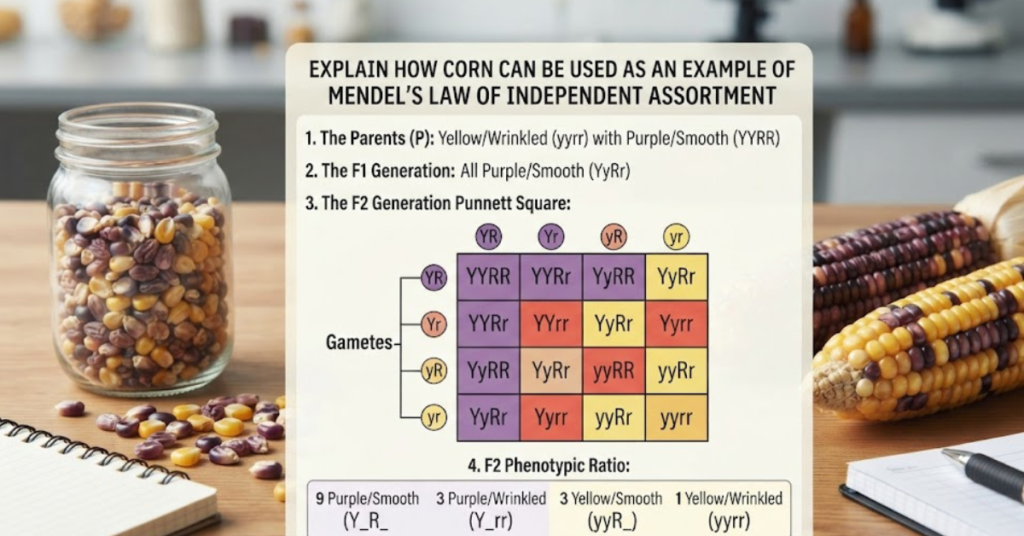
One of the clearest ways to demonstrate independent assortment is through a dihybrid cross, which examines two different traits simultaneously.
Suppose two corn plants are both heterozygous for seed color and seed texture:
YySs × YySs
Here:
- Y = yellow seed color
- y = alternative seed color
- S = smooth texture
- s = wrinkled texture
Each parent can produce four possible gametes:
YS, Ys, yS, ys
The Punnett Square
Combining these gametes produces a 4 × 4 Punnett square with 16 possible allele combinations.
The resulting phenotypes are expected to follow the classic 9:3:3:1 ratio when the traits are controlled by independently assorting genes with complete dominance and when the assumptions of the simple Mendelian model apply.
The expected distribution is:
| Phenotype | Expected proportion |
| Yellow, smooth | 9/16 |
| Yellow, wrinkled | 3/16 |
| Alternative color, smooth | 3/16 |
| Alternative color, wrinkled | 1/16 |
This ratio is not a guarantee for every small group of offspring. Instead, it represents an expected probability that becomes easier to observe as the number of offspring increases.
How the Corn Example Shows Independent Assortment
The important point is that the alleles for the two traits can combine in different ways.
For instance, a parent with genotype YySs does not have to pass Y and S together every time. It can produce:
- YS
- Ys
- yS
- ys
This variety of gametes demonstrates the basic idea behind independent assortment.
The allele inherited for seed color can be combined with different alleles for seed texture. As a result, offspring can receive new combinations of the parental alleles.
Understanding the 9:3:3:1 Ratio
The classic ratio is easier to understand if we break it into separate single-trait probabilities.
For seed color:
- 3/4 may show the dominant phenotype.
- 1/4 may show the recessive phenotype.
For seed texture:
- 3/4 may show the dominant phenotype.
- 1/4 may show the recessive phenotype.
Because the two genes are assumed to assort independently, their probabilities can be combined.
For example:
3/4 × 3/4 = 9/16
So approximately 9 out of 16 offspring are expected to show both dominant phenotypes.
Similarly:
3/4 × 1/4 = 3/16
This gives one dominant and one recessive phenotype.
Finally:
1/4 × 1/4 = 1/16
This represents offspring showing both recessive phenotypes.
What Independent Assortment Does Not Mean
It is important not to interpret Mendel’s law as saying that every pair of genes always behaves independently.
Genes located close together on the same chromosome can be linked and therefore may be inherited together more often than expected under independent assortment.
Independent assortment is most directly applicable to genes on different chromosomes or genes sufficiently far apart on the same chromosome that recombination makes them behave approximately independently.
Therefore, the 9:3:3:1 ratio is a useful classical model rather than a rule that every corn cross must exactly follow.
Why Large Numbers of Corn Kernels Matter
Suppose a genetic cross produces only 16 kernels. You would not necessarily expect to see exactly:
- 9 yellow, smooth
- 3 yellow, wrinkled
- 3 alternative color, smooth
- 1 alternative color, wrinkled
Genetics involves probability, so actual results can differ from expected ratios, particularly when the sample is small.
If thousands of kernels are examined under suitable experimental conditions, the observed proportions may move closer to the predicted probabilities.
This is one reason corn is valuable in genetics research: its large number of offspring provides more data for comparing observed and expected results.
Corn and Mendelian Genetics: Key Takeaways
The corn example can be summarized in a few steps:
- Choose two traits controlled by different genes.
- Identify the alleles responsible for each trait.
- Cross two plants heterozygous for both traits.
- Determine the possible gametes from each parent.
- Combine the gametes using a Punnett square.
- Group the offspring by phenotype.
- Compare the observed results with the expected probabilities.
If the genes assort independently and the other assumptions of the Mendelian model apply, the classic dihybrid cross predicts a 9:3:3:1 phenotypic ratio.
Read also <<< Beauty Pie Pure Oxygen Radiant Glow Moisture Infusion
FAQs About Corn and Independent Assortment
How does corn demonstrate Mendel’s law of independent assortment?
Corn can demonstrate independent assortment by examining the inheritance of two traits simultaneously. A dihybrid cross can show that alleles for different genes can form different combinations in gametes and offspring.
What is an example of independent assortment in corn?
A cross between corn plants heterozygous for two traits, such as YySs × YySs, can illustrate independent assortment. The possible gametes are YS, Ys, yS, and ys.
What ratio is expected in a Mendelian dihybrid cross?
Under the classic assumptions of a dihybrid cross, the expected phenotypic ratio is 9:3:3:1.
Why is corn used in genetics experiments?
Corn produces many offspring and has numerous observable traits, making it useful for studying inheritance patterns and comparing experimental results with genetic predictions.
Does independent assortment always occur in corn?
Not necessarily. Genes that are linked on the same chromosome may not assort independently. Independent assortment is most applicable when genes are on different chromosomes or are sufficiently separated that recombination makes their inheritance approximately independent.
What is a dihybrid cross?
A dihybrid cross examines the inheritance of two different traits at the same time. Mendel’s classic dihybrid experiments helped establish the principle of independent assortment.
Conclusion
To explain how corn can be used as an example of Mendel’s law of independent assortment, consider a dihybrid cross involving two traits. When the genes assort independently, a heterozygous corn plant can produce different combinations of alleles in its gametes, such as YS, Ys, yS, and ys.
When two such plants are crossed under the classic Mendelian assumptions, the offspring are expected to approach a 9:3:3:1 phenotypic ratio. The example shows how alleles for different genes can be distributed into gametes independently, creating new combinations of traits in the offspring.
Corn therefore provides a useful, practical way to connect Mendelian genetics, probability, meiosis, and inheritance patterns in a single example.