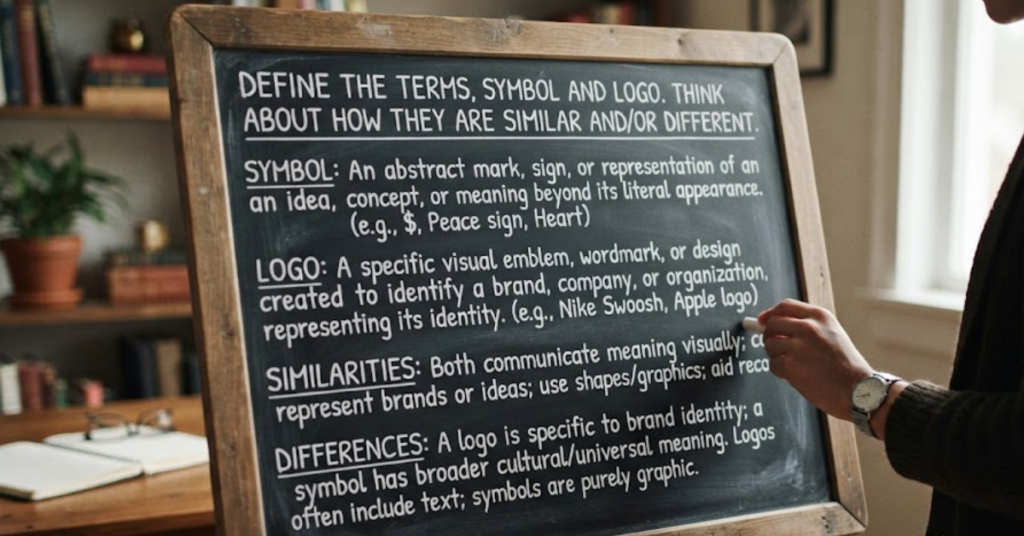

A simple image can sometimes communicate an idea faster than an entire paragraph. A heart can suggest love, a national emblem can represent a country, and a distinctive brand mark can instantly remind you of a company. This is why it is useful to define the terms, symbol and logo and understand how these forms of visual communication work.
Although symbols and logos can look similar, they are not exactly the same thing. A symbol is generally a visual representation of an idea, object, concept, or meaning, while a logo is a distinctive visual identifier used to represent a business, organization, product, or brand.
The two can overlap, though. In fact, a logo may contain a symbol, which is one reason these terms are sometimes used interchangeably.
Define the Terms Symbol and Logo
Before comparing them, it helps to establish a clear definition of each.
What Is a Symbol?
A symbol is a visual representation that stands for something beyond its literal appearance. It can communicate an idea, emotion, object, belief, organization, or concept.
Symbols are everywhere in everyday life.
Examples include:
- A heart symbol representing love
- The recycling symbol representing recycling
- A warning symbol indicating danger or caution
- A national emblem representing a country
- A dove commonly associated with peace
A symbol doesn’t necessarily belong to a particular company. Its meaning may be widely recognized across a culture or community.
What Is a Logo?
A logo is a distinctive visual mark used to identify a particular business, organization, product, service, or brand.
For example, companies may use logos to make their products and communications immediately recognizable.
A logo can consist of:
- A symbol or icon
- A wordmark
- A combination of words and imagery
- Stylized lettering
- An emblem
- A custom graphic
The primary purpose of a logo is identification.
When you see a familiar logo, you may immediately associate it with a particular company or brand.
Symbol vs Logo: What’s the Difference?
The easiest way to understand the distinction is to focus on purpose.
A symbol generally communicates a meaning or idea.
A logo generally communicates identity.
For example, a recycling symbol tells you something about the object or message associated with it. A company’s logo, on the other hand, tells you who created, owns, or represents the product or service.
| Feature | Symbol | Logo |
| Main purpose | Communicate meaning | Identify a brand or organization |
| Can represent an idea? | Yes | Sometimes |
| Usually brand-specific? | Not necessarily | Usually |
| Can contain words? | Sometimes | Often |
| Used in branding? | Sometimes | Yes |
| Meaning | Often broader | Usually connected to a specific identity |
Similarities Between Symbols and Logos
Although symbols and logos have different purposes, they share several important characteristics.
1. Both Communicate Visually
Neither requires a long written explanation to convey a message.
A well-designed visual can communicate information almost instantly.
2. Both Can Be Memorable
Simple shapes, colors, and visual patterns can be easier to remember than lengthy descriptions.
That’s valuable in advertising, signage, packaging, websites, and public communication.
3. Both Can Represent Something Else
A symbol represents an idea or concept, while a logo represents an organization, product, or brand.
In both cases, the visual stands for something beyond the image itself.
4. Both Can Develop Cultural Meaning
Over time, people may associate a particular visual with certain ideas, emotions, or experiences.
This association can become extremely strong.
How Logos Can Contain Symbols
One reason symbol vs logo can be confusing is that the two aren’t mutually exclusive.
A logo can include a symbol.
For example, a company might have:
Symbol + Company Name = Logo
The symbol can work independently in some situations, while the full logo may include both the graphic and the brand name.
This approach gives businesses flexibility. They can use the complete logo when introducing the brand and sometimes use the standalone symbol when the audience already recognizes it.
Types of Logos
Not every logo looks the same. Designers use several common approaches.
Wordmark Logos
A wordmark consists primarily of the company’s name written in a distinctive typeface.
The design focuses on:
- Typography
- Letter shapes
- Spacing
- Font style
- Color
This approach works particularly well when the brand name itself is important.
Lettermark Logos
A lettermark uses initials or abbreviated letters instead of spelling out the entire organization name.
This can be useful for businesses with long names.
Pictorial Logos
A pictorial logo uses a recognizable image or graphic as the main visual element.
Unlike a general symbol, the image is specifically associated with a particular brand.
Abstract Logos
Abstract logos use shapes, forms, or visual compositions that don’t necessarily depict a recognizable object.
Their meaning often comes from the brand identity and the associations built around the design.
Combination Marks
A combination mark brings together text and a graphic element.
For example:
Brand name + symbol
This is one of the most flexible approaches because the elements can sometimes be used together or separately.
Types of Symbols
Symbols can also take many forms.
Informational Symbols
These communicate information quickly.
Examples include:
- Emergency exit signs
- Restroom symbols
- Accessibility symbols
- Traffic signs
Cultural Symbols
These can represent ideas or traditions shared by a particular community or culture.
Mathematical Symbols
Mathematics uses symbols such as:
-
- −
- =
- %
These communicate concepts without requiring full sentences.
Religious or Historical Symbols
Certain symbols carry meanings associated with particular religious, historical, or cultural traditions.
Their interpretation can depend heavily on context.
Symbol vs Logo in Branding
In marketing, the distinction becomes particularly interesting.
A brand may develop a recognizable symbol that becomes strongly associated with the organization. Over time, people may recognize that symbol without seeing the company’s name.
This is one of the goals of effective visual branding.
However, a symbol used by a company doesn’t automatically mean that every symbol is a logo. The surrounding purpose and context matter.
A recycling icon printed on a company’s packaging remains a recycling symbol. A custom graphic created specifically to identify the company can function as part of its logo or broader brand identity.
Logo vs Symbol: A Simple Example
Imagine a fictional company called Green Valley Coffee.
It could have:
- A green leaf symbol
- The words “Green Valley Coffee”
- A specific typeface
- A particular color palette
If the company combines the leaf and its name into one visual identity, that entire design can function as a logo.
The leaf by itself is a symbol or graphic mark associated with the company.
The distinction depends partly on how the visual is designed, defined, and used.
Why Symbols and Logos Matter
Visual communication matters because people often process images quickly.
A strong visual identity can help an organization:
- Become recognizable
- Differentiate itself from competitors
- Create consistent communications
- Build associations with particular ideas
- Make products easier to identify
Symbols have a broader communication role, while logos are particularly important for brand recognition.
Common Mistakes When Comparing Symbols and Logos
Mistake 1: Assuming Every Symbol Is a Logo
Not every symbol represents a brand.
A traffic symbol, mathematical symbol, or recycling icon doesn’t necessarily identify a company.
Mistake 2: Assuming Logos Cannot Be Symbols
A logo can contain a symbol, and a brand’s symbol can sometimes become the most recognizable part of its visual identity.
Mistake 3: Treating the Terms as Perfect Synonyms
While people sometimes use the words interchangeably, their primary purposes are different.
Symbol = representation of meaning
Logo = identification of a brand or organization
Frequently Asked Questions
What is a symbol?
A symbol is a visual representation that stands for an idea, object, concept, emotion, or other meaning. Its interpretation depends on context and shared understanding.
What is a logo?
A logo is a distinctive visual identifier used to represent a business, organization, product, service, or brand.
What is the difference between a symbol and a logo?
A symbol generally communicates an idea or meaning, while a logo primarily identifies a specific brand, organization, or product.
Can a logo be a symbol?
Yes. A logo can contain a symbolic graphic, and some logos function primarily as symbols. However, not every symbol is a logo.
Are symbols and logos the same thing?
No. They overlap, but they serve different purposes. Symbols generally represent concepts or meanings, while logos are primarily designed for identification.
Why are symbols important in communication?
Symbols can communicate information quickly and across language barriers. They’re commonly used in signs, maps, instructions, public spaces, mathematics, and branding.
Why are logos important to businesses?
Logos help businesses establish a recognizable visual identity. A consistent logo can make a company, product, or service easier for customers to identify and remember.
Conclusion
To define the terms, symbol and logo, start with their primary purposes: a symbol represents an idea, concept, object, or meaning, while a logo identifies a particular brand, business, organization, or product. They can look similar and sometimes overlap, especially when a company uses a symbol as part of its logo.
The simplest distinction to remember is meaning versus identity. A symbol generally tells you what something represents, while a logo helps tell you who it represents. Once you understand that difference, it becomes much easier to recognize how symbols and logos work in branding, advertising, signage, and everyday visual communication.