
When something looks “just right,” there is usually more going on than meets the eye. To explain the difference between proportion and balance, it helps to understand that these two ideas are related, but they solve different visual problems.
Proportion is mainly about the relationship between sizes and dimensions. Balance, on the other hand, is about how visual weight is distributed within a composition. Understanding both concepts can make it easier to analyze art, design, architecture, photography, and even everyday objects.
What Is Proportion?
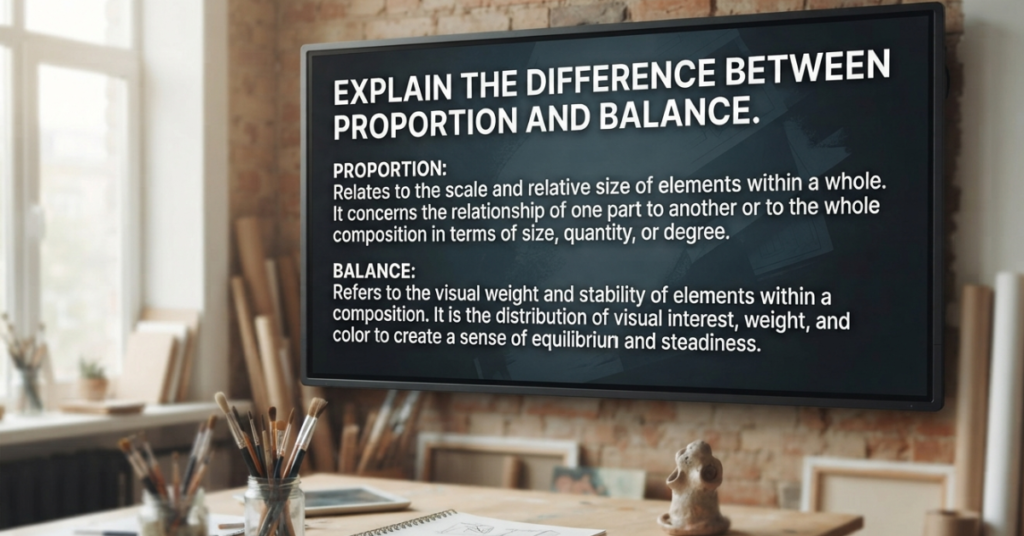
Proportion refers to the relationship between the size of one part and another part, or between individual parts and the whole.
For example, imagine a drawing of a person. If the head is much larger than the body, the figure may look unusual because the proportions are off. The individual parts do not have a convincing size relationship.
Proportion can involve:
- Height compared with width
- One object compared with another
- Parts compared with the entire composition
- Measurements within a structure
- The relationship between shapes, spaces, or forms
In simple terms, proportion asks, “How big is this compared with that?”
Examples of Proportion
Consider a dining table. The tabletop, legs, and chairs need to relate reasonably well in size. A table with extremely tiny legs may look unstable or awkward, even if it is technically functional.
The same principle appears in architecture. A doorway, window, room, and building façade can look harmonious when their dimensions relate appropriately.
What Is Balance?
Balance is the distribution of visual, physical, or conceptual weight within a composition.
In art and design, an object does not have to be physically heavy to have visual weight. A large dark shape, for instance, may attract more attention than a small, light-colored shape.
Balance asks a different question:
“Does the composition feel stable and evenly distributed?”
Balance can be created in several ways, including:
- Size
- Color
- Shape
- Texture
- Position
- Contrast
- Visual emphasis
A composition can therefore be balanced even when its elements are different sizes.
Proportion vs Balance: The Main Difference
The easiest way to remember the distinction is this:
Proportion is about relationships of size; balance is about the distribution of visual weight.
Here is a simple comparison:
| Proportion | Balance |
| Deals with size relationships | Deals with visual weight |
| Compares parts with other parts or the whole | Considers how elements are distributed |
| Helps things look appropriately sized | Helps a composition feel stable |
| Often involves measurements | Often involves visual perception |
| Common in drawing, architecture, and design | Common in art, photography, and graphic design |
These concepts often work together. A design can have excellent proportions but still feel unbalanced if too much visual weight is concentrated on one side.
How Proportion and Balance Work Together
Although proportion and balance are different, they are not completely separate.
Imagine a living room with a large sofa on one side and several small decorations on the opposite side. The furniture may have appropriate proportions individually, but the room could still feel visually heavy on one side.
A designer might solve the problem by adding a larger chair, artwork, lamp, or another substantial element to the opposite side. That changes the balance without necessarily changing the proportions of the original furniture.
This shows why designers consider both principles when creating a pleasing composition.
Types of Balance in Design
Symmetrical Balance
Symmetrical balance occurs when elements are distributed similarly on either side of a central axis.
For example, a building with matching windows on both sides of its entrance can create a strong sense of symmetry and stability.
Asymmetrical Balance
Asymmetrical balance uses different elements that still create an overall sense of equilibrium.
A large object on one side might be balanced by several smaller objects on the other. The two sides are not identical, but their visual weights can still feel comparable.
Radial Balance
Radial balance occurs when elements spread outward from a central point.
Common examples include:
- Flowers
- Circular patterns
- Wheels
- Mandalas
- Certain architectural designs
The repeated arrangement around the center creates a strong sense of organization.
Why Proportion Matters
Good proportion can make objects and compositions appear natural, coherent, and intentional.
In visual arts, proportion helps artists create believable figures and objects. In architecture and interior design, it helps ensure that rooms, furniture, doors, windows, and decorative elements relate appropriately to one another.
Proportion is also important because people naturally notice when something seems unusually large or small compared with its surroundings.
Why Balance Matters
Balance helps prevent a composition from feeling visually unstable or unintentionally heavy.
For example, if nearly all the important elements in a poster are crowded into the upper-right corner, the design may feel awkward. Moving or adding elements elsewhere can distribute attention more effectively.
Balance is especially important in:
- Graphic design
- Photography
- Painting
- Interior design
- Architecture
- Web design
- Fashion
- Product design
A Simple Everyday Example
Think about packing a suitcase.
Proportion concerns the size and relationship of the items. A huge coat takes up more space than a pair of socks.
Balance concerns how the weight is distributed. If you put all the heavy items on one side of the suitcase, it may become awkward to carry.
The same basic idea can be applied visually: proportion deals with relationships, while balance deals with distribution.
Common Mistakes When Comparing Proportion and Balance
One common mistake is treating the two terms as interchangeable. They overlap in practice, but they describe different characteristics.
Another mistake is assuming that balance always means symmetry. A design can be asymmetrical while remaining perfectly balanced.
It is also important to remember that good proportion does not automatically guarantee good balance. An arrangement can contain appropriately sized elements and still have too much visual emphasis in one area.
How to Identify Proportion and Balance
When looking at an artwork, photograph, room, or design, try these questions:
To Analyze Proportion
- How large is each element?
- How does one element compare with another?
- Do the parts relate naturally to the whole?
- Does anything look unusually large or small?
To Analyze Balance
- Where does your eye go first?
- Is one side visually heavier?
- Are colors or shapes concentrated in one area?
- Does the composition feel stable or uncomfortable?
- Could one element be moved or added to improve the distribution?
These questions make it much easier to tell which principle is affecting what you see.
Frequently Asked Questions
Is proportion the same as balance?
No. Proportion concerns the relationship between sizes or dimensions, while balance concerns the distribution of visual weight. They often work together but are not the same principle.
What is an example of proportion?
The relationship between the size of a person’s head and body is an example of proportion. In architecture, the relationship between a doorway and the surrounding wall is another example.
What is an example of balance?
A large dark shape on the left side of an artwork balanced by several smaller lighter shapes on the right is an example of balance.
Can something have good proportion but poor balance?
Yes. An object or composition can have appropriate size relationships while still concentrating too much visual weight in one area.
Does balance always mean symmetry?
No. Balance can be symmetrical, asymmetrical, or radial. Asymmetrical designs can still feel stable when their visual weights are distributed effectively.
Why are proportion and balance important in design?
They help designs feel organized, comfortable, and intentional. Proportion keeps sizes and relationships appropriate, while balance helps distribute attention and visual weight.
Conclusion
The easiest way to explain the difference between proportion and balance is to remember that proportion focuses on how sizes relate, while balance focuses on how visual weight is distributed. Proportion helps individual parts fit together appropriately, whereas balance helps the overall composition feel stable and harmonious.
Once you learn to look for both, analyzing art, architecture, photography, and design becomes much easier. If you’re studying visual design, it is also worth exploring related principles such as symmetry, contrast, emphasis, rhythm, and unity, because these ideas often work together to create an effective composition.