
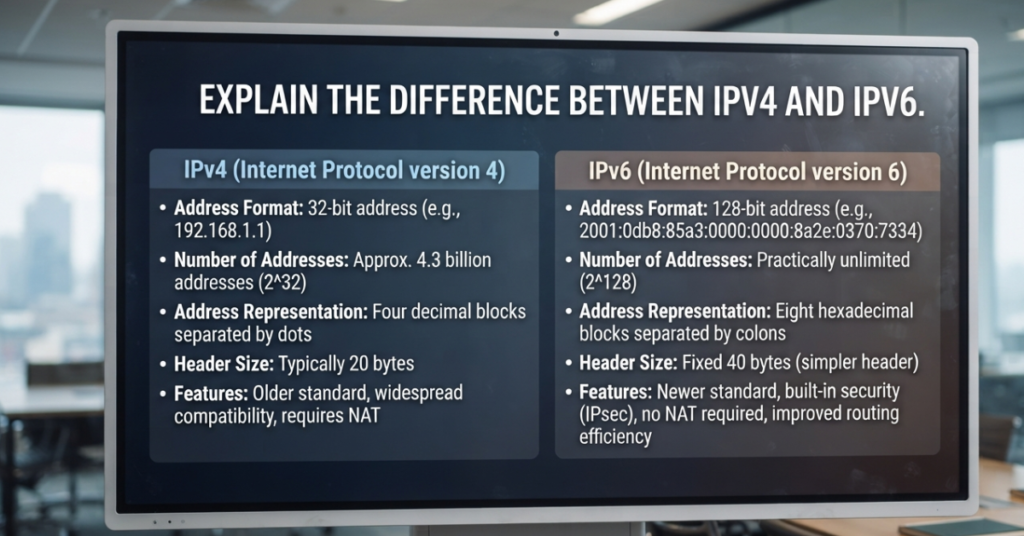

When you connect to Wi-Fi, open a website, or send a message online, your device needs an address so data knows where to go. That is where IPv4 and IPv6 come in. If you want to explain the difference between IPv4 and IPv6, the simplest way to think about it is this: both are Internet Protocol versions used to identify devices and route data, but IPv6 was developed to provide a much larger address space and modernize Internet networking.
The difference becomes clearer when you look at how each protocol works, how addresses are written, and why the Internet has been moving toward IPv6.
What Is IPv4?
IPv4, or Internet Protocol version 4, is the older and still widely used Internet Protocol. It was developed when the Internet was much smaller than it is today.
An IPv4 address contains 32 bits and is normally written as four numbers separated by periods.
For example:
192.168.1.10
Each section can range from 0 to 255.
Because 32 bits can produce about 4.3 billion unique addresses, IPv4 seemed enormous when it was introduced. However, the explosive growth of computers, smartphones, servers, connected appliances, and other devices eventually made that address space insufficient.
How IPv4 Addresses Work
An IPv4 address identifies a device or network interface and helps routers determine where Internet traffic should be delivered.
IPv4 also uses techniques such as Network Address Translation (NAT), which allows multiple devices on a private network to share a single public IPv4 address.
This has helped extend the useful life of IPv4, but it does not solve the underlying shortage of addresses.
What Is IPv6?
IPv6, or Internet Protocol version 6, was created primarily to address the limitations of IPv4, especially its limited number of available addresses.
IPv6 uses 128-bit addresses, creating an extraordinarily large address space—approximately 340 undecillion possible addresses.
An IPv6 address looks very different from an IPv4 address.
For example:
2001:0db8:85a3:0000:0000:8a2e:0370:7334
IPv6 addresses use hexadecimal numbers separated by colons rather than decimal numbers separated by periods.
Why Was IPv6 Created?
The biggest reason was straightforward: the world needed more IP addresses.
The growth of Internet-connected devices made the IPv4 address space increasingly difficult to manage. IPv6 provides such a massive address space that address availability is no longer the same fundamental limitation.
IPv6 also introduces improvements in areas such as address configuration, multicast handling, and network-layer functionality.
IPv4 vs IPv6: Main Differences
The easiest way to understand the difference between IPv4 and IPv6 is to compare their basic characteristics.
| Feature | IPv4 | IPv6 |
| Protocol version | Version 4 | Version 6 |
| Address size | 32 bits | 128 bits |
| Address format | Decimal | Hexadecimal |
| Example | 192.168.1.10 | 2001:db8::1 |
| Address capacity | About 4.3 billion | Approximately 340 undecillion |
| NAT | Commonly used | Generally less necessary |
| Address configuration | Manual or DHCP | Supports automatic configuration |
| Broadcast | Supported | No traditional broadcast |
| Header | More complex | Simplified base header |
| Deployment | Older and widespread | Newer and increasingly adopted |
The important point is that IPv6 isn’t simply IPv4 with longer addresses. It was designed as a newer version of the Internet Protocol with several architectural changes.
IPv4 vs IPv6 Address Format
One of the most obvious differences is how addresses are written.
IPv4 Address Format
IPv4 uses four decimal numbers:
192.168.0.1
Each number represents 8 bits, giving a total of 32 bits.
IPv6 Address Format
IPv6 uses eight groups of hexadecimal values:
2001:0db8:0000:0000:0000:ff00:0042:8329
Because writing a full IPv6 address can be cumbersome, IPv6 allows certain zeros to be shortened.
For example:
2001:0db8:0000:0000:0000:ff00:0042:8329
can be written as:
2001:db8::ff00:42:8329
This shorthand makes IPv6 addresses much easier to read.
Which Has More IP Addresses?
This is where IPv6 has a dramatic advantage.
IPv4 has 2³² possible addresses, or approximately 4.29 billion.
IPv6 has 2¹²⁸ possible addresses.
That is roughly:
340,282,366,920,938,463,463,374,607,431,768,211,456
possible addresses.
Obviously, not every address is assigned for general use. Still, the difference is enormous.
This huge address space allows IPv6 to support the continuing growth of connected devices without relying on the same degree of address-sharing techniques used with IPv4.
Is IPv6 Faster Than IPv4?
A common question is whether IPv6 is automatically faster.
Not necessarily.
IPv6 can provide networking efficiencies in certain environments, but simply using an IPv6 address does not guarantee a faster Internet connection.
Actual performance depends on factors such as:
- Your Internet service provider
- Network congestion
- Routing
- Server configuration
- Hardware
- DNS performance
- The particular website or service you’re accessing
In some situations IPv6 may perform better; in others, IPv4 may be comparable or faster. The protocol version itself shouldn’t be treated as a universal speed switch.
IPv4 vs IPv6 Security
Security is another area where comparisons can become misleading.
IPv6 was designed with modern networking requirements in mind and includes support for IPsec. However, that does not mean that every IPv6 network is automatically more secure than every IPv4 network.
Security depends heavily on how a network is configured and managed.
A secure network should still use appropriate:
- Firewalls
- Access controls
- Authentication
- Monitoring
- Encryption
- Software updates
- Security policies
It is better to think of IPv6 as providing a newer networking foundation rather than assuming that switching protocols automatically makes a network safe.
Does IPv6 Replace IPv4?
Eventually, IPv6 is intended to become the dominant Internet Protocol, but IPv4 has not simply disappeared.
For years, networks have used different approaches to support both protocols. One of the most common is dual-stack networking, where devices and networks support IPv4 and IPv6 simultaneously.
This allows organizations to transition gradually rather than replacing every IPv4 system at once.
Other technologies can also help IPv6 and IPv4 systems coexist during the transition.
Why Is IPv4 Still Used?
If IPv6 solves the address shortage, you might wonder why IPv4 hasn’t vanished.
There are several reasons.
1. Existing Infrastructure
Businesses and Internet providers have invested heavily in IPv4-compatible equipment and systems.
2. Compatibility
Many applications and networks were originally designed around IPv4.
3. Transition Takes Time
Replacing or upgrading networking infrastructure across the entire Internet is a massive undertaking.
4. NAT Extends IPv4
Network Address Translation allows many private devices to communicate through fewer public IPv4 addresses.
Because these technologies work reasonably well, organizations have had less incentive to abandon IPv4 immediately.
IPv4 and IPv6 Can Work Together
For most users, the transition isn’t something they need to manage personally.
Modern operating systems, routers, websites, and Internet providers can support IPv4 and IPv6 simultaneously.
With dual-stack networking, a device may receive both an IPv4 and an IPv6 address. Depending on the network and destination, it can use the appropriate protocol.
This gradual approach is one reason the transition to IPv6 can happen without requiring the entire Internet to change at the same moment.
Why IPv6 Matters for the Future of the Internet
The Internet continues to connect more things than ever before.
Think about:
- Smartphones
- Smart TVs
- Security cameras
- Cars
- Industrial equipment
- Home appliances
- Cloud infrastructure
- Sensors
- Wearable devices
Each connected device can create additional demand for network addresses.
IPv6 provides an address space large enough to accommodate enormous numbers of connected systems. That makes it an important part of the Internet’s long-term development.
A Simple Way to Remember IPv4 vs IPv6
If you’re trying to remember the difference, keep these three ideas in mind:
IPv4 = 32-bit addresses + decimal notation + limited address space
IPv6 = 128-bit addresses + hexadecimal notation + enormous address space
And the reason IPv6 exists is largely because the Internet outgrew the practical limits of IPv4 addressing.
Frequently Asked Questions
Is IPv6 better than IPv4?
IPv6 was designed to overcome important limitations of IPv4, particularly its limited address space. However, “better” depends on the network, equipment, applications, and configuration being considered.
What is the main difference between IPv4 and IPv6?
The biggest difference is the address size. IPv4 uses 32-bit addresses, while IPv6 uses 128-bit addresses, giving IPv6 a vastly larger address space.
Is IPv6 faster than IPv4?
Not automatically. Network performance depends on routing, infrastructure, congestion, configuration, and other factors. IPv6 can perform efficiently, but using IPv6 alone doesn’t guarantee higher speeds.
Can IPv4 and IPv6 work together?
Yes. Networks can use technologies such as dual-stack networking to support both IPv4 and IPv6 during the transition between protocols.
Why does IPv6 have so many addresses?
IPv6 uses 128-bit addresses instead of IPv4’s 32-bit addresses. This produces an enormously larger address space designed to accommodate the continued growth of Internet-connected devices.
Do I need IPv6 at home?
You generally don’t need to manually configure IPv6 if your Internet provider and home router already support it. Many modern networks can handle IPv6 automatically.
Conclusion
To explain the difference between IPv4 and IPv6, start with the most important distinction: IPv4 uses 32-bit addresses, while IPv6 uses 128-bit addresses. That enormous increase in address space is the main reason IPv6 was developed, although the newer protocol also introduces changes to address configuration, packet handling, and other aspects of Internet networking.
IPv4 remains important, but IPv6 provides the foundation needed for a world with billions of increasingly connected devices. Understanding IPv4 vs IPv6 gives you a much clearer picture of how devices find and communicate with one another across the Internet.