
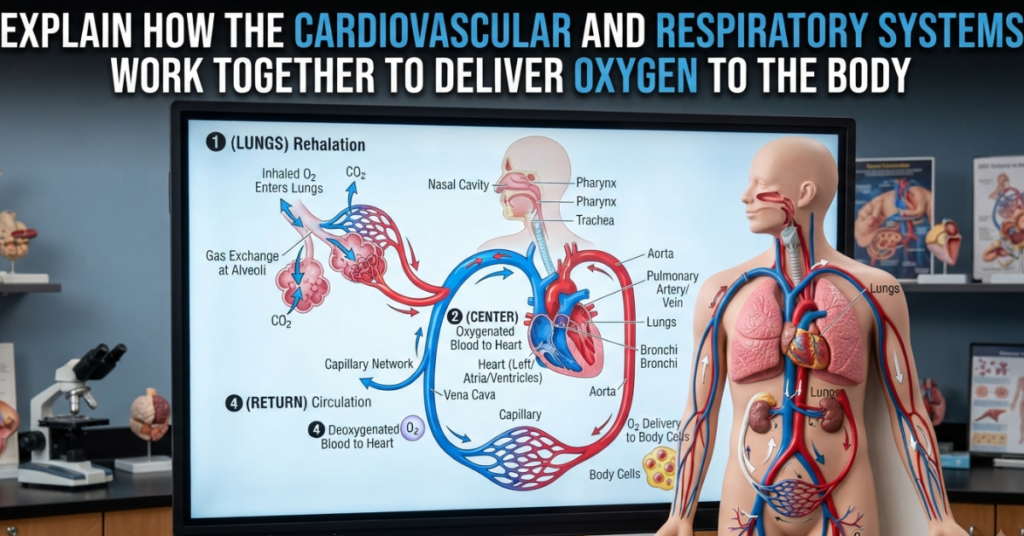

Every cell in your body needs oxygen to keep working, but oxygen doesn’t simply travel from your lungs to your toes on its own. Two major body systems have to work together to make that happen: the respiratory system brings oxygen into the body, while the cardiovascular system transports it where it is needed. Understanding how the cardiovascular and respiratory systems work together to deliver oxygen to the body is essentially about understanding a carefully coordinated transportation system. The lungs load oxygen into the blood, the heart pumps that oxygen-rich blood throughout the body, and the blood returns with carbon dioxide to be removed through the lungs.
What Do the Respiratory and Cardiovascular Systems Do?
Although these systems have different jobs, they depend heavily on each other.
The respiratory system
The respiratory system is responsible primarily for gas exchange. It brings oxygen into the body and removes carbon dioxide, a waste product produced by cells.
Key structures include:
- Nose and mouth
- Trachea
- Bronchi
- Bronchioles
- Lungs
- Alveoli
- Diaphragm
The cardiovascular system
The cardiovascular system acts as the body’s transportation network. It uses the heart, blood, and blood vessels to move oxygen, nutrients, hormones, and waste products around the body.
Its major components include:
- Heart
- Blood
- Arteries
- Veins
- Capillaries
The respiratory system gets oxygen into the bloodstream. The cardiovascular system then delivers that oxygen to tissues throughout the body.
How the Respiratory System Brings Oxygen Into the Body
The process begins when you breathe in.
Air enters through the nose or mouth and travels down the trachea. It then moves through the bronchi and smaller bronchioles before reaching tiny air sacs called alveoli.
The alveoli are especially important because they are where oxygen and carbon dioxide are exchanged between the air and the blood.
Why Are the Alveoli Important?
Your lungs contain millions of alveoli, creating a large surface area for gas exchange.
The walls of the alveoli are extremely thin and surrounded by tiny blood vessels called capillaries. This arrangement allows gases to move efficiently between the air inside the alveoli and the blood.
Oxygen moves from the alveoli into nearby blood, while carbon dioxide moves from the blood into the alveoli.
When you exhale, that carbon dioxide leaves the body.
How the Cardiovascular System Delivers Oxygen
Once oxygen enters the bloodstream, the cardiovascular system takes over much of the transportation job.
Oxygen attaches primarily to hemoglobin, a protein found inside red blood cells. Hemoglobin allows the blood to carry much more oxygen than it could transport dissolved directly in the blood plasma.
The oxygen-rich blood then travels from the lungs toward the heart.
The Heart as an Oxygen Delivery Pump
The heart has four chambers that work together to move blood through two major circuits.
The sequence looks like this:
- Oxygen-poor blood returns from the body to the right side of the heart.
- The right side pumps this blood to the lungs.
- In the lungs, the blood releases carbon dioxide and picks up oxygen.
- Oxygen-rich blood returns to the left side of the heart.
- The left side pumps the oxygen-rich blood into the body’s arteries.
- Blood travels through smaller vessels until oxygen reaches body tissues.
This continuous circulation allows oxygen to reach cells throughout the body.
How Oxygen Reaches Body Cells
After leaving the heart, oxygen-rich blood travels through arteries.
The arteries branch into smaller vessels called arterioles, which eventually connect to microscopic capillaries. These capillaries are where oxygen moves from the blood into surrounding tissues.
At the same time, cells release carbon dioxide into the blood.
So the exchange works in both directions:
Blood → oxygen → body cells
Body cells → carbon dioxide → blood
The blood then carries carbon dioxide back toward the heart and lungs.
How Carbon Dioxide Returns to the Lungs
The cardiovascular and respiratory systems don’t just deliver oxygen. They also work together to remove carbon dioxide.
After tissues use oxygen for cellular processes, carbon dioxide is produced as a waste product. The blood carries this carbon dioxide away from the tissues.
Oxygen-poor blood returns through veins and enters the right side of the heart. The heart then pumps it toward the lungs.
At the lungs, carbon dioxide moves from the blood into the alveoli and is eventually expelled when you breathe out.
This creates a continuous cycle:
Inhale → oxygen enters lungs → oxygen enters blood → heart pumps blood → cells receive oxygen → carbon dioxide enters blood → blood returns to lungs → carbon dioxide is exhaled.
The Role of the Diaphragm in Oxygen Delivery
The diaphragm may not directly transport oxygen, but it plays an essential role in getting air into and out of the lungs.
When you inhale, the diaphragm contracts and moves downward. This increases the space inside the chest and helps draw air into the lungs.
When you exhale, the diaphragm relaxes, allowing the lungs to move toward their resting position and helping push air outward.
Without effective breathing, the lungs cannot continuously replenish the oxygen supply needed by the bloodstream.
Why the Heart and Lungs Must Work Together
Think of the respiratory system as the loading station and the cardiovascular system as the delivery network.
The lungs load oxygen onto the blood. The heart and blood vessels then transport it to the tissues.
If one system cannot perform its job properly, the other system can be affected.
For example:
- Poor lung function can reduce the amount of oxygen entering the blood.
- Problems with circulation can limit oxygen delivery to tissues.
- A weakened heart may have difficulty pumping enough blood.
- Narrowed or blocked blood vessels can restrict blood flow.
- Problems affecting red blood cells or hemoglobin can reduce oxygen-carrying capacity.
That’s why oxygen delivery isn’t controlled by one organ alone. It depends on the coordinated function of the lungs, heart, blood, and blood vessels.
What Happens During Exercise?
The cooperation between these systems becomes particularly obvious during physical activity.
When you exercise, your muscles need more energy and therefore require more oxygen. They also produce more carbon dioxide.
Your body responds by increasing both breathing and circulation.
During exercise:
- Breathing becomes faster and often deeper.
- More oxygen enters the lungs.
- The heart beats faster to circulate blood more quickly.
- Blood flow increases to working muscles.
- More oxygen is delivered to active tissues.
- Additional carbon dioxide is transported back to the lungs.
- Breathing helps remove the increased carbon dioxide.
This coordinated response helps muscles meet their increased energy demands.
Oxygen Delivery in One Simple Example
Imagine you’re running up a flight of stairs.
Your leg muscles suddenly need more oxygen. Your brain signals your breathing to increase, allowing more oxygen to enter the lungs.
At the same time, your heart rate rises. Oxygen-rich blood leaves the heart and travels through arteries toward your working leg muscles.
At the capillaries, oxygen leaves the blood and enters the muscle cells. The blood picks up carbon dioxide and carries it back toward the lungs, where you eventually breathe it out.
In just a few seconds, the respiratory and cardiovascular systems are working together to respond to the increased demand.
Frequently Asked Questions
How do the cardiovascular and respiratory systems work together?
The respiratory system brings oxygen into the lungs and removes carbon dioxide. The cardiovascular system transports oxygen-rich blood from the lungs to body tissues and carries carbon dioxide-rich blood back to the lungs for removal.
What is the role of the lungs in oxygen delivery?
The lungs allow oxygen from inhaled air to move into the bloodstream through gas exchange in the alveoli. They also remove carbon dioxide from the blood.
What is the role of the heart in oxygen transport?
The heart pumps oxygen-rich blood from the lungs to the rest of the body and sends oxygen-poor blood back toward the lungs.
Where does oxygen enter the blood?
Oxygen enters the blood primarily at the alveoli in the lungs. It then binds mainly to hemoglobin inside red blood cells.
How does blood carry oxygen?
Most oxygen is transported by binding to hemoglobin in red blood cells. This allows blood to carry oxygen efficiently from the lungs to body tissues.
Why does breathing increase during exercise?
Working muscles require more oxygen and produce more carbon dioxide. Breathing increases to bring in additional oxygen and help remove the extra carbon dioxide.
Why is circulation important for oxygen delivery?
Even if the lungs bring oxygen into the bloodstream, that oxygen must be transported to tissues. The heart and blood vessels provide the circulation needed to distribute oxygen throughout the body.
Conclusion
The best way to explain how the cardiovascular and respiratory systems work together to deliver oxygen to the body is to think of them as two parts of the same transportation system. The respiratory system brings oxygen into the lungs and removes carbon dioxide, while the cardiovascular system uses blood circulation to transport oxygen to cells and return carbon dioxide to the lungs.
The heart, lungs, blood, and blood vessels all have distinct roles, but none works in isolation. Together, they maintain the steady supply of oxygen that cells need to produce energy and keep the body functioning.