
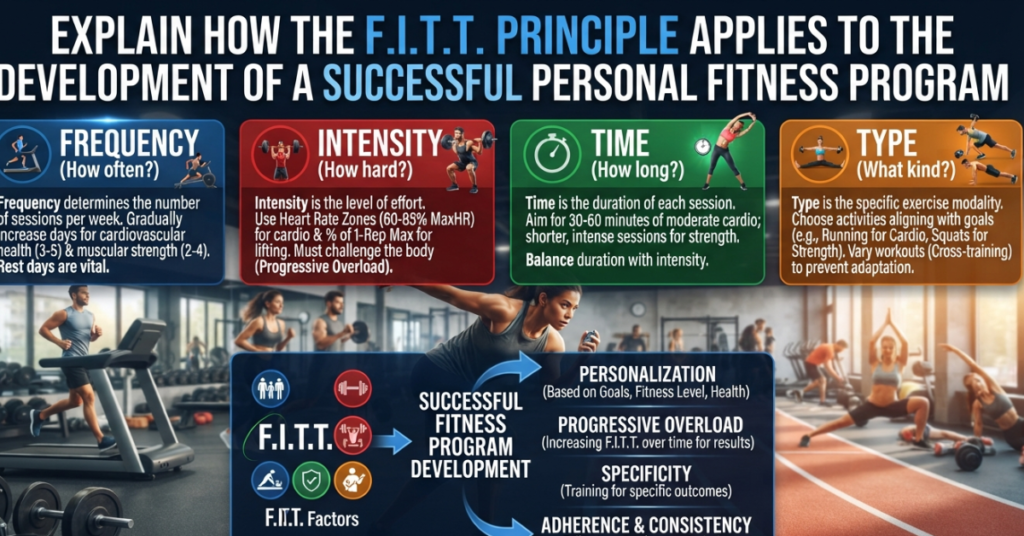

A good fitness program is not simply about exercising harder. It is about knowing what to do, how often to do it, and how to gradually improve. To explain how the FITT principle applies to the development of a successful personal fitness program, it helps to understand its four basic components: Frequency, Intensity, Time, and Type.
Together, these elements provide a simple framework for organizing exercise around an individual’s goals, fitness level, schedule, and preferences.
What Does FITT Stand For?
FITT is an acronym for four important exercise-programming variables:
- Frequency: How often you exercise
- Intensity: How hard you exercise
- Time: How long each exercise session lasts
- Type: What kind of exercise you perform
Changing these variables allows a person to create a program that is challenging enough to produce progress without making every workout unnecessarily difficult.
How Frequency Applies to a Fitness Program
Frequency refers to how often you perform physical activity. The ideal frequency depends on your goals and the type of exercise you are doing.
For example, someone trying to improve cardiovascular fitness might include aerobic activity several days per week, while strength training may be scheduled on separate days to allow specific muscle groups to recover.
A balanced program should also include rest or recovery periods. More exercise is not automatically better if the body does not have enough time to adapt.
How Intensity Affects Exercise
Intensity describes how hard your body is working during an activity. It can vary considerably depending on the exercise and your current fitness level.
For cardiovascular exercise, intensity can be monitored through factors such as:
- Heart rate
- Breathing rate
- Perceived exertion
- The ability to speak comfortably while exercising
For resistance training, intensity can be adjusted through variables such as resistance, repetitions, sets, and exercise difficulty.
A beginner generally benefits from starting at an appropriate intensity and gradually increasing the challenge as fitness improves.
How Time Fits Into a Fitness Plan
Time refers to the duration of an exercise session or, depending on the context, the amount of time spent performing a particular activity.
For example, a person might begin with shorter workouts and gradually increase their exercise duration as their endurance develops.
Time does not have to mean spending hours at the gym. A well-planned workout can be effective even when it fits into a busy schedule.
How Type Determines the Right Exercise
Type refers to the kind of physical activity you choose. A successful fitness program usually includes activities that match your goals.
Common types include:
- Aerobic exercise: Walking, running, cycling, or swimming
- Strength training: Free weights, resistance machines, or bodyweight exercises
- Flexibility training: Stretching and mobility exercises
- Balance training: Activities that improve stability and coordination
Choosing exercises you enjoy can also make it easier to remain consistent over time.
How to Use the FITT Principle to Build a Personal Program
The four FITT components work together rather than functioning as isolated rules. You can use them to turn a general fitness goal into a practical exercise routine.
1. Identify Your Goal
Start by deciding what you want to accomplish.
Your goal might be to:
- Improve cardiovascular endurance
- Build muscular strength
- Increase flexibility
- Improve general fitness
- Support healthy weight management
- Develop sport-specific fitness
A clear goal makes it easier to determine which FITT variables deserve the most attention.
2. Choose an Appropriate Frequency
Decide how many days per week you can realistically exercise. Your schedule should be sustainable rather than overly ambitious.
Consistency is important. A program that you can follow regularly is generally more useful than an intense plan that you abandon after a few weeks.
3. Set the Right Intensity
Choose an exercise intensity appropriate for your current fitness level. Beginners should generally avoid jumping immediately into extremely demanding workouts.
As your fitness improves, intensity can be increased gradually to provide an appropriate training stimulus.
4. Determine the Time
Decide how long each workout should last. Consider your fitness level, goals, schedule, and the type of exercise you are performing.
If time is limited, shorter sessions can still contribute to an active lifestyle. The important thing is to make physical activity a regular part of your routine.
5. Select the Type of Exercise
Choose activities that directly support your goal. Someone focused on cardiovascular endurance will need different exercises from someone primarily interested in increasing muscular strength.
Including different forms of exercise can also help create a more well-rounded fitness program.
Why the FITT Principle Is Effective
The FITT principle provides structure without forcing everyone into the same workout routine. Two people can have completely different fitness programs while using the same framework.
It also makes it easier to adjust a program as fitness changes. If progress slows, you can examine frequency, intensity, time, or type and determine whether an appropriate adjustment is needed.
FITT and Progressive Overload
The FITT principle also connects closely with progressive overload, the idea of gradually increasing training demands so the body continues to adapt.
For example, a person might progress by:
- Exercising slightly more frequently
- Increasing workout intensity
- Gradually extending exercise duration
- Choosing a more challenging form of an activity
Changes should be gradual and appropriate to the person’s ability and recovery.
Example of a FITT Fitness Program
Consider someone whose goal is to improve cardiovascular fitness.
| FITT Element | Example |
| Frequency | 3–5 exercise sessions per week |
| Intensity | Moderate effort, adjusted to fitness level |
| Time | Approximately 20–40 minutes per session |
| Type | Brisk walking, cycling, swimming, or similar aerobic activity |
This is only an example. A person’s actual program should account for their health, fitness level, goals, available time, and any professional guidance they have received.
Common Mistakes When Using FITT
The FITT principle is straightforward, but a few common mistakes can make a fitness program less effective.
Increasing Everything at Once
You do not necessarily need to increase frequency, intensity, time, and exercise difficulty simultaneously. Changing too many variables at once can make recovery difficult.
Ignoring Recovery
Rest is part of a successful training plan. Recovery gives the body an opportunity to adapt to exercise.
Choosing Exercise That Does Not Match the Goal
If your goal is to improve strength, simply adding more low-intensity cardio may not provide the specific training stimulus you need.
Making the Plan Unrealistic
A theoretically perfect program is not useful if it does not fit your lifestyle. A sustainable routine is much easier to maintain.
Frequently Asked Questions
What does FITT stand for in fitness?
FITT stands for Frequency, Intensity, Time, and Type. These four factors help organize and adjust an exercise program.
How does the FITT principle help create a fitness program?
It provides a framework for deciding how often to exercise, how hard to work, how long to exercise, and which activities to perform.
Can beginners use the FITT principle?
Yes. The principle can be adapted to different fitness levels. Beginners can start with manageable amounts of exercise and gradually progress.
How does FITT help improve fitness?
By adjusting the four FITT components appropriately, a person can create enough training stimulus to improve fitness while allowing adequate recovery.
Should all four FITT components be increased at the same time?
No. Progress can often be achieved by gradually changing one or more variables while maintaining a manageable overall workload.
Conclusion
To explain how the FITT principle applies to the development of a successful personal fitness program, think of it as a practical planning tool. Frequency, Intensity, Time, and Type help you match your workouts to your goals while making it easier to monitor progress and adjust your routine.
The best fitness program is not necessarily the hardest one. It is one that is appropriate, balanced, progressive, and realistic enough to maintain consistently.