
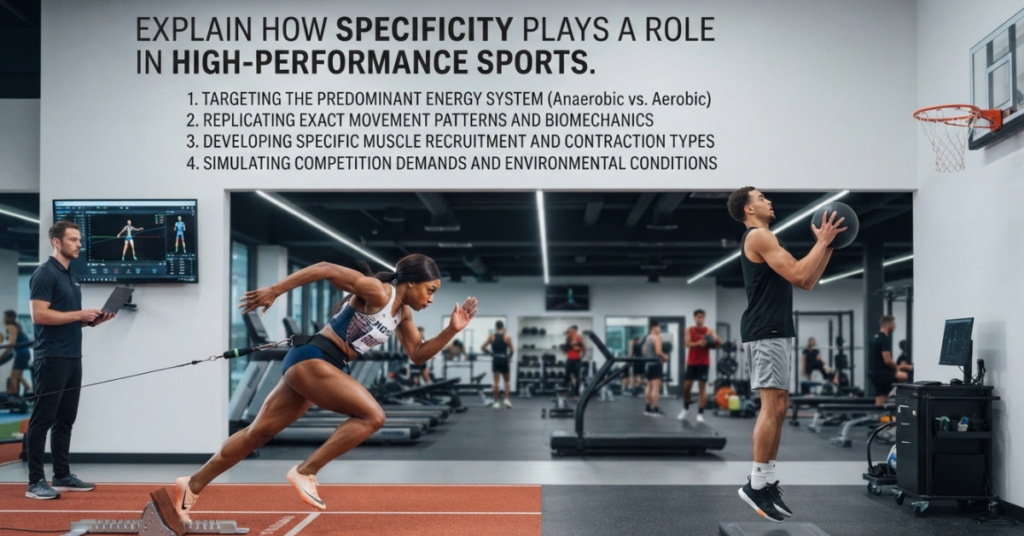

A great athlete does not become great by simply working hard at everything. They improve by spending time on the right type of training for the demands of their sport. This is where specificity becomes especially important. To explain how specificity plays a role in high-performance sports, think of the principle this way: athletes should train in ways that closely reflect what they need to do during competition. A sprinter needs explosive speed, a marathon runner needs endurance, and a basketball player needs a combination of speed, jumping, agility, strength, and sport-specific skills.
Specificity helps coaches turn general fitness into performance that actually transfers to competition.
What Is Specificity in Sports Training?
Specificity is the training principle that adaptations tend to reflect the particular demands placed on the body.
In simple terms, your body becomes better at what you repeatedly ask it to do.
For example, if an athlete repeatedly performs short, explosive sprints, the body develops adaptations that support high-intensity speed and power. If another athlete spends most of their training running for long periods, their adaptations will be more closely related to endurance.
Specificity can apply to several aspects of performance, including:
- Movement patterns
- Muscle actions
- Speed
- Strength
- Power
- Energy systems
- Skill execution
- Coordination
- Decision-making
- Competition demands
Why Is Specificity Important in High-Performance Sports?
At recreational levels, general fitness can provide major benefits. At elite levels, however, small differences can determine whether an athlete wins, loses, qualifies, or misses the final.
Specific training helps athletes develop abilities that are directly relevant to their sport.
For example, a professional tennis player may need to repeatedly accelerate, stop, change direction, rotate the torso, and hit a ball accurately under pressure. Simply becoming stronger in the gym won’t automatically produce those skills.
The training needs to connect strength and conditioning with the actual demands of tennis.
Specificity and Sport-Specific Movements
One of the clearest examples of specificity is movement.
Athletes don’t compete in generic exercises. They compete using particular movements.
A volleyball player jumps, lands, reaches, and reacts to an opponent. A swimmer repeatedly produces coordinated movements against water resistance. A soccer player accelerates, decelerates, changes direction, kicks, and responds to changing situations.
Training movements that resemble competition can help develop the physical and technical qualities needed for those actions.
However, this does not mean every training exercise must look exactly like the sport.
A well-designed program usually combines:
- General physical preparation
- Strength and conditioning
- Technical skill development
- Sport-specific practice
- Competition-specific preparation
The goal is appropriate transfer rather than simply copying the sport.
Specificity and Energy Systems
Different sports place different demands on the body’s energy systems.
For example:
- Sprinters rely heavily on short-duration, high-intensity energy production.
- Distance runners require substantial aerobic endurance.
- Soccer players repeatedly alternate between lower-intensity activity and short bursts of intense effort.
- Weightlifters need extremely high levels of strength and power over brief efforts.
Training should reflect these demands.
An endurance athlete who only performs short, maximal efforts may develop qualities that are useful but insufficient for their event. Likewise, a power athlete may not benefit from making long-distance endurance work the centerpiece of every training session.
The closer the training stimulus is to the relevant competitive demand, the more useful the resulting adaptation can be.
Specificity and Strength Training
Strength training is another area where specificity matters.
A stronger athlete is not automatically a better athlete. Strength is only one component of performance.
Consider a baseball player. General strength may help provide a foundation, but throwing a baseball requires coordination, timing, rotational movement, and highly specific technical skill.
A useful strength program may therefore develop:
- General force production
- Lower- and upper-body strength
- Rotational strength
- Power
- Stability
- Movement control
These qualities can then be integrated with sport-specific practice.
Specificity and Speed
Speed training provides another excellent example.
If an athlete needs to sprint 30 meters during competition, training should eventually include acceleration and sprinting that resemble the demands of that event.
Important variables can include:
- Sprint distance
- Acceleration requirements
- Maximum velocity
- Recovery periods
- Starting position
- Movement direction
- Competition timing
A 100-meter sprinter and a soccer player may both be “fast,” but their speed requirements aren’t identical.
That is why specificity matters.
Specificity and Skill Development
Physical conditioning is only part of high-performance sport.
Athletes also need technical and tactical skills.
A basketball player doesn’t simply need the physical ability to jump. They need to jump at the right moment, often while reacting to an opponent and maintaining control of the ball.
This means specificity can involve:
- Technique
- Timing
- Coordination
- Perception
- Decision-making
- Tactical awareness
As competition approaches, training often becomes increasingly focused on reproducing the technical and tactical demands athletes will face.
Specificity Should Increase as Competition Approaches
Training doesn’t need to be maximally specific all year.
In many training programs, athletes begin with broader physical preparation before gradually shifting toward competition-specific work.
A simplified progression might look like this:
Early Training Phase
The emphasis may be on developing broad qualities such as:
- General strength
- Aerobic fitness
- Mobility
- Movement quality
- Basic conditioning
Later Training Phase
Training can become more specific by emphasizing:
- Sport-specific intensity
- Competition movements
- Event-specific conditioning
- Technical execution
- Tactical situations
Competition Phase
Training is often focused on maintaining physical qualities while maximizing readiness and performance.
This progression allows athletes to build a broad foundation before concentrating on the exact demands of competition.
Specificity Does Not Mean Doing Only Sport-Specific Exercises
This is an important distinction.
It would be a mistake to assume that athletes should spend every training session copying their sport.
General training has an important role because athletes need foundational qualities such as strength, mobility, coordination, and conditioning.
For example, a basketball player can benefit from squats even though they never perform a squat during a game.
The squat can help develop physical qualities that contribute to jumping, acceleration, and force production.
The exercise itself doesn’t need to look identical to the sport for the adaptation to be useful.
The Principle of Specificity and Training Adaptation
Specificity is closely connected to training adaptation.
When the body repeatedly encounters a particular training stimulus, it adapts to handle that stimulus more effectively.
This is why training needs to be aligned with the athlete’s goals.
If the goal is to improve:
- Maximum strength → training should emphasize high-force production.
- Endurance → training should develop the ability to sustain activity.
- Power → training should emphasize rapid force production.
- Sprint speed → training should address acceleration and high-speed running.
- Sport-specific skill → practice should closely reflect the technical demands of competition.
The desired adaptation should guide the training stimulus.
Examples of Specificity in Different Sports
Swimming
A swimmer needs to train the muscles, coordination, breathing patterns, and energy demands associated with swimming.
Pool-based practice therefore plays a central role, while strength training can complement it.
Cycling
A cyclist needs sustained power production and endurance while maintaining an efficient pedaling pattern.
Training can therefore emphasize cycling-specific endurance, power, and pacing.
Soccer
Soccer requires repeated accelerations, decelerations, changes of direction, technical skills, and decision-making.
Training should therefore combine conditioning with technical and tactical situations.
Weightlifting
Competitive weightlifters need extremely high levels of strength and power in specific lifts.
Their training is consequently highly specific to the competition movements, while accessory exercises help address supporting physical qualities.
Benefits of Specificity in High-Performance Sports
When used appropriately, specificity can help athletes:
- Improve sport-specific performance
- Develop relevant physical adaptations
- Transfer training gains to competition
- Prepare for competition demands
- Use training time more efficiently
- Refine technical skills
- Improve sport-specific conditioning
For elite athletes with limited time and high training demands, efficient transfer is particularly valuable. Explain how specificity plays a role in high-performance sports.
The Limits of Specificity
Specificity is powerful, but it isn’t the only training principle that matters.
Athletes also need to consider:
- Progressive overload
- Recovery
- Individual differences
- Training volume
- Training intensity
- Periodization
- Injury prevention
- Skill development
- Competition schedules
Too much specificity can also become a problem.
Repeating the exact same movement or stimulus constantly can increase fatigue and potentially contribute to overuse problems. Explain how specificity plays a role in high-performance sports. A balanced program uses specific training alongside complementary exercises and appropriate recovery.
Frequently Asked Questions
What does specificity mean in sports?
Specificity means training should address the physical, technical, tactical, and energy-system demands that are relevant to an athlete’s sport or event.
Why is specificity important for athletes?
Specificity helps ensure that training adaptations transfer effectively to competition. Athletes become better prepared for the movements, intensities, skills, and demands they actually encounter.
Does specificity mean athletes should only practice their sport?
No. High-performance programs generally combine sport-specific training with general strength, conditioning, mobility, recovery, and other supporting work.
When should training become more specific?
Training often becomes increasingly specific as competition approaches, although the exact structure depends on the athlete, sport, season, and training plan.
Can strength training be specific to a sport?
Yes. Strength training can be selected and programmed to develop qualities that support the demands of a particular sport. However, general strength exercises can also be valuable even when they don’t exactly reproduce competition movements.
What is an example of specificity in sports?
A sprinter practicing acceleration and maximum-velocity running is an example of specificity. The training directly targets qualities required during sprint competition.
Is specificity the same for every athlete?
No. Specificity depends on the sport, event, position, level of competition, individual strengths and weaknesses, and the demands the athlete needs to meet.
Conclusion
To explain how specificity plays a role in high-performance sports, the simplest answer is that athletes improve most effectively when training prepares them for the demands they will actually face in competition.
Specificity can involve movement patterns, energy systems, strength, power, speed, technical skills, decision-making, and competition intensity. At the same time, effective training isn’t about copying competition in every exercise. Athletes need a combination of general preparation and sport-specific work.
The key is finding the right balance: build broad physical qualities, then apply them specifically to the sport. When training is carefully matched to competition demands, athletes have a much better opportunity to turn training adaptations into real-world performance.