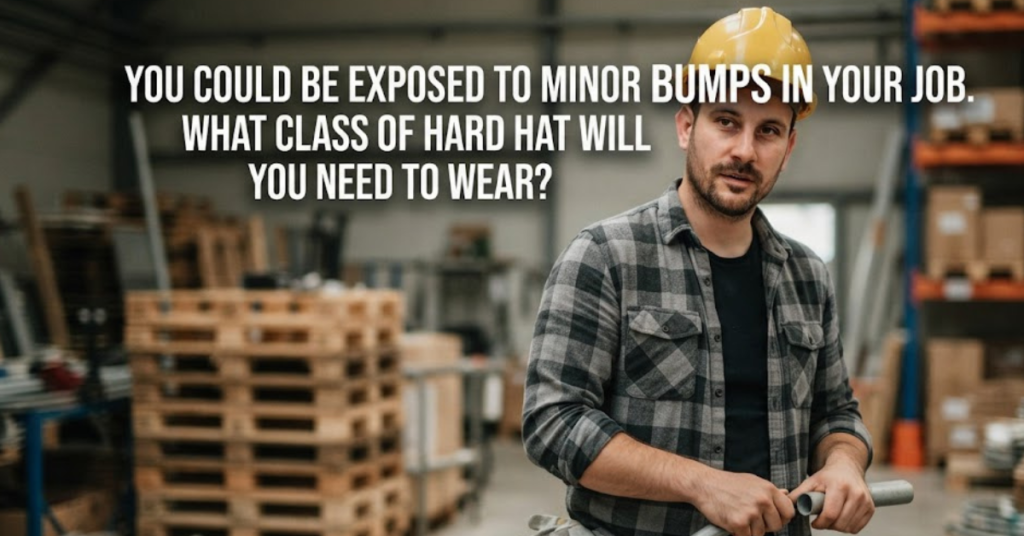

A hard hat may seem unnecessary when the main risk on a job is only minor bumps against fixed objects. But even a low overhead beam, pipe, or other obstruction can cause a serious head injury if the right protection isn’t used. So, you could be exposed to minor bumps in your job—what class of hard hat will you need to wear? The answer depends on the exact hazard and the safety standard being used. Under the modern ANSI/ISEA Z89.1 classification system, Class C (Conductive) head protection is designed without electrical protection, while the choice between Class G, Class E, and Class C should ultimately be based on the workplace hazard assessment.
What Class of Hard Hat Is Used for Minor Bumps?
If the hazard is limited to bumping your head against fixed objects and there is no electrical hazard, the traditional answer is Class C.
OSHA’s educational guidance describes Class C head protection as providing protection for workers who may bump their heads against fixed objects, while offering no protection from electrical shock.
However, there is an important detail: Class C is not simply a universal “minor bump” hard hat. Modern protective helmets should be selected according to the actual hazards present at the workplace.
The modern hard hat classes
Under ANSI/ISEA Z89.1, the commonly used classes are:
- Class G — General: Provides electrical protection against low-voltage conductors.
- Class E — Electrical: Designed for protection against higher-voltage electrical hazards.
- Class C — Conductive: Provides no electrical protection.
So, if your work involves only non-electrical bump hazards, a suitable Class C helmet may be appropriate, provided it meets the applicable standard and your employer’s hazard assessment supports that choice.
Why Do Hard Hat Classes Matter?
Not all hard hats provide the same type of protection. The class indicates an important part of the helmet’s electrical performance, while the Type designation addresses impact protection.
This distinction is easy to overlook.
For example, a modern helmet can be classified as Type I, Class G. “Type I” relates to protection against impacts to the top of the head, while “Class G” relates to electrical protection. OSHA explains that Type II helmets are designed to reduce forces from impacts to both the top and sides of the head.
Class vs. Type
Think of it this way:
| Designation | What it tells you |
| Type I | Protection primarily from top impacts |
| Type II | Protection from top and lateral impacts |
| Class G | General electrical protection |
| Class E | Higher-level electrical protection |
| Class C | No electrical protection |
This means asking only “What class do I need?” may not be enough. You also need to consider the type of impact hazard involved.
When Is Class C Hard Hat Protection Appropriate?
Class C may be considered when the workplace presents impact hazards but no electrical hazards.
For example, a worker might encounter:
- Low ceilings
- Exposed pipes
- Beams
- Fixed structural components
- Other overhead or stationary objects
OSHA specifically identifies bumping the head against fixed objects as a situation in which head protection may be necessary.
But Class C should not be selected around electrical hazards simply because the expected contact is minor.
Class C helmets are not intended to provide protection against contact with electrical conductors.
What If There Is an Electrical Hazard?
This is where the answer changes.
If workers could accidentally contact electrical conductors, the head protection needs appropriate electrical performance. Modern classifications include:
Class G
Class G, or General, helmets are designed to reduce the danger of contact with low-voltage conductors. They are proof-tested at 2,200 volts under the ANSI classification system.
Class E
Class E, or Electrical, helmets are intended for exposure to higher-voltage electrical conductors and are proof-tested at 20,000 volts.
These proof-test voltages should not be interpreted as the voltage at which the helmet will necessarily protect a worker. They are test values used for classification.
Does a Minor Bump Mean You Don’t Need a Hard Hat?
Not necessarily.
OSHA states that head protection is needed where employees may be exposed to hazards such as falling objects, bumping their heads against fixed objects, or electrical hazards.
The fact that an object is unlikely to cause a severe impact doesn’t automatically eliminate the hazard.
A proper workplace assessment should consider:
- What could strike the worker’s head?
- Could an object fall or move unexpectedly?
- Could the worker strike a stationary object?
- Is there an electrical hazard nearby?
- Could the helmet need protection from side impacts as well as top impacts?
- Does the helmet comply with the applicable standard?
The employer’s hazard assessment is particularly important when selecting appropriate head protection. OSHA recommends evaluating workplace hazards before determining which protective helmet is appropriate.
Class C vs. Class G vs. Class E
Here’s a quick comparison:
| Hard Hat Class | Electrical Protection | Typical Consideration |
| Class C | None | Non-electrical impact hazards |
| Class G | Low-voltage protection | General work where limited electrical protection is needed |
| Class E | Higher-voltage protection | Work involving significant electrical exposure |
The important point is that Class C isn’t “better” or “worse” than Class G or E. Each class is intended for different hazards.
Choosing the right one means matching the helmet to the environment rather than simply choosing the lightest or most comfortable option.
Type I or Type II: Which Matters for Bumps?
If the question specifically concerns minor bumps from objects to the side of the head, the Type designation becomes especially important.
Modern ANSI classifications distinguish:
- Type I: Primarily top-of-head impact protection
- Type II: Top and lateral impact protection
For workplaces where lateral impacts are foreseeable, OSHA guidance indicates that employers should select Type II protection.
This is why a question about “minor bumps” cannot always be answered by the class alone.
Common Hard Hat Mistakes to Avoid
Even the correct class won’t provide adequate protection if the helmet is poorly maintained or used incorrectly.
Avoid these common mistakes:
- Choosing a helmet solely by color: Helmet color generally doesn’t tell you its protection class.
- Ignoring electrical hazards: Class C provides no electrical protection.
- Using damaged equipment: Cracks, dents, or deteriorated components can compromise protection.
- Wearing an improperly adjusted suspension: A loose or poorly fitted helmet may not stay in the correct position.
- Ignoring side-impact hazards: Consider Type II when lateral impacts are foreseeable.
- Assuming every hard hat is interchangeable: Check the markings and manufacturer’s instructions.
OSHA recommends inspecting head protection and replacing damaged equipment.
How to Choose the Right Hard Hat
If you’re responsible for selecting head protection, a simple process can help.
1. Identify the hazard
Determine whether workers face:
- Fixed-object impacts
- Falling objects
- Side impacts
- Electrical contact
- Multiple hazards at the same time
2. Check the required protection
Determine whether the job requires Type I or Type II impact protection and whether Class C, G, or E electrical performance is appropriate.
3. Check the helmet markings
Look for the applicable ANSI/ISEA designation and manufacturer’s information.
4. Inspect the helmet
Check the shell and suspension for damage, deterioration, or other signs that the equipment needs replacement.
5. Follow workplace requirements
Your employer’s safety program and hazard assessment may require protection beyond what seems necessary from the description of a single hazard.
Read also <<< How Should Food Workers Protect Food From Contamination After It Is Cooked?
Frequently Asked Questions
What class of hard hat is used for minor bumps?
For non-electrical hazards involving bumps against fixed objects, Class C may be appropriate. However, the complete selection should be based on the workplace hazard assessment and the required impact protection type.
Is Class C a good choice around electricity?
No. Class C provides no electrical protection and should not be selected when electrical hazards are present.
What is the difference between Class C and Class G hard hats?
Class C helmets are conductive and provide no electrical protection, while Class G helmets provide protection against contact with low-voltage conductors.
What is the difference between Class G and Class E?
Both provide electrical protection, but Class E is designed for higher-voltage electrical exposure than Class G. Class G helmets are proof-tested at 2,200 volts, while Class E helmets are proof-tested at 20,000 volts.
Is Type II better than Type I?
Not necessarily in every situation. Type II provides protection against impacts to the top and sides of the head, making it useful where lateral impacts are foreseeable. Type I focuses primarily on top impacts.
Do minor bumps really require head protection?
They can. OSHA identifies bumping the head against fixed objects as a potential reason for head protection. The employer should evaluate the hazard and select appropriate PPE.
Conclusion: What Hard Hat Do You Need for Minor Bumps?
If your job exposes you could be exposed to minor bumps in your job. what class of hard hat will you need to wear? may be the appropriate class under the modern ANSI classification system. But don’t stop at the class designation.
You also need to consider whether Type I or Type II impact protection is appropriate and whether other workplace hazards are present. OSHA emphasizes hazard assessment when determining the proper head protection.
The safest approach is simple: identify the hazard first, then choose the helmet designed for that hazard. A minor bump today may seem insignificant, but proper head protection is designed to prevent injuries before they happen.