
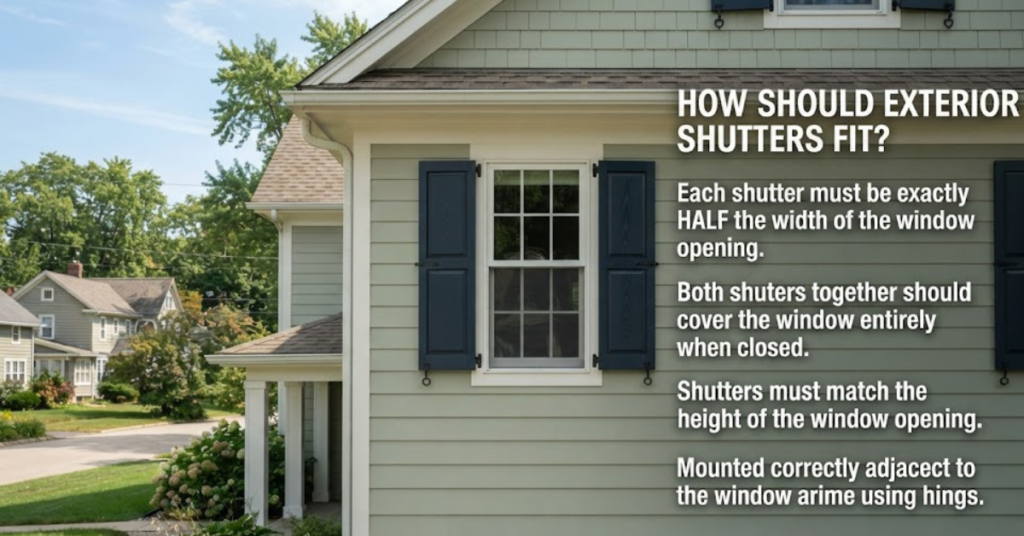

Exterior shutters can make a window look finished almost instantly—but only when they are the right size. If they are too narrow, too short, or mounted too far from the window, they can look more like decorative strips than real shutters. So, how should exterior shutters fit drhextreriorly? The basic rule is simple: they should be proportioned to the window so they look as though they could actually cover it when closed. For traditional or functional shutters, each shutter is generally about half the width of the window opening, while the height should closely correspond to the window opening or appropriate trim.
The exact measurement can vary depending on whether the shutters are functional or purely decorative, as well as the style of the window and home.
How Should Exterior Shutters Fit a Window?
A properly fitted exterior shutter should look naturally connected to the window rather than noticeably smaller than it.
For most traditional installations:
- The height should closely match the window opening or the intended trim-to-trim height.
- Each shutter should generally be about half the window’s width if the shutters are intended to look functional.
- The shutters should sit symmetrically on both sides of the window.
- Decorative shutters should still be large enough to create the appearance that they could cover the window.
- Functional shutters require additional attention to clearances, hinges, and mounting hardware.
Home Depot similarly recommends that decorative shutters be approximately the same height as the window and casing, while the appropriate width depends on the particular installation and style.
What Size Should Exterior Shutters Be?
There are two measurements you need to get right: height and width.
Exterior Shutter Height
Height is usually the easiest dimension to determine.
For decorative shutters, a common approach is to measure the window and its surrounding casing and choose a shutter height that visually aligns with that area. Home Depot notes that shutters generally look best when their height corresponds to the window and casing, while avoiding unrelated elements such as a sill or overhang.
For example, if the relevant window-and-trim height is 60 inches, a shutter around 60 inches tall will generally look more proportional than one that is only 48 inches tall.
The important thing is to measure each window rather than automatically assuming every window on the house is identical. Older homes and custom construction can have small variations.
Exterior Shutter Width
Width is where many homeowners make mistakes.
For shutters that are supposed to look functional, a traditional rule is that each shutter should be roughly half the width of the window opening.
For example:
- Window width: 36 inches
- Left shutter: 18 inches
- Right shutter: 18 inches
- Combined shutter width: 36 inches
The idea is that if the two shutters were swung inward, they would cover the window.
This proportional approach is widely recommended in shutter-sizing guidance and is one reason undersized shutters often look unnatural.
Should Exterior Shutters Cover the Window?
If the shutters are functional, yes. They should be sized so that they can cover the window opening when closed.
That is part of what makes a shutter look authentic: its dimensions make practical sense.
For example, imagine a 40-inch-wide window with two shutters that are only 8 inches wide each. Even though they may be centered beside the window, they could never realistically cover it.
That creates a visually unbalanced appearance.
For decorative shutters, they do not physically need to close over the window. However, they should generally maintain realistic proportions. Otherwise, the installation can look obviously decorative rather than architectural.
Decorative vs. Functional Exterior Shutters
Before measuring, decide what type of installation you have.
Functional Shutters
Functional shutters are designed to open and close over the window.
Because they actually move, you need to consider:
- Window dimensions
- Shutter dimensions
- Hinges
- Mounting points
- Clearance
- Shutter thickness
- Hardware placement
- The surface surrounding the window
The measurements need to be precise because the shutters must physically operate without hitting the frame or surrounding materials.
Decorative Shutters
Decorative shutters are fixed to the wall and are primarily used to improve the home’s appearance.
They are easier to install because they do not have to swing closed. However, correct proportions still matter.
A decorative shutter that is dramatically too narrow or too short can make a window appear oddly proportioned.
How to Measure for Exterior Shutters
Accurate measurements are the foundation of a good fit.
A useful approach is to measure the window at multiple points rather than assuming the opening is perfectly square. This is especially important with older homes, where openings may not be perfectly uniform. This Old House recommends measuring horizontally and vertically in several places and using the smaller measurements when determining opening dimensions for its installation approach.
Step 1: Measure the Window Height
Measure the relevant height from the top of the window or casing to the bottom of the window area being used for the shutter dimensions.
Take measurements on:
- The left side
- The center
- The right side
Record the measurements.
If they differ, don’t automatically assume the largest number is correct. The appropriate measurement depends on the shutter type and manufacturer’s specifications.
Step 2: Measure the Window Width
Measure the width at:
- The top
- The middle
- The bottom
Again, record all three measurements.
This gives you a better picture of whether the opening is perfectly square or has slight variations.
Step 3: Determine the Shutter Width
For a traditional functional-looking pair, divide the appropriate window width by two.
For example:
48-inch window ÷ 2 = 24-inch shutter width
That gives you two shutters measuring approximately 24 inches wide each.
However, decorative shutters may use different proportions depending on the home’s architecture. Some manufacturers recommend narrower decorative shutters, so always check the specific product’s sizing instructions before ordering.
How Far Should Exterior Shutters Be From the Window?
The shutters should be positioned close enough to the window that they appear to belong to it.
Avoid leaving a large, unexplained gap between the window and shutter.
At the same time, you should not install shutters so close that they interfere with:
- Window operation
- Trim
- Hinges
- Hardware
- Drainage
- Other architectural details
For functional shutters, the required clearance depends on the specific hardware and installation method. This is one reason manufacturers’ installation instructions should take priority over a generic measurement rule.
Should Exterior Shutters Match the Window Trim?
They don’t necessarily have to be the same color, but their scale should work with the window and surrounding trim.
For example, a very narrow shutter next to a large, substantial window frame may look visually weak. Conversely, an oversized shutter can overwhelm a small window.
Think of the window, trim, and shutters as one composition.
A useful way to judge the result is to step back from the house and look at the entire façade rather than judging the shutter from only a few feet away.
Common Exterior Shutter Sizing Mistakes
Even attractive shutters can look wrong if the dimensions are off.
1. Choosing Shutters That Are Too Narrow
This is one of the most noticeable mistakes.
If shutters are supposed to look functional, they should have enough width that they could realistically cover the window.
2. Choosing Shutters That Are Too Short
A shutter that ends well above or below the relevant window height can make the installation look disconnected.
3. Using the Same Size Everywhere
Not every window necessarily has the same dimensions.
Using one shutter size for small, medium, and large windows can create inconsistent proportions.
4. Measuring Only the Glass
The visible glass is not always the correct reference point.
Depending on the design, you may need to consider the window opening, casing, trim, sill, or other architectural elements. Different shutter manufacturers use different measurement conventions, so follow the instructions for the product you’re purchasing.
5. Ignoring the Shutter’s Intended Function
A decorative shutter and a functional shutter do not necessarily use identical sizing rules.
If the shutter will actually close, the measurements must account for operation and clearance.
A Simple Exterior Shutter Sizing Example
Suppose you have a window that measures:
- 60 inches high
- 40 inches wide
For a traditional functional-looking pair, a starting point would be:
Height: approximately 60 inches
Each shutter: approximately 20 inches wide
That gives you:
20 + 20 = 40 inches
If the shutters were closed, their combined width would correspond to the window width.
For a decorative installation, you might choose a somewhat different width based on the home’s proportions and the manufacturer’s recommendations. The important thing is to avoid treating the 50% rule as a universal requirement for every decorative application.
How Should Exterior Shutters Be Positioned?
Once the dimensions are correct, placement matters just as much.
The shutters should generally be:
- Vertically aligned with the window
- Evenly spaced
- Centered relative to the window
- Mounted securely
- Positioned so architectural details do not make them look misplaced
For a pair of shutters, the left and right sides should visually balance one another.
If one shutter is noticeably higher, lower, or farther away from the window than the other, the entire installation can look uneven.
What About Arched or Unusual Windows?
Not every window is a simple rectangle.
Arched, circular, unusually shaped, or multi-section windows may require custom shutter sizing or a design that follows the shape of the opening.
In these situations, forcing standard rectangular shutters into the space can produce a poor result.
For unusual windows, it is worth taking detailed measurements and checking the shutter manufacturer’s recommendations before ordering.
Should Exterior Shutters Be the Same Size on Every Window?
Not necessarily.
If the windows are genuinely the same size and shape, using matching shutters usually creates a cohesive appearance.
But if the windows vary substantially, the shutters may need to vary as well.
The goal is consistent proportion, not necessarily identical dimensions.
For example, a large first-floor window may need wider shutters than a narrow second-floor window. Matching them by proportion can look more natural than putting identical shutters on every opening.
Quick Checklist for Proper Exterior Shutter Fit
Before ordering or installing your shutters, check the following:
-
Have you measured each window?
-
Did you check height and width?
-
Did you measure more than one point?
-
Are the shutters appropriate for functional or decorative use?
-
Is the height visually proportional to the window?
-
Are functional-looking shutters wide enough to cover the opening?
-
Are both sides symmetrical?
-
Have you checked the manufacturer’s installation requirements?
-
Will the shutters clear the window, trim, and hardware?
-
Do the shutters look proportional when viewed from the street?
FAQs About How Exterior Shutters Should Fit
How wide should exterior shutters be?
For traditional shutters that are intended to look functional, each shutter is commonly sized at about half the width of the window opening. Decorative shutters can be narrower depending on the design and manufacturer’s recommendations.
Should exterior shutters be the same height as the window?
Generally, yes. Decorative shutters commonly look best when their height corresponds to the window and surrounding casing. The exact measurement should account for the particular window and shutter design.
Should shutters be wider than the window?
Usually not if they are intended to represent functional shutters. The traditional approach is for the pair to have a combined width approximately equal to the window opening.
How far should exterior shutters be from the window?
They should sit close enough to look naturally associated with the window, while leaving enough clearance for the window, trim, and hardware. Functional installations require clearance based on the specific shutter and hardware system.
Can decorative shutters be narrower than half the window width?
Yes. The 50% rule is primarily a traditional proportional guideline for shutters intended to look as though they could cover the window. Decorative shutters may use narrower proportions depending on the home’s style and the manufacturer’s recommendations.
Should exterior shutters cover the window trim?
It depends on the shutter style and how the window is constructed. Some decorative sizing methods use the window and casing as the visual reference, while functional shutters are sized around the actual opening they need to cover. Always follow the specific installation instructions.
Should all exterior shutters be the same size?
Only when the windows themselves have matching dimensions and proportions. Different-sized windows may look better with appropriately scaled shutters rather than identical shutters.
Conclusion: Getting Exterior Shutters to Fit Properly
Knowing how should exterior shutters fit drhextreriorly comes down to proportion, accurate measurements, and the purpose of the shutters.
For a traditional look, the shutters should be tall enough to correspond naturally with the window and wide enough to appear capable of covering it when closed. A common starting point is to make each shutter about half the window’s width, although decorative shutters can use different proportions depending on the home’s design.
Before buying, measure each window carefully, determine whether the shutters are functional or decorative, and check the manufacturer’s sizing requirements. Getting those details right can make the difference between shutters that look like an afterthought and shutters that genuinely complement the architecture of your home.