
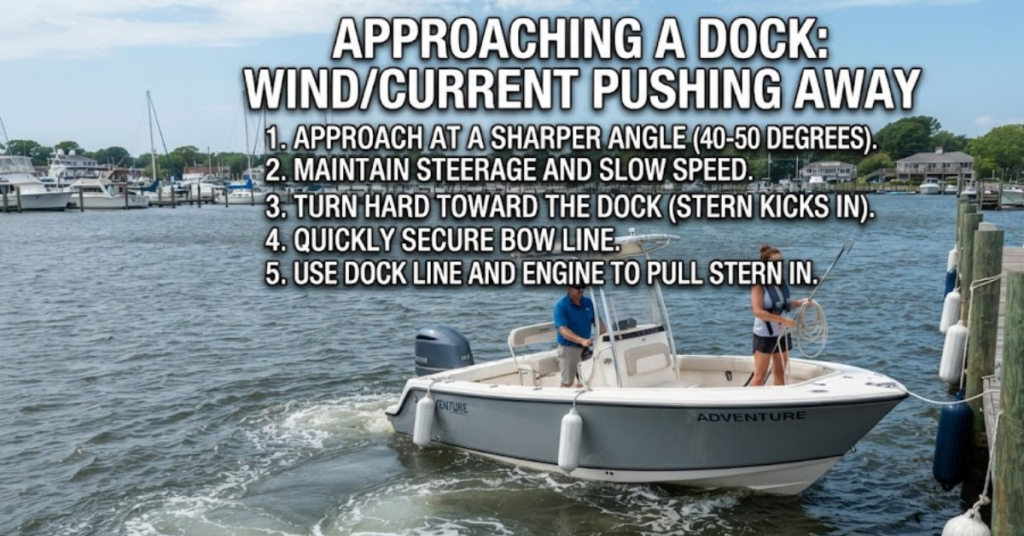

Docking can be one of the trickiest parts of operating a boat, especially when wind or current is pushing you away from the dock. In these conditions, simply pointing the boat directly toward the dock may not give you enough control to make a safe landing.
So, how should you approach a dock when the wind or current is pushing you away from the dock? The general approach is to come in at a shallow angle, maintain enough control to counter the wind or current, and approach slowly. The exact technique depends on the boat, dock layout, wind, current, and your experience.
The goal isn’t to fight the forces with excessive speed. It’s to use controlled boat movement and positioning so you can make a predictable approach.
Why Wind and Current Make Docking Difficult
Wind and current can move a boat even when the operator isn’t changing direction.
A boat may:
- Drift sideways
- Move toward or away from the dock
- Turn unexpectedly
- Lose its intended approach angle
- Require more frequent steering adjustments
The stronger the wind or current, the more quickly the boat’s position can change.
That’s why docking in these conditions requires planning before you get close to the dock.
How Should You Approach a Dock When Being Pushed Away?
When wind or current is pushing your boat away from the dock, the general strategy is to approach at a shallow angle while maintaining enough propulsion and steering authority to counter the drift.
Avoid approaching at high speed.
Instead, establish your intended approach well before reaching the dock and make small, deliberate corrections.
A useful way to think about it is:
Angle toward the dock → maintain control against the force → approach slowly → straighten as appropriate → secure the boat
The exact maneuver will depend on the boat’s propulsion system and handling characteristics.
Approach the Dock at a Shallow Angle
A shallow approach gives you more opportunity to correct your position.
Coming in nearly parallel to the dock can make it easier to control lateral movement, while a steep approach can leave less room to correct if the boat begins drifting.
A controlled angle also allows you to reassess the situation as you get closer.
If the wind or current suddenly changes, you have more time to adjust before reaching the dock.
Maintain Enough Power for Control
One common mistake is reducing power too early.
When wind or current is pushing you away from the dock, you may need enough propulsion to maintain steering control and counter the force acting on the boat.
That doesn’t mean approaching quickly.
Instead, think about controlled power.
Too little propulsion may leave the boat drifting unpredictably. Too much speed can make stopping or correcting difficult.
The ideal amount depends on the boat and conditions.
Approach Slowly and Deliberately
Speed is one of the most important factors in docking safety.
A slow approach gives you more time to:
- Observe the dock
- Assess wind and current
- Make steering corrections
- Stop or change direction
- Communicate with passengers
- Respond to unexpected movement
The objective is to arrive with enough control that the boat can be stopped or redirected without a hard impact.
Use the Wind or Current to Your Advantage
Wind and current aren’t always something you have to fight directly.
Experienced boat operators often consider how the environmental force will affect the boat throughout the maneuver.
Before approaching, ask:
- Which direction is the wind moving?
- Which direction is the current flowing?
- How strong are they?
- Is the force consistent?
- What happens if propulsion is reduced?
- What will happen if the boat gets close to the dock?
Understanding those forces allows you to anticipate movement instead of reacting to it at the last second.
Don’t Aim Directly at the Dock Without Considering Drift
A common beginner mistake is pointing the bow directly at the desired landing spot and assuming the boat will continue along that line.
Wind and current can change that trajectory.
Instead, your approach should account for the direction in which the boat is being pushed.
Think about the boat’s actual path over the water, not just where the bow is pointing.
This distinction is especially important in stronger wind or current.
Prepare Before You Get Close
Good docking begins before the final approach.
Before entering the docking area:
Check the conditions
Look at wind direction, current, traffic, and available space.
Prepare lines and fenders
Have the appropriate docking equipment ready before you need it.
Brief passengers
Everyone should know what they’re expected to do and when.
Choose an escape route
Think about what you’ll do if the approach doesn’t go as planned.
Having a backup plan is particularly valuable when environmental conditions are changing.
Keep the Docking Area Clear
Passengers should never be encouraged to jump from a moving boat onto the dock.
Likewise, don’t put hands, arms, or legs between the boat and dock to try to stop the boat.
A boat can move suddenly, creating a serious crush or fall hazard.
Instead, use proper docking equipment and controlled boat handling.
What If the Approach Starts Going Wrong?
Don’t force the landing.
If the boat begins moving away from the intended approach line, there may be enough space to safely move away from the dock and try again.
A second controlled approach is usually preferable to trying to rescue a bad approach at the last moment.
A useful rule is:
If the approach isn’t working, reset early.
Waiting until you’re almost against the dock gives you fewer options.
Docking With Wind vs. Docking With Current
Wind and current affect boats differently.
Wind
Wind can push the exposed surfaces of the boat sideways, particularly on boats with substantial cabin or freeboard areas.
Its effect may change depending on the boat’s orientation.
Current
Current moves the water beneath the boat and can affect the boat’s movement even when the wind is calm.
Current can be particularly challenging around narrow channels, river entrances, and areas where water flow changes direction.
Understanding which force is dominant helps you plan the approach.
Common Docking Mistakes to Avoid
Approaching too fast
Higher speed reduces your reaction time and increases the consequences of a mistake.
Waiting too long to correct
Small corrections are usually easier than dramatic last-second maneuvers.
Ignoring the wind or current
Environmental forces should be considered before the approach begins.
Having passengers unprepared
Passengers should know where to sit or stand and what their role is.
Trying to stop the boat with your body
Never use your hands, feet, or body as a substitute for proper docking control.
Refusing to abort a bad approach
There is nothing wrong with moving away and trying again.
A Simple Docking Checklist
Before approaching a dock when being pushed away from it, consider this checklist:
- Identify the wind or current direction.
- Determine which force is stronger.
- Prepare lines and fenders.
- Brief passengers.
- Choose a controlled approach angle.
- Maintain enough propulsion for steering control.
- Keep your speed low.
- Make small corrections early.
- Avoid putting people between the boat and dock.
- Abort and reset if the approach becomes unsafe.
Frequently Asked Questions
How should you approach a dock when the wind or current is pushing you away from the dock?
Approach at a controlled, relatively shallow angle while maintaining enough propulsion and steering control to counter the wind or current. Keep your speed low and make corrections early.
Should you approach a dock quickly when wind or current is pushing you away?
Generally, no. A controlled, slow approach gives you more time to respond to changing conditions and reduces the consequences of an incorrect maneuver.
Should you approach the dock straight on?
Not necessarily. The best angle depends on the boat, dock, wind, current, and available space. When being pushed away, a shallow, controlled approach can provide better opportunities for correction.
What should you do if you lose control of the approach?
If sufficient space is available, move away from the dock, regain control, reassess the conditions, and make another approach. Don’t try to force an unsafe landing.
What should passengers do while docking?
Passengers should remain in safe positions and follow the operator’s instructions. They should not place hands, feet, or other body parts between the boat and dock.
Why is speed important when docking?
Lower speed provides more time to assess movement and make corrections. It also reduces the impact if the boat doesn’t reach the dock exactly as intended.
Conclusion
So, how should you approach a dock when the wind or current is pushing you away from the dock? The key is controlled positioning rather than excessive speed. Approach at a manageable angle, maintain enough propulsion for steering control, account for the direction and strength of the wind or current, and make corrections early.
Most importantly, don’t feel pressured to complete a poor approach. If conditions aren’t working in your favor, move away, regain control, and try again. With practice and proper boating instruction, understanding how environmental forces affect your boat can make docking considerably safer and more predictable.