
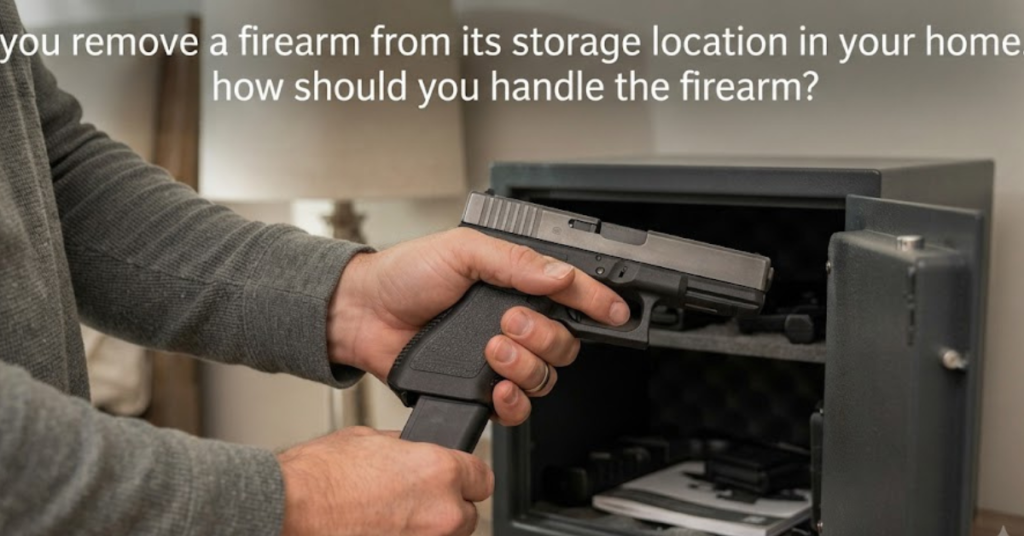

A firearm should always be treated as potentially dangerous, even when you believe it is unloaded. If you remove a firearm from its storage location in your home, how should you handle the firearm? The safest approach is to minimize handling, keep the firearm pointed in a safe direction, keep your hands away from the trigger, and prevent access by anyone who should not have it.
Safe firearm handling isn’t about becoming comfortable with a gun. It’s about developing habits that reduce the possibility of an accidental discharge or unauthorized access. If you are unfamiliar with a particular firearm, consult its manufacturer’s instructions or seek hands-on instruction from a qualified firearms-safety professional.
The First Priority: Treat Every Firearm as Loaded
One of the most important firearm-safety principles is to treat every firearm as if it were loaded.
This remains true even if someone tells you the firearm is unloaded or you believe it was safely stored.
A firearm’s condition should never be assumed based solely on appearance or memory.
That mindset encourages careful behavior and reduces the risk of dangerous mistakes.
Keep the Firearm Pointed in a Safe Direction
When handling a firearm, maintain awareness of where it is pointing.
A safe direction is one in which an unintended discharge would be unlikely to injure someone or cause serious damage. The appropriate direction depends on the construction of the home and the circumstances, so there isn’t one universally safe direction for every household.
Avoid casually pointing a firearm toward:
- People
- Yourself
- Pets
- Doors or areas where people may be present
- Objects you don’t intend to damage
The safest practice is to avoid unnecessary handling altogether.
Keep Your Finger Away From the Trigger
Another fundamental safety principle is to keep your finger outside the trigger guard unless you are at a lawful shooting location and have received appropriate training.
At home, there is generally no reason to place your finger on the trigger simply because you’re holding or moving the firearm.
Keeping the trigger area untouched reduces the possibility of an unintended trigger press.
Don’t Assume a Stored Firearm Is Unloaded
Storage does not automatically determine a firearm’s condition.
A firearm may have been stored in a particular condition, but you shouldn’t rely on assumptions about what someone previously did with it.
If you need to determine its condition, follow the manufacturer’s safety instructions or have a qualified professional assist you. If you don’t know how to safely verify the condition of a firearm, don’t experiment with it or attempt unfamiliar procedures.
A firearms instructor or qualified gunsmith can provide hands-on guidance appropriate to the specific firearm.
Keep Other People Away From the Firearm
If a firearm is removed from storage, unauthorized people should not have access to it.
This is particularly important when children, visitors, or other people who aren’t authorized or trained to handle firearms are present.
Keep the firearm under your direct control and return it to secure storage as soon as it is no longer needed.
Never leave it unattended on:
- A table
- A bed
- A countertop
- A chair
- A vehicle seat
- Any other accessible location
Temporary placement can quickly become an access problem.
Avoid Handling a Firearm When Impaired
A firearm should never be handled while you are impaired by:
- Alcohol
- Recreational drugs
- Medication that affects alertness or judgment
- Extreme fatigue
- Severe emotional distress
Good judgment and attention are essential to firearm safety.
If you’re impaired or unsure of your ability to handle the firearm safely, the safest choice is to leave it secured and avoid handling it.
Use Manufacturer Instructions for Your Specific Firearm
Firearms differ substantially in their designs, controls, loading systems, and safety mechanisms.
For that reason, general advice cannot replace the manufacturer’s instructions for a specific model.
If you need to handle, inspect, transport, clean, or maintain a firearm, consult the official owner’s manual and consider instruction from a qualified firearms-safety professional.
Do not guess how an unfamiliar firearm works.
What If You Find an Unfamiliar Firearm?
Finding a firearm in your home that you don’t recognize or aren’t comfortable handling is a different situation.
The safest response is to avoid unnecessary manipulation.
Instead:
- Keep people and pets away from the area.
- Do not experiment with the firearm.
- Avoid touching the trigger or attempting unfamiliar operations.
- Seek qualified professional assistance.
- If there is an immediate safety threat, contact the appropriate emergency services.
If you’re unsure whether a firearm is safe to handle, uncertainty itself is a reason to stop and seek expert assistance.
Returning a Firearm to Home Storage
Once the firearm is no longer needed, it should be returned to secure storage consistent with applicable laws and the manufacturer’s recommendations.
Responsible storage generally means:
- Preventing unauthorized access
- Using an appropriate locking device or secure storage container
- Keeping access restricted to authorized adults
- Following applicable local laws
- Keeping ammunition stored appropriately according to applicable safety guidance
Storage practices should account for children and other people who may be able to access the home.
Why Safe Storage and Safe Handling Work Together
Safe handling and safe storage are closely connected.
Safe storage reduces unauthorized access when the firearm isn’t being used.
Safe handling reduces the chance of an accident when the firearm is being handled.
A responsible approach requires both.
For example:
Secure storage → Controlled access → Careful handling → Minimal unnecessary handling → Secure storage again
This creates a consistent safety routine instead of relying on memory or assumptions.
Common Firearm-Handling Mistakes to Avoid
Several mistakes can increase the risk of an accident.
Assuming the firearm is unloaded
Never rely solely on another person’s statement or your memory.
Touching the trigger unnecessarily
There is no reason to place your finger on the trigger simply because you’re handling the firearm.
Leaving the firearm unattended
A firearm should not be left where an unauthorized person could access it.
Handling it while impaired
Alcohol, drugs, fatigue, and impaired judgment can increase risk.
Guessing how an unfamiliar firearm works
Different firearms have different designs. Consult the manufacturer’s instructions or a qualified professional instead.
Allowing children access
Children should not have uncontrolled access to firearms. Secure storage is an essential part of preventing unauthorized access.
Read also <<< EMDR Hand Buzzers Hypnosis Device Product Info and Reviews
Frequently Asked Questions
If you remove a firearm from storage at home, how should you handle it?
Treat it as loaded, keep it pointed in a safe direction, keep your finger away from the trigger, prevent unauthorized access, and avoid unnecessary handling. If you’re unfamiliar with the firearm, consult the manufacturer’s instructions or a qualified firearms-safety professional.
Should I assume a firearm is loaded?
Yes. Treating every firearm as loaded is a fundamental safety principle, regardless of what you believe its condition to be.
Where should your finger be when handling a firearm?
For general safety, keep your finger outside the trigger guard unless you are in an appropriate shooting environment and have received proper training.
Can children access a firearm stored at home?
Firearms should be secured so that children and other unauthorized people cannot access them. Follow applicable laws and recognized safe-storage practices.
What should I do if I don’t know how a firearm works?
Don’t experiment with it. Consult the manufacturer’s owner’s manual or seek assistance from a qualified firearms-safety instructor or gunsmith.
Is it safe to handle a firearm after drinking alcohol?
No. Firearms should not be handled while impaired by alcohol, recreational drugs, or anything else that can affect judgment, coordination, or alertness.
What should I do if I discover an unfamiliar firearm in my home?
Avoid unnecessary handling, keep other people away from it, and seek assistance from an appropriately qualified professional. If there is an immediate danger, contact the appropriate emergency services.
Conclusion
If you remove a firearm from its storage location in your home, how should you handle the firearm? The safest approach is to treat it as loaded, keep it pointed in a safe direction, keep your finger away from the trigger, prevent unauthorized access, and avoid unnecessary handling.
If you don’t know the firearm’s condition or aren’t familiar with its operation, don’t guess. Use the manufacturer’s instructions or obtain hands-on guidance from a qualified firearms-safety professional. Above all, maintain secure storage and make firearm safety a consistent household practice rather than something you think about only when a firearm is in your hands.